Official Logo of Columbia Business School
Academics
  • Visit Academics
  • Degree Programs
  • Admissions
  • Tuition & Financial Aid
  • Campus Life
  • Career Management
Faculty & Research
  • Visit Faculty & Research
  • Academic Divisions
  • Search the Directory
  • Research
  • Research Resources
  • Teaching Excellence
Executive Education
  • Visit Executive Education
  • For Organizations
  • For Individuals
  • Program Finder
  • Online Programs
  • Certificates
About Us
  • Visit About Us
  • CBS Directory
  • Events Calendar
  • Leadership
  • Our History
  • The CBS Experience
  • Newsroom
Alumni
  • Visit Alumni
  • Update Your Information
  • Lifetime Network
  • Alumni Benefits
  • Alumni Career Management
  • Women's Circle
  • Alumni Clubs
Insights
  • Visit Insights
  • AI & Transformative Tech
  • Climate
  • Business & Society
  • Entrepreneurship
  • Finance & Investing
  • Magazine
Insights
  • AI & Transformative Tech
  • Climate
  • Business & Society
  • Entrepreneurship
  • Finance & Investing
  • Magazine
  • More 

Challenging the Benefits of Corporate Social Responsibility

According to research by Chazen Senior Scholar Shivaram Rajgopal, requiring monetary contributions to CSR causes might actually backfire.

Published
January 20, 2023
Publication
Business and Society
Jump to main content
Return on investment concept and saving money Seedling on a blurred natural background
Category
Thought Leadership
Topic(s)
Economics and Policy

0%

India is the first country in the world to mandate spending on corporate social responsibility (CSR). In 2014, the Government of India passed a law requiring all companies above a certain profit threshold (INR 50 million) to spend at least two percent (2%) of their average net profits of three years on CSR-related activities.

While NGOs welcomed the move, many business leaders expressed serious concern over what they thought should be a voluntary activity. One senior executive of a large Indian business conglomerate was quoted as saying, “charitable giving used to be a big reputation builder for us... now it's just about legal compliance.” Another senior executive stated, “for most organizations, the discussion at the board level is now not about what we do, but does it count as CSR and does it meet the legal requirements.” According to new research, their concerns were well placed.

In “Does Mandated Corporate Social Responsibility Crowd Out Voluntary Corporate Social Responsibility?” Chazen Senior Scholar Shivaram Rajgopal and Indian School of Business Professor Prasanna Tantri find that the move from a voluntary activity to a compliance exercise has had an unintended effect on corporate philanthropy in India.

The Research

With data obtained from the Center for Monitoring Indian Economy and India's Ministry of Corporate Affairs, the researchers analyzed the levels of CSR spending by companies before and after passage of the Indian law. In particular, they assessed the law's effect on overall CSR giving as well as the financial performance of companies in compliance.

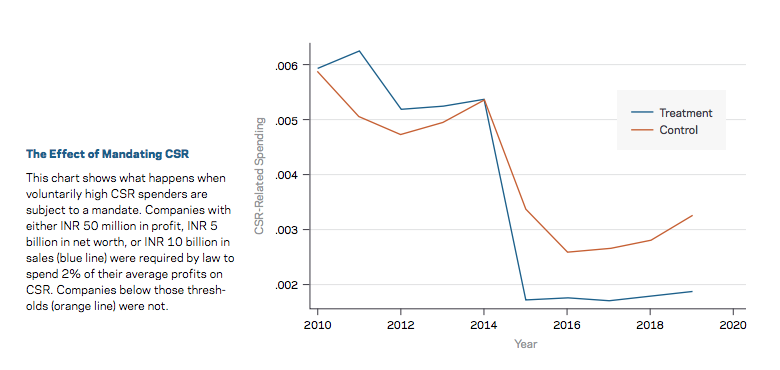
Rajgopal and Tantri first identified companies who were voluntarily spending at levels higher than 2% of their profits pre-regulation. They then charted the impact of the law's minimum requirement on the level of CSR spending for those voluntary high-spenders, and on companies contributing less than 2% or nothing at all pre-mandate. The researchers also compared how sensitive CSR spending levels were to profitability shocks, both before and after the law took effect.
Return on investment concept and saving money Seedling on a blurred natural background

The Results

The research shows that instituting a minimum requirement on CSR spending actually does more harm than good. Instead of boosting the total amount of funds available for worthy causes, it is likely did the opposite.

One would expect a mandate to increase projected spending on CSR, particularly in the short run, because it forces a larger number of companies to contribute to CSR-related activities. But the regulation has actually reduced total CSR spending. The reason: higher-spending companies chose to cut back on their contributions to meet the federal minimum. In fact, their total CSR spending declined by 33% over the time period studied.

The mandate had another surprising result. Prior to the regulation, CSR spending was seen as a special form of “signaling” in that it allowed companies to publicly express both the virtue of their business and higher quality of their products simultaneously. The research reveals companies that were voluntary high spenders before the mandate not only reduced their CSR spending, but they also increased advertising outlays, perhaps to compensate for CSR's reduced signaling power.

And despite a substitution of CSR by advertisement, the overall financial performance of these companies declined, with stock prices falling by about one percent (1%) and the return on assets (ROA) dropping by eight percent (8%) on average. According to researchers, this suggests a unique role for voluntary CSR in signaling virtue and product quality.

You Might Like

Finance and Economics
Type
Business and Society
Date
May 20, 2026
Finance and Economics

‘Put your money where your mouth is’: The path to the top

Former Estée Lauder CFO Tracey Travis reflects on how leading a struggling Pepsi bottling unit became the defining risk that shaped her path to global leadership.
  • Read more about ‘Put your money where your mouth is’: The path to the top about ‘Put your money where your mouth is’: The path to the top
Business and Society
Date
April 07, 2026
Federico Marchetti '99 and Professor Silvia Bellezza.
Business and Society

Federico Marchetti’s ‘99 Playbook on Risk and Reinvention in Fashion and Beyond

The YOOX founder shared lessons on entrepreneurship, risk-taking, timing, and sustainability from his new book The Geek of Chic at a recent CBS event.
  • Read more about Federico Marchetti’s ‘99 Playbook on Risk and Reinvention in Fashion and Beyond about Federico Marchetti’s ‘99 Playbook on Risk and Reinvention in Fashion and Beyond
Accounting, Artificial Intelligence, Business and Society, Capital Markets and Investments, Energy Solutions
Date
February 08, 2026
A rack of servers in a server room photo. Photo by Kevin Ache on Unsplash.com
Accounting, Artificial Intelligence, Business and Society, Capital Markets and Investments, Energy Solutions

The $660 Billion Disconnect Between Corporate Accounting And GDP

GDP conflates consumption and investment spending and hence confuses motion for progress
  • Read more about The $660 Billion Disconnect Between Corporate Accounting And GDP about The $660 Billion Disconnect Between Corporate Accounting And GDP
Business and Society, Economics and Policy, Finance and Economics
Date
December 12, 2025
Photo Image of Glenn Hubbard and Tano Santos
Business and Society, Economics and Policy, Finance and Economics

Why Modern Political Economy Matters: Lessons from Adam Smith for Today’s World

Hubbard and Santos use Adam Smith’s ideas to explore how technology, globalization, and alienation define today’s MPE moment.
  • Read more about Why Modern Political Economy Matters: Lessons from Adam Smith for Today’s World about Why Modern Political Economy Matters: Lessons from Adam Smith for Today’s World
Save Article

Download PDF

More to Explore
Share
  • Share on Facebook
  • Share on Threads
  • Share on LinkedIn
Official Logo of Columbia Business School

Columbia University in the City of New York
665 West 130th Street, New York, NY 10027
Tel. 212-854-1100

Maps and Directions
    • Centers & Programs
    • Current Students
    • Corporate
    • Directory
    • Support Us
    • Recruiters & Partners
    • Faculty & Staff
    • Newsroom
    • Careers
    • Contact Us
    • Accessibility
    • Privacy & Policy Statements
Back to Top Upward arrow
TOP

© Columbia University

  • X
  • Instagram
  • Facebook
  • YouTube
  • LinkedIn

External CSS

Homepage Breadcrumb Block