
As the proliferation of renewables and natural gas drive down the price of power, the big oil producers are grappling with volatility and wrestling with long-term risk/reward models that will determine how the next generation defines the industry.
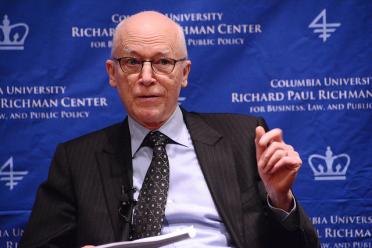
In the midst of such upheaval, Columbia University's Richman Center for Business, Law, and Public Policy assembled an insightful panel to discuss “Energy Industry Developments and Trump Administration Policy.” Moderated by Jesse Green, senior fellow at the Richman Center, the program was headlined by two Columbia professors and an oil field services analyst. Here are five takeaways to help put the energy game into perspective:
- OPEC failed in a momentous strategic play and consequences are BIG. The panelists tracked the recent price volatility specifically to an OPEC gamble to derail the fracking industry. By increasing supply, the oil producers deliberately depressed the price of energy, making the rewards less attractive to the newcomers.
Instead, “the frackers, who needed $60 or $70 a barrel to make profits as recently as two years ago, now seem to be making money at $50 a barrel,” said panelist Geoff Heal, a professor of social enterprise at Columbia Business School. “Some claim they can make money at significantly less than that.”
Renewables have become competitive as well, even as the subsidies that jump-started the movement peter out. “Wind and solar both have become cheaper than gas in the right locations,” said Heal.
- Low oil prices put the Saudis, in particular, under pressure. As OPEC licks its wounds, the biggest member of the consortium has even more at stake than usual. On the one hand, Saudi oil may cost as little as $5 a barrel to scrape out of the desert, far less than required by deep-water oil wells and oil sand production, which could cost upwards of $100 a barrel, making the latter clearly unprofitable at current price points.
But low prices have crippled oil industry valuations as Saudi Aramco prepares an IPO, likely for sometime next year. Saudi Aramco executives need to persuade investors that the company is worth $2 trillion, which assumes the oil company will continue pulling in greater revenues and promises of long-term viability in a world of differentiated energy sources.
It remains unclear what Saudi Arabia and OPEC will do to reenergize the price of oil. Although the cartel made a big deal of Russia's 2016 pledge to cap production, and Saudi flows slowed somewhat early this year, other OPEC members took those occasions to increase market share. Within the oil producing world, “there's a lot of nervousness about long-term demand,” said Antoine Halff, senior research scholar at Columbia University's Center for Energy Policy. “They realize now that anything they do to cut production just invigorates competition.”
- Technology may have its limits—for some players. Producers in traditional oil, deep-water and shale, as well as gas and renewables, have all reported amazing bumps in efficiencies over the past few years. But crude exploration in particular attributes some gains simply to squeezing service operators. Operators have also concentrated on the most promising sites and retired or salvaged parts from old rigs as new planned equipment becomes available.
“At the peak we were running in the order of 1900 oil rigs in the United States,” estimated Colin Davies, senior research analyst, AB Bernstein. After dropping to around 400 rigs at the trough, the industry started installing newer, more efficient equipment. Still, “we basically cut out 80% of the rig activity in the space of just under two years.”
Although wind, solar and electric vehicles all appear poised for more productivity to come, the panelists were not so sure about fracking. “We spent five or six years revising upwards our estimates for the shale market,” said Halff. “All these revisions are working themselves into growth models. In fact, I think we're entering a cycle when we will move our predictions of shale production downwards. There is a limit to how much efficiency improvement we can get from new technologies.” When the fracking industry has to focus beyond its most promising sites, production “probably won't be as prolific as in today's sweet spot.”
What's more, fracking has not been as portable as early-adopters had hoped, with ventures in Poland and China failing. Noting that gas has to be liquefied before it can be transported, an increasing number of observers suggest fracking may remain a particularly American achievement for the reasonable future.
- A “paradigm shift” is shaking up the financing time frame. The 30-year capital deployments traditional in an industry that has had to think in terms of large-scale exploration and infrastructure projects appears in the midst of change. With lower risk/return ratios and competition from new energy suppliers that can achieve substantially shorter production cycles, big oil companies are sitting on capital rather than spending it.
Davies estimates that the global oil industry spent in excess of $800 billion as recently as two years ago. In 2016, the large oil companies barely spent half that. “We are in a world that's far more volatile and where investment can more easily flow to the growth areas that need it, which is equity markets,” said Davies. “So the real challenge is long-term reserve replacement.”
- You got that wrong, President Trump…beginning with coal. The economics just can't line up, argued the panel. Just a few years back, coal produced about 55% of US electricity generation, according to Heal. Today it's around 37%. “Coal has been displaced initially by gas and more recently by wind and by solar, both of which are somewhat cheaper than gas in the right locations. That's not something President Trump can change.”
Of course demand for coal remains strong globally, but countries such as India and China have large deposits of coal to draw from, so have little need for imports. And most countries have vowed to cut back on coal for environmental reasons, although the pace of withdrawal may have slowed for political and social motives. “Coal mining is a great source of employment in China,” reminded Halff.
Amid all the uncertainty and turmoil, a great deal remains at stake. Although the verdict remains out on how the public will value a Saudi Aramco public offering, OPEC and the big oil companies know they are in the fight of their lives. “There's been a fundamental change in the dynamic of the global industry,” said Davies. “The elasticity of energy production is in the hands of a much higher number of smaller companies.”