

Cloud computing has become the backbone of today’s artificial intelligence revolution. Training and deploying large-scale models requires specialized infrastructure on a scale that few could have imagined even five years ago.
Few leaders have been as closely involved in this revolution than CoreWeave CEO Michael Intrator SIPA ‘95, who cofounded the cloud computing giant in 2017. In less than a decade, the company has grown from an experimental startup into one of the world’s largest AI-focused cloud providers, with a market capitalization of $59.8 billion. Recently, the company struck a major deal with Meta: CoreWeave will supply the tech giant with AI cloud infrastructure under a $14.2 billion agreement running through 2031.
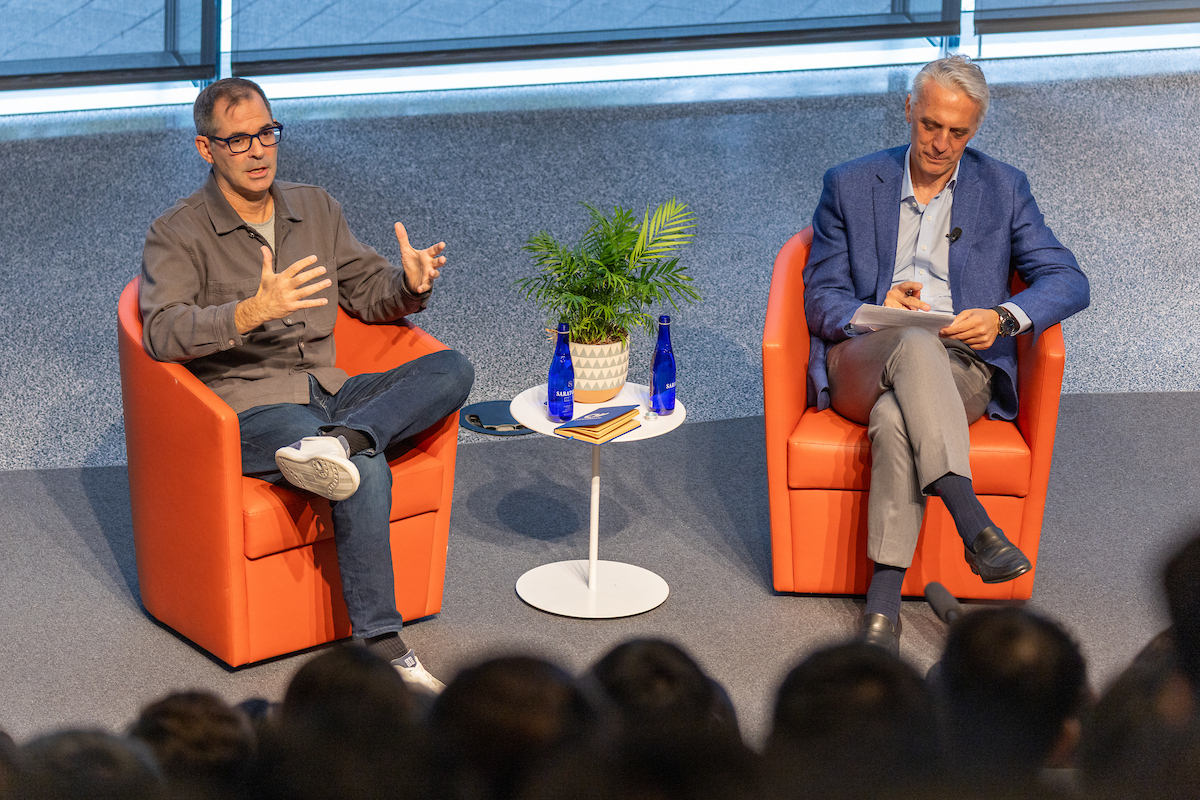
As part of Columbia Business School’s Distinguished Speaker Series, Intrator joined Dean Costis Maglaras to discuss how his company is meeting the demand for AI—and what the technology’s rapid growth means for industries, energy systems, and leadership. The event was co-hosted by the School’s Digital Future Initiative and the Tamer Institute for Social Enterprise and Climate Change, as part of Climate Week NYC 2025.
In conversation with Maglaras, Intrator described how CoreWeave is building infrastructure for a new generation of computing and the broader implications of scaling AI across the global economy.
The Hidden Costs of AI
While CoreWeave’s growth highlights the promise of AI, it also illustrates its costs. Intrator acknowledged that AI’s appetite for energy is immense. Advances like liquid cooling have reduced data center energy consumption by as much as 60 percent, but he cautioned that overall demand continues to rise faster than efficiency gains can offset.
“You're making investments in infrastructure that has to survive for 20, 40 years. You need to really think about that from an environmental perspective, sustainability perspective, and a financial viability perspective,” Intrator said.
To address this challenge, CoreWeave has made sustainability central to its strategy. Earlier this year, the company announced a $2 billion investment in Scotland to build data centers powered entirely by renewable energy.
In the U.S., CoreWeave has repurposed GPU infrastructure once used for crypto mining to power AI workloads. The company is also experimenting with more flexible systems that can reduce or shift power consumption during peak demand without compromising critical operations.
Intrator’s background in climate finance and risk management informs this approach. Before founding CoreWeave, he managed one of the world’s largest private capital pools focused on climate change. That experience, he noted, impressed on him that building infrastructure is not a short-term decision. Data centers, energy systems, and financing structures must be designed to operate for decades, not just election cycles.
Building AI’s Engine Room
CoreWeave’s origins lie in experiments with cryptocurrency mining and GPU infrastructure. Intrator and his co-founders quickly realized that GPUs could power more than just crypto—they offered the flexibility needed for parallelized computing. That insight led to what Intrator calls “the first AI-native cloud,” designed from the ground up for AI workloads rather than retrofitted from CPU-based systems.
This architectural choice gave CoreWeave an edge as generative AI workloads surged. Data centers grew from single clusters into sprawling complexes “multiple football fields” in size, according to Intrator. The company built systems for real-time monitoring, rapid scaling, and GPU-first performance, allowing customers to train and deploy some of the world’s most complex models.
CoreWeave’s edge is not the hardware alone, but the software and technical expertise layered on top, according to Intrator. That orchestration of systems makes GPUs efficient, scalable, and accessible for builders. It’s this elegant services layer that has become the company’s true differentiator, he noted.
"The technical differentiation is enormous. That was the first place we started. The physical ability to deliver infrastructure," Intrator said. “You’ve got to build the data center, you've got to deal with an untold amount of power moving through the systems and build an organization that's capable of doing that at velocity and at scale."
That differentiation helped CoreWeave secure a long-term partnership with NVIDIA, including a deal under which NVIDIA agreed to purchase billions of dollars’ worth of CoreWeave’s cloud capacity through 2032. The arrangement and others such as Open AI represent a powerful endorsement of CoreWeave’s approach.
From Inference to Impact
Beyond the technical and environmental challenges, Intrator underscored the economic transformation AI is driving. He highlighted inference—the deployment of trained models in real-world applications—as the moment when artificial intelligence delivers tangible value. From healthcare to finance and media, inference is where AI produces efficiency gains and creates lasting business models.
Yet the same transformation is disruptive. Intrator noted that AI is reshaping labor markets, creating uncertainty about jobs and retraining. Still, he argued that the long-term effect could be a net positive: sustained productivity growth—potentially accelerating the economy by 15 percent—has the potential to expand employment and raise standards of living, even if the short-term adjustment is difficult.
On leadership, Intrator emphasized that speed and focus are essential in a fast-moving sector. At CoreWeave, he delegates decision-making widely and insists that teams prioritize execution over perfection, stressing that survival depends on maintaining relentless focus on product and moving quickly in a hyper-competitive market.
FAQs:
Q: How is CoreWeave addressing sustainability?
A: Through innovations in cooling, renewable-powered data centers, and strategies to optimize grid usage.
Q: Which industries are seeing the biggest impact from AI right now?
A: AI adoption in healthcare, finance, media, and manufacturing are creating efficiency gains and new business models.
Q: What leadership lessons does Intrator employ at Coreweave
A: Empower teams, move fast, and stay focused on product—never let the pursuit of perfection slow execution.