Official Logo of Columbia Business School
Students
  • Visit Students
  • Degree Programs
  • AI and Student Life at CBS
  • Admissions
  • Tuition & Financial Aid
  • Campus Life
  • Career Management
Faculty & Research
  • Visit Faculty & Research
  • Academic Divisions
  • MBA Transformed
  • Search the Directory
  • Research
  • Research Resources
  • Teaching Excellence
Executive Education
  • Visit Executive Education
  • For Organizations
  • For Individuals
  • Program Finder
  • Online Programs
  • Certificates
About Us
  • Visit About Us
  • CBS Directory
  • Events Calendar
  • Leadership
  • Our History
  • The CBS Experience
  • Newsroom
Alumni
  • Visit Alumni
  • Update Your Information
  • Lifetime Network
  • Alumni Benefits
  • Alumni Career Management
  • Women's Circle
  • Alumni Clubs
Insights
  • Visit Insights
  • AI & Transformative Tech
  • Climate
  • Business & Society
  • Entrepreneurship
  • Finance & Investing
  • Magazine

AI Created the Illustrations in this Magazine: Here's How

While new technologies are often considered to be disruptive forces that can shake up entire industries and sectors, graphic designers may not need to fear for their jobs just yet.

Published
May 5, 2023
Publication
AI and Transformative Tech
Focus On
AI & Transformative Tech
Jump to main content
Article Author(s)

Columbia Business

Affiliated Author
Cover of Columbia Business magazine
Category
Thought Leadership
Topic(s)
Artificial Intelligence, AI and Transformative Tech, Innovation

0%

While new technologies are often considered to be disruptive forces that can shake up entire industries and sectors, graphic designers may not need to fear for their jobs just yet.

In recent months, there has been a rapid expansion of AI-powered tools, the most well-known of which is ChatGPT, a widely used language-generation program created by Open AI. Using machine learning, it can comprehend the nuances and patterns of natural language, enabling it to provide responses that closely resemble human, written communication.

Can AI tools do the same for art? Several programs, including Stable Diffusion, Midjourney, and DALL·E, attempt to produce high-quality images based on a text prompt from a user. We felt compelled to use this groundbreaking new technique for the cover image and story illustrations inside this issue of Columbia Business magazine.

Our traditional approach to creating illustrations involves working with human designers. We first decide on the articles and pages we want to enhance with an illustration and review the work of several designers to decide on a short list. Working with our AI designer—in this case Shutterstock's AI image generator, Shutterstock.AI, which is powered by Open AI and LG technology—is a very different process.

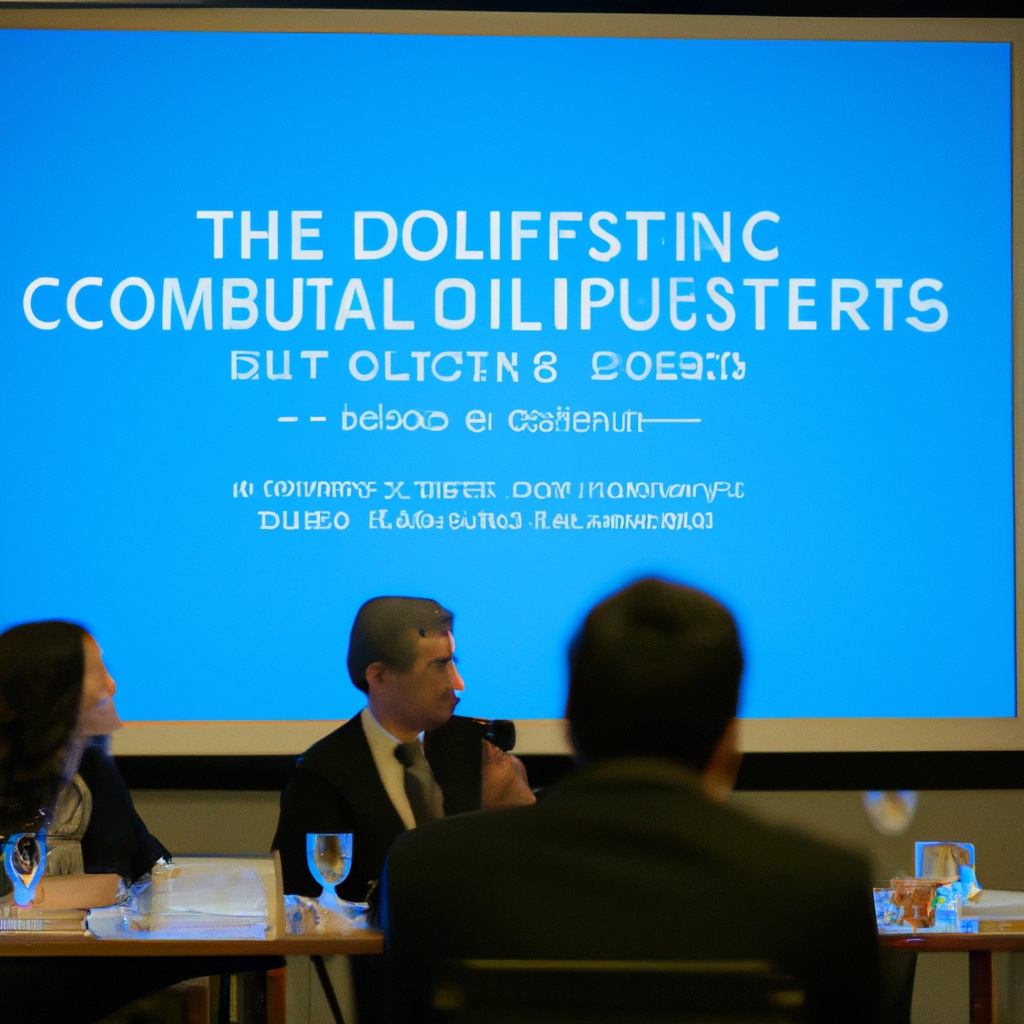
The briefing with the AI designer consisted of little more than typing a desired phrase into a browser. But getting our AI designer to come up with some usable art was a hit-or-miss affair, mostly consisting of misses. For example, when we opted to input the phrase “the Digital Future Initiative at Columbia Business School,” this is the sort of image we received:
AI art

We next tried using longer text (the full 77-word description of the new Algorithmic Economy Lab, for example), but adding more words did not yield more focused or usable images. Instead, we saw bizarre images with colored squares and indecipherable text—a message from the future, perhaps?

We soon realized we needed to be more prescriptive in our image descriptions, conceptualizing the image first and then giving the AI designer very clear instructions on the look, tone, and contents of the image. After inputting scores of phrases, using trial and error to find the most interesting ones, and honing the prompts that generated them, here's what the phrase “a person looking into the digital future with zeros and ones raining down” yielded for us:

AI art

While the image was closer to the one we were looking for—a conceptual image of the digital future—we felt we could do better.

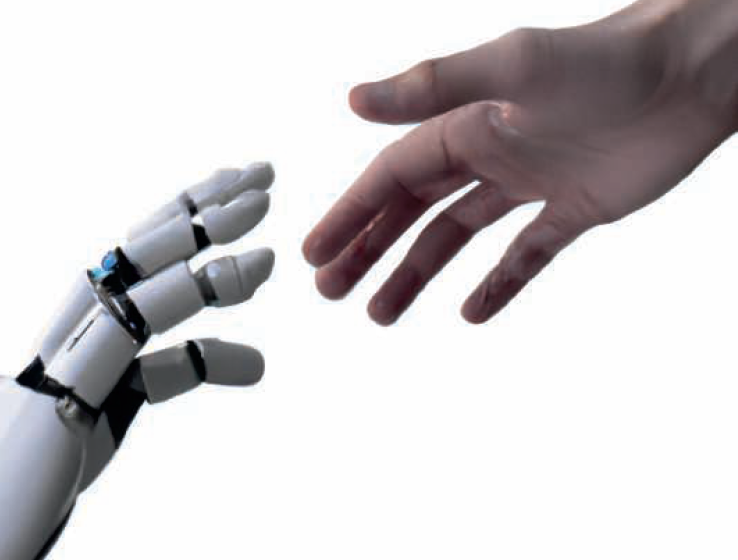
Our next step was to borrow an idea from one of the most creative and influential artists in the history of Western art: Michelangelo. We sought to emulate his image of Adam reaching out to God in the Creation of Adam fresco on the ceiling of the Sistine Chapel. As with the famous image, where God's gesture represents the creation of humanity, the new cover image we generated would suggest a new creation—of artificial intelligence by humans.

The new command “3D photorealistic rendering of a robot hand reaching out to a human hand in the style of Michelangelo Sistine Chapel” generated these images (closer to our intended concept, but with a clear bias towards lighter skin tones):

AI art

Finally, after some reworking of our prompt, “an ai-generated photo of a human hand with mid- tone skin color reaching down to touch a robot hand, suitable for use on a magazine cover; the image should be visually striking and evoke a sense of connection or contrast,” we came up with an image that we were happy with:
AI art

What can we learn from our experience using AI to generate art?

Despite its ability to rapidly produce images, the AI art generator often failed to effectively convey the themes we sought to illustrate. We had to input a very specific set of text commands that we discovered through trial and error. And we had to find a way to circumvent the bias we found in the results.

The bottom line is that the human factor remains crucial, and the ingenuity that comes with it cannot be wholly substituted by machines. In creative fields such as design, illustration, or music composition, it's likely that, for now, the human-AI partnership will power the work-places of the future. AI will aid artists in generating novel forms of art rather than rendering their jobs obsolete.

You Might Like

Artificial Intelligence
Date
May 08, 2026
Composite image of different kinds of communication mediums.
Artificial Intelligence

Why speaking to AI may be better for brainstorming

At Columbia Business School, students debate CAiSEY, an AI adversary, by voice or text. New research shows the way they interact with AI can dramatically shape how many ideas they generate.
  • Read more about Why speaking to AI may be better for brainstorming about Why speaking to AI may be better for brainstorming
Operations
Date
April 23, 2026
A panel hosted at Columbia Business School's Operational Innovation Network summit
Operations

Adapting at Speed: What It Takes to Redesign Organizations in a Faster, More Uncertain World

Organizations are getting better at spotting change, but acting on it is harder. Leaders across industries share how they’re redesigning their decision-making and supply chains to move faster.
  • Read more about Adapting at Speed: What It Takes to Redesign Organizations in a Faster, More Uncertain World about Adapting at Speed: What It Takes to Redesign Organizations in a Faster, More Uncertain World
AI and Transformative Tech
Date
April 15, 2026
Gracy Sarkissian and Brett House
AI and Transformative Tech

AI and the MBA: Preparing for a changing job market

As AI raises the bar for MBAs, Columbia Business School explores how students can build AI fluency and prepare for the roles that are still taking shape.
  • Read more about AI and the MBA: Preparing for a changing job market about AI and the MBA: Preparing for a changing job market
Business and Society, Distinguished Speaker Series, Industry Perspectives
Date
March 18, 2026
Kopit Kevien Photo Image
Business and Society, Distinguished Speaker Series, Industry Perspectives

How The New York Times Company is Reinventing Itself for the Digital Age

The company’s CEO Meredith Kopit Levien explains how a 175-year-old institution became a digital subscription powerhouse — while defending journalism’s future in the AI era.
  • Read more about How The New York Times Company is Reinventing Itself for the Digital Age about How The New York Times Company is Reinventing Itself for the Digital Age
Save Article

Download PDF

More to Explore
Share
  • Share on Facebook
  • Share on Threads
  • Share on LinkedIn
Official Logo of Columbia Business School

Columbia University in the City of New York
665 West 130th Street, New York, NY 10027
Tel. 212-854-1100

Maps and Directions
    • Centers & Programs
    • Current Students
    • Corporate
    • Directory
    • Support Us
    • Recruiters & Partners
    • Faculty & Staff
    • Newsroom
    • Careers
    • Contact Us
    • Accessibility
    • Privacy & Policy Statements
Back to Top Upward arrow
TOP

© Columbia University

  • X
  • Instagram
  • Facebook
  • YouTube
  • LinkedIn

External CSS

Homepage Breadcrumb Block