
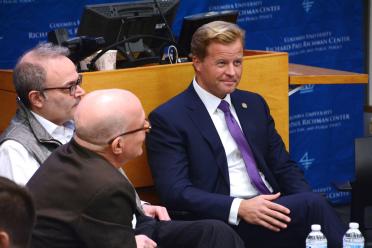
The Richard Paul Richman Center for Business, Law, and Public Policy recently hosted a panel discussion, Regulating Cryptocurrencies—The Future of Bitcoin, Ether, and Other Tokens, bringing together Columbia's own fintech expert R.A. Farrokhnia; Commissioner Brian Quintenz of the Commodity Futures Trading Commission (CFTC); as well as Gary DeWaal and Lee Schneider, leading legal experts on blockchain technology at Katten Muchin Rosenman LLP and McDermott Will & Emery, respectively. In discussion with each other and the audience, the group tackled questions about the major challenges facing users, regulators, and gatekeepers of cryptocurrencies.
Farrokhnia, who leads Advanced Projects and Applied Research in Fintech at Columbia Business School, kicked off the discussion by expressing profound appreciation for the core idea of the distributed ledger—an immutable and decentralized way of keeping assets. Panelists and audience members alike echoed this sentiment through the evening, pointing to the vast potential of blockchain technology beyond finance. Speaking of cryptocurrencies specifically, Farrokhnia stressed that cryptocurrencies are having an identity crisis—to begin with, should they be called cryptocurrencies, or are we better off speaking about blockchain tokens?—and that this crisis is both fueling regulatory confusion and challenging the idea of what it means to be a regulator. A common question amid this confusion is whether bitcoin and its peers are commodities or securities.
As a regulator of futures and options, the CFTC has grappled with this question while defining its regulatory jurisdiction in recent years. Tracing the history of the CFTC's approach to cryptocurrencies, Commissioner Quintenz pointed to several milestones—including initial discussion of CFTC jurisdiction by Chairman Timothy Massad in 2014; the declaration, in the 2015 Coinflip case, that bitcoin is a commodity; and the 2016 enforcement action against Bitfinex, a futures exchange that failed to register with the CFTC. Speaking frankly, Quintenz noted that he prefers regulators to avoid policymaking through enforcement, and instead finds that regulators should provide bright lines, interpretive guidance, or tests. The CFTC is taking such an approach in developing a bright line test for the application of an "actual delivery" framework to virtual currencies. The framework dictates that exchanges and traders demonstrate their ability to physically deliver commodities to their owners within 28 days of purchase, and the commission is exploring how the framework can be adapted to virtual currencies. Its proposal is currently open for public comment.
Speaking from a securities perspective, Schneider emphasized the need for regulators to consider blockchain tokens in the broadest possible sense and through the framework of the investment contract, a key facet of securities law as established in SEC v. W.J. Howey Co. (1946). If we accept the proposition that a blockchain token is a representation of any asset, Schneider noted, then there are serious regulatory questions to consider beyond whether bitcoin and other tokens are securities or commodities. Blockchain is a technology and not an industry, Schneider reminded the audience. It has applications in a wide range of industries, all subject to their own regulatory entities—and those individual fields are where specific regulatory issues are flowing from. Parallel to this is the matter of overlapping regulatory jurisdictions. As noted by DeWaal, the use of a single token in the United States can fall under the purview of state money transmitter laws, the CFTC, the Securities Exchange Commission (SEC), and the Financial Crimes Enforcement Network (FINCEN), to name a few. And internationally? The regulatory landscape varies widely, with some countries attempting to fit blockchain tokens into their existing regulatory structures and others outright resisting the idea of a decentralized ledger.
Considering the wide range of regulatory frameworks and dispositions, what are some of the broad tensions currently at play? One lies in definitions and jurisdictions. Noting that regulators are prone to casting a wider net than common usage requires, Schneider warned that this currently rings true for regulators' definitions of digital tokens. Expanding on this, DeWaal suggested that nomenclature, rather than purely the technology, is currently driving regulation in the United States. "Regulators think in terms of names," he noted. "If something is deemed a security, including an investment contract, the SEC says, 'It's mine, and I'm going to regulate it!'" DeWaal and Schneider also agreed that the SEC's regulatory approach has left lawyers feeling pressured. They referred specifically to recent statements about lawyers' liabilities in initial coin offerings (ICOs) made by Chairman John Clayton, who has noted that his agency will be "on high alert for approaches that may be contrary to the spirit of our securities laws and the professional obligations of the U.S. securities bar." Such statements, DeWaal and Schneider stressed, have left lawyers feeling like they have enforcement targets on their backs.
Clearing up regulatory confusion is not just imperative for smooth market and legal operations. Needless to say, a key objective is guarding against fraud. Another is consistency across the regulatory landscape, which Commissioner Quintenz stressed is essential for antifraud protections as well. Finally, the panel refocused on the very awe and appreciation of blockchain that kicked off the evening—to pursue some of the phenomenal uses of the technology that have risen from the health to the energy sectors, we have to get the regulation right first.
Speaking with the audience at the end of the evening, the panelists fielded questions about a wide variety of issues, including recent media bans on ICO ads, the use of cryptocurrencies in settlements, fraud prevention, variations in the international regulatory landscape, and the environmental impact of bitcoin mining. During the discussion, the panelists also recommended a number of resources for those interested in further exploring blockchain, cryptocurrencies, and related regulatory questions.