

A 2026 NAREIM Survey found 91% of firms have deployed Microsoft Copilot, yet the industry rates its own AI maturity at 5.7/10: "that gap between how much firms care about AI and how prepared they are to use it is really the central finding of this survey."
Common use cases include deal memo generation, analysis of inbound investment packages, and legal document review. These raise productivity but confer no sustainable advantage. We can consider these as "beta." Generating new insights that improve capital allocation can be termed "alpha," which is the focus of this article.
Case Study - Miami Hotels
In late 2025, agentic coding tools crossed a critical threshold: letting knowledge workers without engineering or data-science backgrounds build applications and analyze large datasets. I applied that capability to the Miami hotel market, using guest reviews to generate investment insights.
Data Sourcing and Structuring
TripAdvisor, the largest travel review platform (over one billion reviews), provides a star rating, visit date, hotel name, review text, and sub-ratings across six dimensions - one of which, critically for real estate, is location. The analysis used 272,014 reviews from 470 Miami hotels (~80% of the market), cleaned to 82,546 by keeping English reviews from the last 36 months and removing duplicates and management responses.
Converting raw text into actionable data is technical. A Python script is quick and easily generated using coding tools but fails to account for nuances in the data - flagging "clean" in a five-star review while missing "my only complaint is that the bathroom wasn't clean." AI offers a better approach. I used an LLM to read each review and generate structured data that can be analyzed by real estate professionals.
Each complaint was extracted and categorized as OpEx (service quality, cleanliness), CapEx (room condition, HVAC/mechanical), or structural (view quality, noise from being above a restaurant) - the backbone of the analysis. Additional fields captured guest type, whether the guest would return, value-for-money perception, review intensity (1-5), and positive comments.
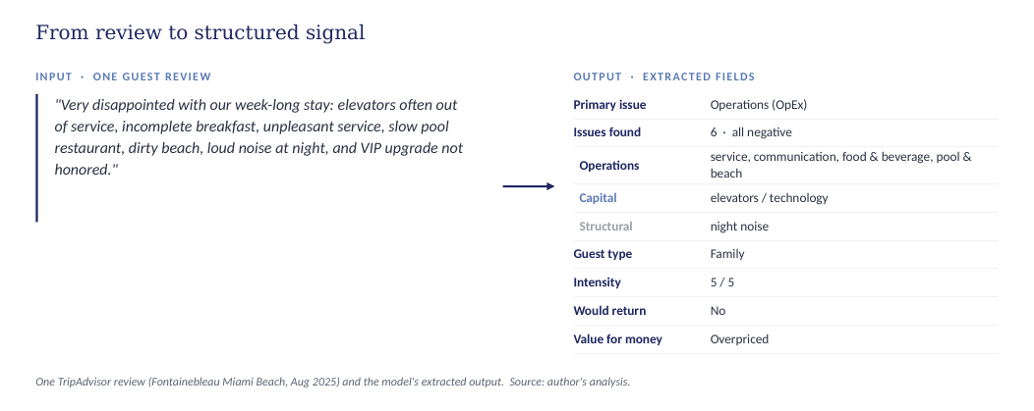
This step requires real estate domain expertise. An analyst with no industry background can build the pipeline but needs guidance, and priorities differ by firm: a vertically integrated, operationally focused firm may weight OpEx complaints heavily and apply defined levers such as maintenance-tracking analytics or housekeeping training.
Data Analysis and Insight Generation
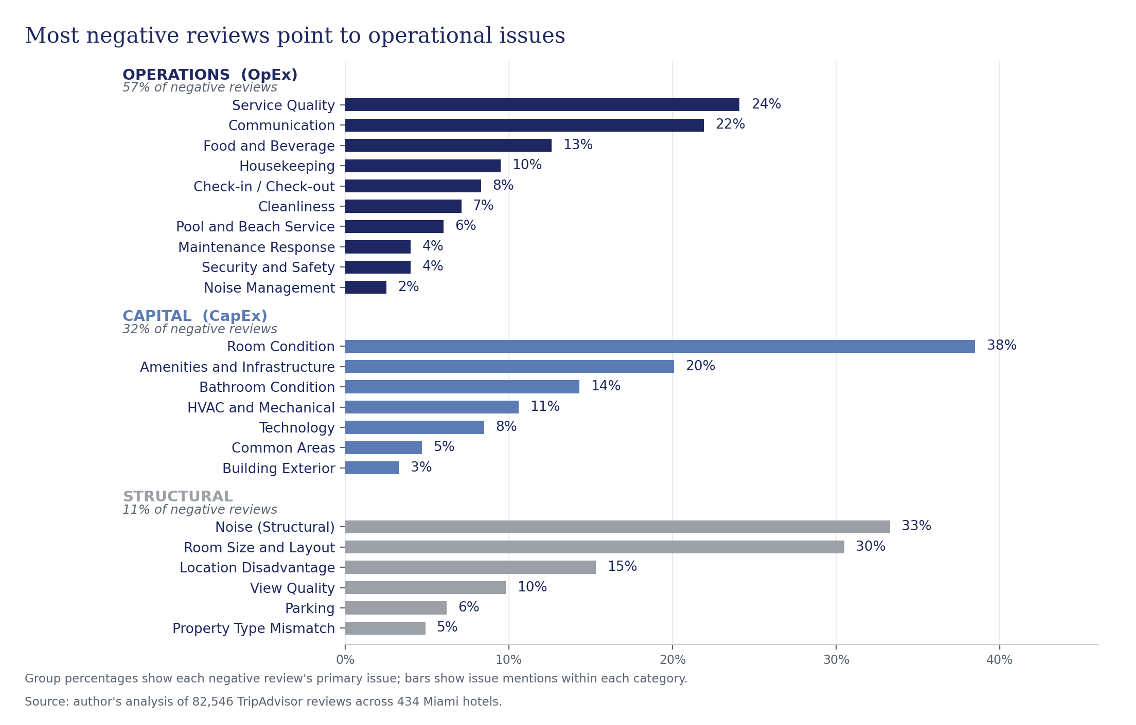
Using each negative review's primary issue (as designated by the LLM during its analysis), OpEx was the dominant category in 56.8% of negative reviews, versus 31.8% for CapEx and 11.4% for structural issues. Because operational issues rarely require significant capital to remedy, higher returns may lie in operationally challenged assets. Within those categories, room condition represented 38% of CapEx issue mentions, while location disadvantage represented only 15% of structural issue mentions.
What the Market Sees vs. What We See
Not all reviews are equal, and 71.4% are five-star - many reflecting incentive or selection effects rather than independent experience. I created a credibility scoring model that weighted each review using factors from industry research (e.g., prolific reviewers are more credible) and intuition (e.g., specificity: named staff, incidents, or amenities). Combining extracted issues with credibility weighting yields two things competitors working from headline ratings lack: a granular map of each hotel's specific problems, and a credibility-adjusted score that can diverge from the public rating, flagging where the market may misjudge an asset.
When using the credibility model, most review scores shift down as low-credibility reviews are discounted. However, some hotels reveal higher ratings, indicating that headline ratings may understate operating quality in certain cases. Examples include The Four Seasons Miami and AC Brickell. Tested against TripAdvisor sub-ratings the model never saw, the pattern held: where reviews flagged service, cleanliness, or room issues, the corresponding sub-ratings were sharply lower, confirming the complaints were real.
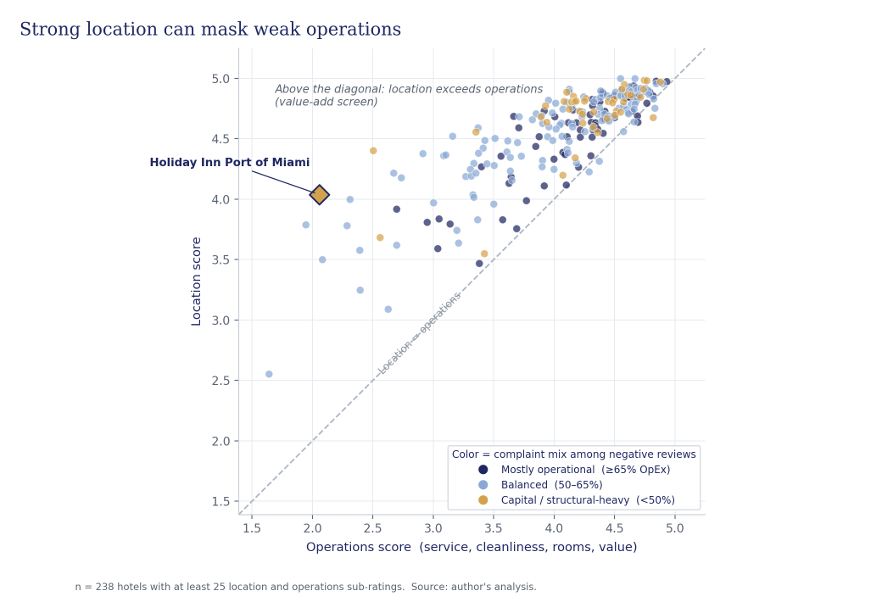
Domain expertise remains decisive. The top-scoring opportunity, the Holiday Inn Port of Miami, rated location 4.0 but operations 2.0; local experts noted it is a covered land play slated for demolition to make way for Regalia on the Bay, an 82-story mixed-use tower - explaining its limited operational focus. The screen still surfaced the right questions for the right property, and domain diligence prevented a false positive.
Investment Rankings - Bringing It Together
Insights only have value if they improve returns. In an academic study, Anderson (2012) estimated that "if a hotel increases its review scores by 1 point on a 5-point scale (e.g., from 3.3 to 4.3), the hotel can increase its price by 11.2% and still maintain the same occupancy or market share." Building on this, projected returns from score improvements can be modeled. Calls with Miami-experienced investment and asset-management professionals produced cost estimates for each intervention; each hotel was scored on projected cost and expected return to yield a ranked list - surfacing opportunities off a firm's radar and adding data-informed color to existing ones.
The Real Constraint Is Not Technical
I'm not a software engineer or data scientist, and I cannot code without AI agent tools. Generating insight from unstructured data no longer requires deep technical expertise; the binding constraints are ideation, time, and opportunity cost. Experienced professionals are well-positioned, because domain expertise is required to produce valuable output. Each project demands dozens of decisions - from problem selection (the most important) to schema design, edge cases, validation rules, and prompt phrasing - and mistakes compound without seasoned intuition.
Application to Multifamily
The process applies to any asset class. In multifamily, zoning, permits, inspection records, entitlement files, and certificate-of-occupancy data can test supply assumptions: if forecasts show 15,000 units delivering in an MSA, municipal-record analysis may reveal permit approvals slowing or CO issuance delayed by staffing constraints - sharpening, not replacing, existing supply forecast tools and vendors.
Implications for Investment Firms
As capital takes longer to raise, concentrates among the largest firms, and competes with asset classes such as infrastructure and private credit, differentiation becomes essential. As one GP advisor observed, "All investment firms sound the same (to LPs) and they don't realize it." Track record and deep sourcing relationships are table stakes; more is required. LPs rightly treat GP data-insight claims skeptically given their lack of substance, so firms must demonstrate proprietary insights or data sources - through vertical integration or affiliate relationships, for example.
Organizational design will matter. Firms that are serious about proprietary analytics will place technical talent close to investment decision-making, not only in reporting, IT, or innovation functions. Agentic coding tools will also blur role boundaries: semi-technical investment professionals can now generate analyses well beyond the non-agentic power user, even if still below a quantitative-first firm. The common "improve underperforming in-place management" business plan can now be quantified, and LPs should be expected to demand such analyses as tools improve.
Alpha Decay and Outlook
The edge from agentic AI analyses like the Miami hotel study will not last; the same tools are available to all market participants. Firms that consistently apply them, source and analyze new datasets, and operationalize the results may retain and compound their advantage. As these alpha insights standardize, vendors will productize the workflows into SaaS tools that are cheaper, easier to use, and easier to maintain - useful in any firm's tech stack, but not a source of alpha or a solution to the differentiation challenge.
A weak fundraising market combined with AI advances is likely to sustain consolidation among the largest firms while compounding existential pressure on undifferentiated mid-size managers; lower barriers to entry should also bring more emerging managers to market - reinforcing a barbell dynamic in which scale platforms grow larger, specialized managers become easier to launch, and the undifferentiated middle is squeezed.
The current window is real but temporary. The firms that benefit most will not simply license the newest AI tool; they will match domain expertise with proprietary or underused data, validate outputs rigorously, and embed the resulting insights into investment decisions and processes. In the next fundraising cycle, LPs will hear many AI claims. The more credible question will be: what can this firm see that others cannot, and can it show that acting on that insight produces better outcomes, not just different decisions?
References:
Anderson, Chris K. "The Impact of Social Media on Lodging Performance." Cornell Hospitality Report, Vol. 12, No. 15, 2012.
