

But the lease is only the beginning of the underwriting. Somewhere behind the rent check, customers must pay enough for AI services to support the buildings, electricity, and chips being assembled on an extraordinary scale. How much revenue does that require? And what happens to the landlord and lender if the answer proves harder to achieve than expected?
In my recent paper, Financing the AI Buildout, I examine the investment pipeline and the financing arrangements supporting it. For real estate practitioners, the central finding is that the economics of the tenant's business, the useful life of the infrastructure, and the terms of the financing need to be evaluated together.
Start with the scale. A representative 200-megawatt AI campus costs approximately $8.2 billion, including computing equipment. Roughly one-third pays for the facility and associated power infrastructure; two-thirds pays for IT equipment. Applying those costs to a scenario for the U.S. development pipeline produces nearly $9 trillion of investment during 2025–2032, with about 188 gigawatts of additional capacity operational by 2032. This scenario already allows for substantial cancellations and downsizing relative to the announced pipeline and assumes no further additions to that pipeline. It also does not factor in the cost of IT refresh after the initial vintage of IT capital has reached the end of its useful life. Thus, while enormous, the $9 trillion buildout estimate may prove to be conservative.
The revenue needed to support that investment is equally striking. My paper asks what the completed capacity must earn to recover its cost and provide investors with a return. The central calculation assumes a 10 percent annual return before leverage, a 50 percent operating cash-flow margin, a six-year economic life for IT equipment, and a 20-year life for the remaining assets. It also compensates investors for capital committed during construction.
The result is approximately $3.55 trillion in annual revenue by 2032, once the capacity is operating and mature. That is equivalent to 8.8 percent of projected U.S. GDP in 2032. Greg Ip's recent Wall Street Journal article puts that roughly 9 percent figure at the center of the discussion. It is a useful way to convey the magnitude of the commercial challenge.
The interpretation matters. This is a required revenue calculation, not a prediction of what customers will spend. Nor is it a calculation of data center rents: it covers the combined investment in facilities, power infrastructure, and computing equipment. Expressing revenue as a share of GDP provides a sense of scale; it does not establish that an equivalent share of domestic final spending must go to AI.
For practitioners, the more revealing comparison may be with the price and utilization of computing capacity. Using the paper's benchmark hardware configuration, the central revenue requirement works out to about $5.10 per installed GPU-hour if every hour is sold. At 80 percent utilization, the required price rises to roughly $6.40 per billed hour; at 70 percent, it reaches about $7.30. These are prices for access to the specialized processors that run AI workloads.
The paper finds that these requirements are broadly comparable to observed frontier-compute rental prices in late August 2026. That makes the economics conceivable. The harder question is whether providers can maintain those prices while filling an enormous amount of new capacity. Today's shortage can support attractive pricing. It cannot establish what pricing will look like after today's construction pipeline opens.
This is a familiar real estate problem with an unfamiliar underlying business. A market can have strong demand growth and still deliver disappointing investment returns if supply grows faster, rent growth is weaker than expected, or operating costs absorb too much of the revenue. AI adoption can succeed while particular campuses struggle to meet their underwriting.
Two assumptions deserve particular attention. First, the operating margin. If only one-third of revenue becomes operating cash flow, rather than one-half, the same completed capacity needs approximately $5.38 trillion in annual revenue to support a 10 percent return. While a 50% margin is close to the average margin of the hyperscalers today, it is arguable too high for other companies in the AI ecosystem such as the neoclouds, and there may be margin compression for the hyperscalers in the future. Investors should ask how much room the tenants have to absorb competition, power costs, and other expenses before their infrastructure commitments become burdensome.
Second, equipment life. If the IT equipment remains economically useful for three years rather than six, the central revenue requirement rises to approximately $5.7 trillion annually. The distinction between a chip that still works and a chip that remains competitive is crucial. Faster replacement consumes cash even when the buildings remain fully usable.
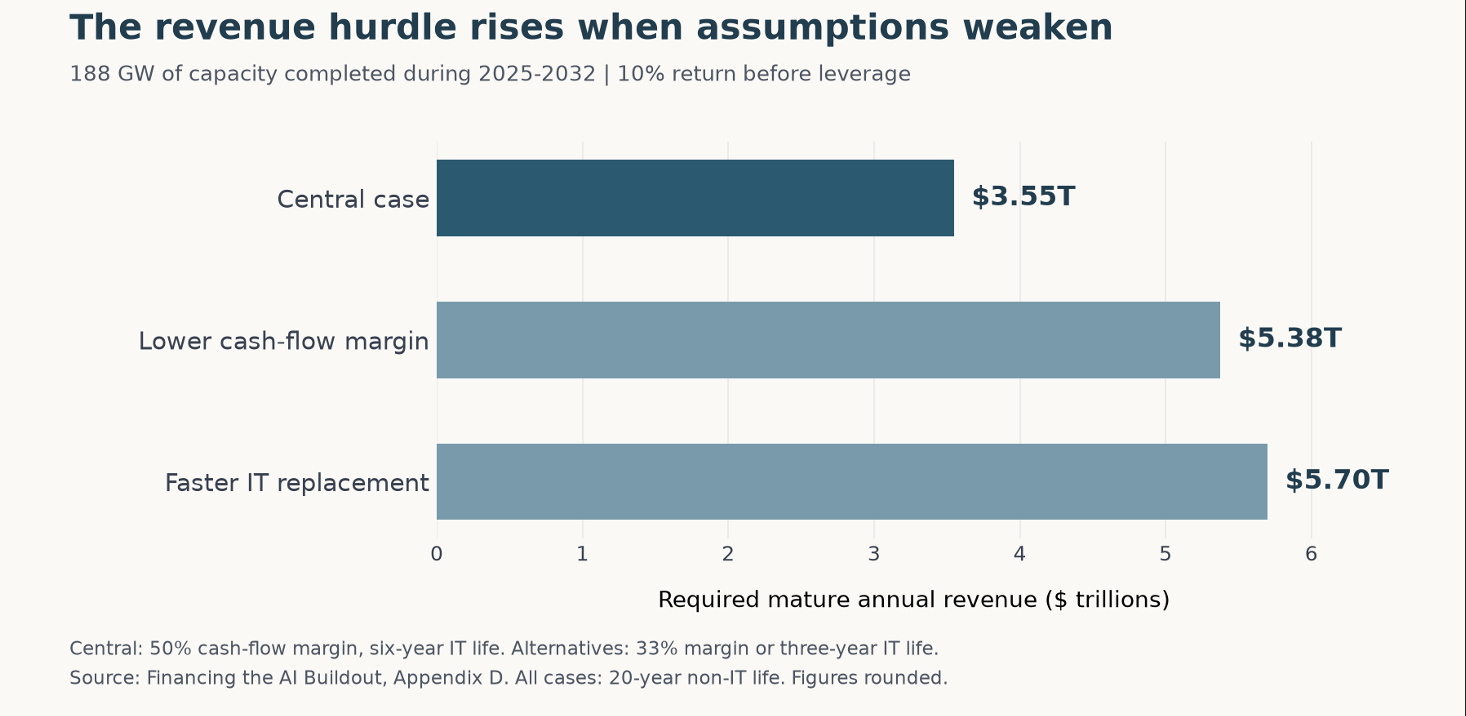
Figure: Required mature annual revenue from capacity completed during 2025–2032. All scenarios assume a 10 percent return before leverage and a 20-year life for non-IT assets. The central case assumes a 50 percent operating cash-flow margin and six-year IT life; each alternative changes one assumption. Source: Financing the AI Buildout, Appendix D. Rounded figures.
Landlords may not own the chips, but they still need to understand this replacement cycle. Higher power densities and new cooling requirements can make a facility expensive to adapt. At renewal, the relevant question is how much it costs to make the campus competitive for the next tenant or the next generation of equipment. A long physical life does not automatically produce a long economic life.
Tenant credit remains an important protection. A binding obligation from a strong company can support rent payments even when a particular AI application disappoints. The protection depends, however, on who signs the contract, what is guaranteed, when the obligation begins, and whether (and when) the tenant can reduce capacity or exit. If demand softens, a hyperscaler may favor its owned facilities over leased space as contracts permit. Several properties leased to the same small group of technology companies also offer less diversification than their locations might suggest.
Meta's Hyperion campus illustrates why the details matter. The approximately $30 billion facility and infrastructure project was financed with about $27 billion of debt, or roughly 90 percent of asset value. The transaction's reported debt service coverage ratio was 1.12 times—a thin cash-flow cushion. Meta's strong corporate credit helps make the financing possible, but project-level leverage remains substantial.
The leases also differ from a conventional, uninterrupted 20-year commitment. Meta can terminate at four-year renewal dates, subject to a residual-value guarantee that requires it to cover a shortfall between sale proceeds and a specified minimum value. That guarantee is central to lender protection. A review focused only on the tenant's name, the bond rating, or the headline lease horizon would miss how the transaction allocates risk.
Execution adds another layer. A completed building cannot generate the expected cash flow without power, cooling, and computing equipment arriving together. Grid connections, permits, and hardware deliveries involve parties outside the developer's control. Underwriting should therefore connect the construction schedule to the actual conditions for rent commencement and identify who pays when one part of the campus is ready and another is delayed. Oracle’s recent force majeure notice at Project Jupiter in New Mexico brings this risk into sharp focus: when power is delayed, who bears the cost?
Finally, the exit deserves as much scrutiny as the initial investment. A loan can mature while a lease is still performing, yet refinancing depends on the property's remaining competitiveness and the willingness of lenders to finance it. A stress case should combine lower renewal rents, retrofit spending, a higher exit cap rate, and less available debt. Those pressures could arrive together if enthusiasm for AI infrastructure cools.
There is a substantial opportunity here. Well-located, adaptable facilities with reliable power and enforceable tenant support can earn attractive returns. Real estate investors are also supplying capital that helps make broader AI adoption possible. But the investment case needs to survive more than a forecast of rising AI use. It must withstand slower revenue growth, faster equipment replacement, delayed power, and a less accommodating refinancing market. The strongest deals will be those whose contracts and capital structures can absorb those outcomes while the technology continues to evolve.