Official Logo of Columbia Business School
Academics
  • Visit Academics
  • Degree Programs
  • Admissions
  • Tuition & Financial Aid
  • Campus Life
  • Career Management
Faculty & Research
  • Visit Faculty & Research
  • Academic Divisions
  • Search the Directory
  • Research
  • Research Resources
  • Teaching Excellence
Executive Education
  • Visit Executive Education
  • For Organizations
  • For Individuals
  • Program Finder
  • Online Programs
  • Certificates
About Us
  • Visit About Us
  • CBS Directory
  • Events Calendar
  • Leadership
  • Our History
  • The CBS Experience
  • Newsroom
Alumni
  • Visit Alumni
  • Update Your Information
  • Lifetime Network
  • Alumni Benefits
  • Alumni Career Management
  • Women's Circle
  • Alumni Clubs
Insights
  • Visit Insights
  • AI & Transformative Tech
  • Climate
  • Business & Society
  • Entrepreneurship
  • Finance & Investing
  • Magazine
Insights
  • AI & Transformative Tech
  • Climate
  • Business & Society
  • Entrepreneurship
  • Finance & Investing
  • Magazine
  • More 

The Power of Procurement Officers

Giving frontline officers more leeway, not more oversight, in the procurement process could save governments significant time and money.

Published
February 14, 2023
Publication
Business and Society
Jump to main content
Supply Chain Management Industry Abstract Background Concept 3D Render
Category
Thought Leadership
Topic(s)
Leadership and Strategy

0%

Public procurement — the process by which governments purchase goods and services—accounts for approximately 12 percent of the world's GDP. But too often, this process is mired in red tape, resulting in a lot of waste, inefficiency, and even corruption, particularly in developing countries. How can we make procurement more efficient so that governments will be able to do more with their money?

In “The Allocation of Authority in Organizations: A Field Experiment with Bureaucrats” Chazen Senior Scholar Andrea Prat and co-authors from Columbia University and the London School of Economics show that the power to improve the public procurement process may rest in the hands of procurement officers themselves. By giving these officers more autonomy, governments could potentially save billions of dollars and curb corruption in the process.

Research

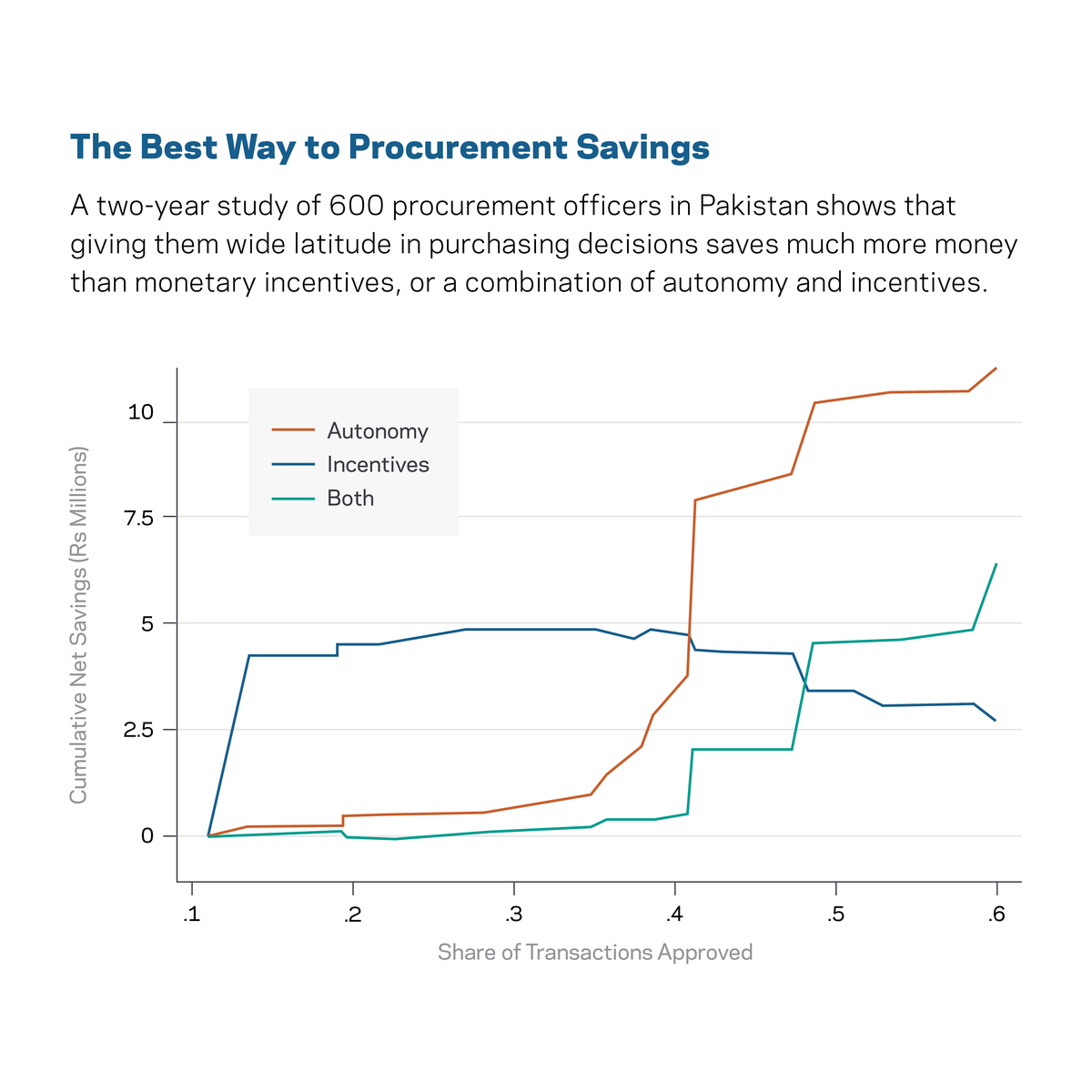
In collaboration with the World Bank and the Government of Punjab, Pakistan, the researchers assessed thousands of purchasing decisions made by procurement officers (POs), who were given more responsibility over their actions (by shifting authority from an independent agency of the federal government known as the Accountant General's office or AG) and incentivized the POs with rewards for spending less. Prat and his colleagues studied 600 procurement officers across 26 districts who made a total of 20,000 purchases over a two-year period, and their interactions with AG monitors. Officers were randomly placed into four groups:

  • A control group
  • An autonomous group in which officers were given more latitude in purchasing decisions
  • A pay-for-performance group in which officers were given prizes, ranging from half a month's salary to two months' salary, for spending less on departmental and administrative purchases
  • A group that received both greater autonomy and monetary incentives

Results

The study found that giving procurement officers more control over the process pays off. In fact, shifting authority to these frontline officers reduced the average prices paid for generic goods by 9% without reducing quality. According to the researchers, this intervention removes red tape and reduces long delays in monitor approvals, and more than offsets the loss of benefits that monitoring provides.

Incentives, on the other hand, showed little to no impact on savings, except when the monitor approved purchases more quickly. For instances in which monitoring is onerous, officers are too tangled up in red tape to do anything to improve their performance, even when offered a financial reward.
Supply Chain Management Industry Abstract Background Concept 3D Render

The effect of both treatments ultimately depends on the type of monitor assigned to each officer. The autonomy treatment delivered the most savings — up to 15% — when the monitor was more inefficient or delayed approvals. But when the monitor was effective and approved purchases more quickly, the pay for performance treatment delivered around 6% in savings.

The researchers stress that the optimal allocation of authority between agents at different levels of a hierarchy should be determined by their relative degrees of wastefulness. In essence, the more wasteful the mangers, the more savings that can be gained by relinquishing control to frontline personnel.

You Might Like

Finance and Economics
Type
Business and Society
Date
May 20, 2026
Finance and Economics

‘Put your money where your mouth is’: The path to the top

Former Estée Lauder CFO Tracey Travis reflects on how leading a struggling Pepsi bottling unit became the defining risk that shaped her path to global leadership.
  • Read more about ‘Put your money where your mouth is’: The path to the top about ‘Put your money where your mouth is’: The path to the top
Business and Society
Date
April 07, 2026
Federico Marchetti '99 and Professor Silvia Bellezza.
Business and Society

Federico Marchetti’s ‘99 Playbook on Risk and Reinvention in Fashion and Beyond

The YOOX founder shared lessons on entrepreneurship, risk-taking, timing, and sustainability from his new book The Geek of Chic at a recent CBS event.
  • Read more about Federico Marchetti’s ‘99 Playbook on Risk and Reinvention in Fashion and Beyond about Federico Marchetti’s ‘99 Playbook on Risk and Reinvention in Fashion and Beyond
Accounting, Artificial Intelligence, Business and Society, Capital Markets and Investments, Energy Solutions
Date
February 08, 2026
A rack of servers in a server room photo. Photo by Kevin Ache on Unsplash.com
Accounting, Artificial Intelligence, Business and Society, Capital Markets and Investments, Energy Solutions

The $660 Billion Disconnect Between Corporate Accounting And GDP

GDP conflates consumption and investment spending and hence confuses motion for progress
  • Read more about The $660 Billion Disconnect Between Corporate Accounting And GDP about The $660 Billion Disconnect Between Corporate Accounting And GDP
Business and Society, Economics and Policy, Finance and Economics
Date
December 12, 2025
Photo Image of Glenn Hubbard and Tano Santos
Business and Society, Economics and Policy, Finance and Economics

Why Modern Political Economy Matters: Lessons from Adam Smith for Today’s World

Hubbard and Santos use Adam Smith’s ideas to explore how technology, globalization, and alienation define today’s MPE moment.
  • Read more about Why Modern Political Economy Matters: Lessons from Adam Smith for Today’s World about Why Modern Political Economy Matters: Lessons from Adam Smith for Today’s World
Save Article

Download PDF

More to Explore
Share
  • Share on Facebook
  • Share on Threads
  • Share on LinkedIn
Official Logo of Columbia Business School

Columbia University in the City of New York
665 West 130th Street, New York, NY 10027
Tel. 212-854-1100

Maps and Directions
    • Centers & Programs
    • Current Students
    • Corporate
    • Directory
    • Support Us
    • Recruiters & Partners
    • Faculty & Staff
    • Newsroom
    • Careers
    • Contact Us
    • Accessibility
    • Privacy & Policy Statements
Back to Top Upward arrow
TOP

© Columbia University

  • X
  • Instagram
  • Facebook
  • YouTube
  • LinkedIn

External CSS

Homepage Breadcrumb Block