
What does bringing a breakthrough climate technology from the lab to the real world take? At Columbia Business School, a course designed by Professors Bruce Usher, Alan West, and Dave Kirkpatrick offers students the rare opportunity to explore that question firsthand by teaming up with venture capitalists to evaluate emerging climate solutions with the potential to reshape entire industries.
The course, Climate Tech, builds on foundational coursework like Business and Climate Change, immersing students in the practical, high-stakes world of early-stage climate technology investing.
What sets the course apart, however, is its structure: an interdisciplinary format that pairs MBA students with engineering master’s students and matches each student team with a real-world venture capital fund investing in climate tech.
According to Usher, the Elizabeth B. Strickler ’86 and Mark T. Gallogly ’86 Faculty Director at the School’s Tamer Institute for Social Enterprise and Climate Change, the result is a deeply experiential course that tests students’ abilities to evaluate technologies not just for their scientific or commercial promise but also for their potential to help solve the defining crisis of our time.
“Having engineering and MBA students work together, we thought there would be learning in that, and there absolutely is. How engineers approach problems is extremely different,” Usher says.
The course aims to teach students how to collaborate effectively across the two disciplines, understand the investment process for early-stage climate technologies, and develop deep expertise in specific climate solution areas ripe for investment.
Real Ventures, Real Stakes
Each spring, 40 students are selected for the course—20 MBA students and 20 engineering students from the School of Engineering and Applied Science (SEAS). The cohort is then divided into 10 four-person teams, each composed of two MBA students and two engineering students. Every team is assigned a unique climate technology and a sponsoring VC fund from a network of early-stage investors working at the frontier of climate innovation.
Throughout the semester, students collaborate closely with their assigned funds, beginning with a kickoff meeting and continuing with biweekly check-ins. This culminates in final presentations delivered both in class and directly to the funds.
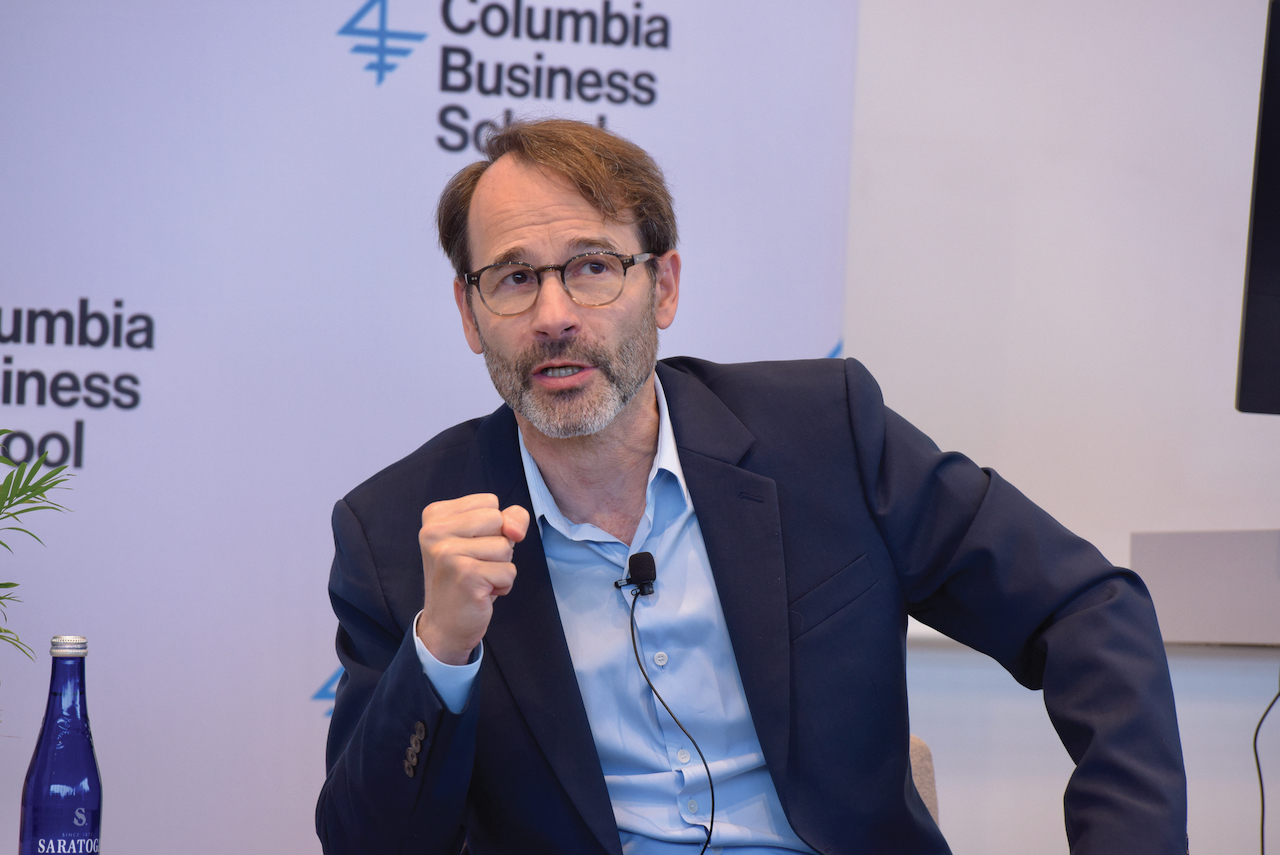
Professor Bruce Usher
Students are tasked with rigorously evaluating their assigned technology across three core dimensions: technical viability, commercial feasibility, and climate impact. This includes assessing whether a technology will work at scale, whether a viable business model exists, and what kind of emissions- reduction or adaptation potential it could unlock.
In the most recent iterations of the course, student teams have analyzed innovations ranging from next-generation geothermal systems to new formulations of low-carbon concrete. Some groups conclude the technologies are promising; others advise their VC sponsors to pass. According to Usher, either outcome represents a successful learning experience.
“Students quickly learn this is a complex world, complex both from an engineering perspective and from a business perspective. How do you replace an incumbent industry? How do you change the way people buy things and monetize it? If it’s not profitable, it will not be financially sustainable,” Usher says.
For one student team, that complexity came into sharp focus during a project on grid stability. Its assigned task: assess how replacing coal and gas power plants—which provide essential “grid inertia” via large spinning turbines—with solar and wind pow- er affects frequency stability on the electric grid. The group spent weeks consulting with experts, many of whom acknowledged the risk of grid instability in high-renewable scenarios but also emphasized that the exact tipping point remained unclear.
Just one day before the team’s final presentation to the VC fund, the Iberian power grid in Spain and Portugal collapsed—reportedly due to a momentary imbalance triggered by over 70 percent of electricity being supplied by renewables at the time. The blackout underscored the fragility of grids that lack sufficient “grid-forming” assets, and it instantly reframed the relevance of the team’s work.
The real-world event brought urgency and clarity to their recommendations, which focused on nascent climate technologies like grid-forming inverters and synchronous condensers to stabilize high-renewable grids.
“This clearly demonstrated the relevance of our project and made it much easier to explain the importance of adding grid-forming inverters or synchronous condensers to grids with high renewable penetration,” says Quint Houwink ‘25, a former MBA student who worked on the team.
“Students quickly learn this is a complex world, complex both from an engineering perspective and from a business perspective. How do you replace an incumbent industry? How do you change the way people buy things and monetize it? If it’s not profitable, it will not be financially sustainable.”
- Professor Bruce Usher
Teaching the Reality of Climate Tech
Usher notes that the course emerged from a broader vision to expand Columbia’s climate curriculum, particularly its offerings focused on business and innovation. As co-director of the School’s Tamer Institute for Social Enterprise and Climate Change and a faculty member at the Columbia Climate School, he has long emphasized the role of business in addressing environmental challenges.
The Climate Tech course now sits at the heart of that mission, building directly on the Business and Climate Change prerequisite course. While that course lays the groundwork in climate science, market structures, and policy, Climate Tech offers a hands-on opportunity to apply those concepts to real technologies, teams, and investors.
A key design principle of the course is its cross-disciplinary approach. “When you’re out in a working environment, particularly around something like climate technologies, it will always be a mix of engineers and business folks. It just is, be- cause you have to understand both those angles,” Usher says.
Engineers bring technical depth; MBAs contribute market insight. Each group learns from the other’s perspective—and, in many cases, figures out how to bridge language, assumptions, and problem-solving approaches that initially feel worlds apart.
The learning curve can be steep. Students must master the details of unfamiliar sectors quickly, often narrowing from broad topics like carbon capture and sustainable agriculture to deep dives on specific technologies or startups. Many teams conclude that no investable opportunity exists. That is still a valuable outcome that reflects the real risks in climate tech investing, according to Usher.
Workload expectations are also substantial. Students spend up to nine hours weekly on research, fund meetings, and deliverables. Evaluation is based on group milestones, including a midterm report, final presentation, and final individual reflection.
Despite logistical challenges—coordinating across two schools, grading across disciplines, and navigating constrained capacity—the course has proved to be one of Columbia’s most innovative experiential offerings.
The payoff is meaningful, too. Some VC sponsors have pursued student-recommended investments while others have benefited from advice not to pursue some technologies. Most of the VC funds have returned every year to participate in the course, providing rare access and feedback that students wouldn’t otherwise find in a classroom.


