
“When evaluating something as horrific as the Holocaust, it is very easy and even comforting to imagine yourself as one of the victims. Indeed, you may make parallels between what happened to the Jewish population during this period to injustices you have personally suffered or witnessed. During our time together, I encourage you to instead see yourself through the lens of the perpetrator, which is usually a much more difficult approach to take.”
That was the challenge laid out by the executive director of the 2025 Fellowships at Auschwitz for the Study of Professional Ethics (FASPE) on my first day in the program. I, along with a few dozen fellow graduate students and early career professionals across business, design/technology, and law were embarking on a two-week excursion in Germany and Poland to learn about the history of the Holocaust, discuss the ethical questions from that time, and derive insights for our own future professional journey.
The progression of this period could be seen as happening gradually then suddenly all at once. The regime, although consistently racist through its history, slowly introduced its ideals and policies—what started as economic and social limitations eventually led to mass killings within a decade. Visits to various German and Polish museums, labor camps, euthanasia centers, and death camps provided a visceral and emotional backdrop to our experience. Images and testimonials from Auschwitz survivors were particularly gruesome. What made it worse was the realization that the people we heard from were the “lucky” ones who made it out alive.
As we grappled with real situations that German businesses dealt with in the 1930-40s and contextualized the brutality of the concentration camps, our ethical assumptions and foundations were continually questioned. The people on the trip had a high degree of professional influence and autonomy as compared to the average individual, and almost all of us could draw a direct line from our career to one that existed in Nazi Germany. After all, bankers, lawyers, engineers, consultants, managers, and executives were notable and influential back then as well. We examined this period from this perspective.
FASPE emphasized the empathic feeling of “that could have been me” does not only apply to those who suffered, but also to those who caused the suffering. It’s easy for one to believe “I would have refused to work with the Nazis” or “I wouldn’t have taken part in designing the gas chambers”. However, these views are naive and unverifiable. Oftentimes, it wasn’t the case that anyone even “had” to do these things. People won the honor and privilege of a prestigious government partnership and opportunity. While some chose not to work on these projects, the majority did.
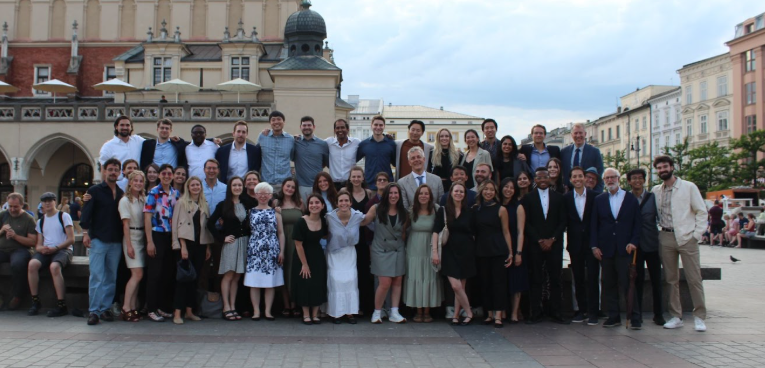
These people weren’t directly running the concentration camps, rounding up prisoners or ultimately murdering millions of people. However, they did design, finance, insure, and consult on these Nazi endeavors. And they were well compensated for their services both monetarily and socially. So, the natural conclusion is that these people were greedy opportunists profiteering off the suffering of others, right? Well not necessarily. Many individuals were opposed to what was happening politically. However, for people who took pride in their careers, working on these projects was the avenue to continue practicing their craft.
We, as future business leaders, must be mindful of the ramifications of our decisions. Even if not on the scale of the Holocaust, ethical quandaries will always exist. What is morally right or wrong? Or more realistically, what ethical trade-off do I have to make? Or even more realistically, how do I balance my own personal incentives and security with doing something that’s morally “better”? Which battles should I fight? What are the second- or third-order effects of my decision that are not immediately obvious?
We, as future business leaders, must be mindful of the ramifications of our decisions.
These were all tough questions, and I am thankful for the superb community of individuals I was able to ponder/debate them with on the trip. Undoubtedly the greatest asset to this experience has been meeting the faculty and fellows who came in with varied backgrounds to tackle and evaluate these challenges together. Listening to others from across disciplines discuss their own experiences, ethical dilemmas, and decision-making processes demonstrated the necessity and difficulty of making tough moral choices and allowed me to perspective-take on a higher level.
It was liberating to realize there is rarely a clear right answer. The only wrong path is to stick your head in the sand and not reflect on the process at all. Taking some time to even briefly evaluate the ethical consequences, a step that is very often skipped will drastically improve the quality of moral decision making. And, if you have the support and insights of others who share similar values, well then that’s even more powerful.
Adam Shen is a second year MSFE student at Columbia Business School. He has past experience and interests in derivatives trading, AI, and crypto and is excited about both new technologies as well as their ramifications for society.