Official Logo of Columbia Business School
Academics
  • Visit Academics
  • Degree Programs
  • Admissions
  • Tuition & Financial Aid
  • Campus Life
  • Career Management
Faculty & Research
  • Visit Faculty & Research
  • Academic Divisions
  • Search the Directory
  • Research
  • Research Resources
  • Teaching Excellence
Executive Education
  • Visit Executive Education
  • For Organizations
  • For Individuals
  • Program Finder
  • Online Programs
  • Certificates
About Us
  • Visit About Us
  • CBS Directory
  • Events Calendar
  • Leadership
  • Our History
  • The CBS Experience
  • Newsroom
Alumni
  • Visit Alumni
  • Update Your Information
  • Lifetime Network
  • Alumni Benefits
  • Alumni Career Management
  • Women's Circle
  • Alumni Clubs
Insights
  • Visit Insights
  • AI & Transformative Tech
  • Climate
  • Business & Society
  • Entrepreneurship
  • Finance & Investing
  • Magazine
Insights
  • AI & Transformative Tech
  • Climate
  • Business & Society
  • Entrepreneurship
  • Finance & Investing
  • Magazine
  • More 

China’s Phase-Out of Solar Feed-in Tariffs Is a Sign of a Mature Sector, Not a Waning One

China’s Solar PV installations dropped 85 percent in June after a planned subsidy phase-out. But far from a retreat from renewables, the country's energy policy reforms reflect an increasingly mature and competitive solar industry. 

Download Deck PDF

Download Deck PPT

Published
August 14, 2025
Publication
Climate
Focus On
Climate, Economy & Policy
Jump to main content
Article Author(s)
Photo Image of Isabel Hoyos

Isabel Hoyos Arango

Senior Staff Associate I in the Faculty of Business
Economics Division
Hyae Ryung (Helen) Kim

Hyae Ryung (Helen) Kim

Senior Staff Associate II in the Faculty of Business
Economics Division
Gernot Wagner

Gernot Wagner

Senior Lecturer in Discipline of Economics in the Faculty of Business
Economics Division
Faculty Director, Climate Knowledge Initiative
Tamer Institute for Social Enterprise and Climate Change
Faculty Fellow
CESifo
Board Member
CarbonPlan
Columnist
Project Syndicate
Senior Fellow
Jain Family Institute
An engineer inspecting solar panels

An engineer inspects a bank of solar panels

Category
Thought Leadership
In Collaboration With
Climate Knowledge Initiative
Topic(s)
Climate and Policy, Climate and Solutions, Climate and Sustainability, Energy, Solar

About the Researcher(s)

Gernot Wagner

Gernot Wagner

Senior Lecturer in Discipline of Economics in the Faculty of Business
Economics Division
Faculty Director, Climate Knowledge Initiative
Tamer Institute for Social Enterprise and Climate Change
Faculty Fellow
CESifo
Board Member
CarbonPlan
Columnist
Project Syndicate
Senior Fellow
Jain Family Institute

0%

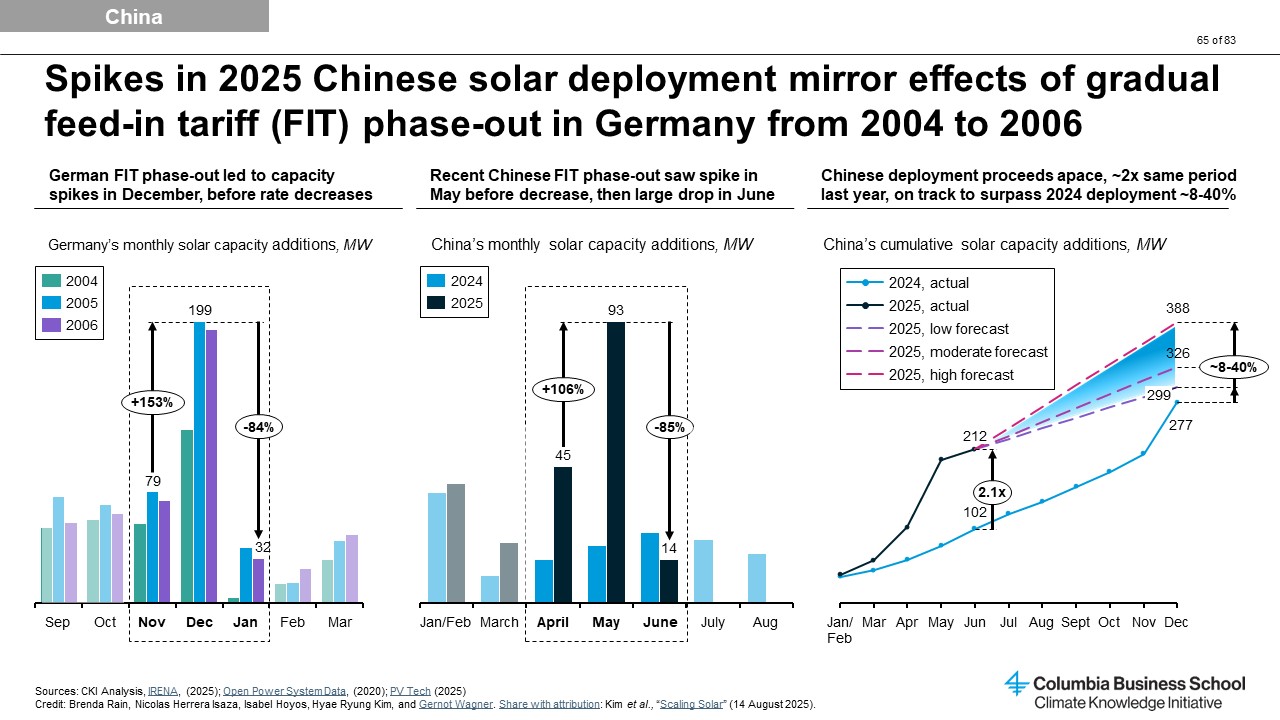
This past June, China installed around 14 gigawatts of solar PV, 85 percent less than the previous month and close to 40 percent less than June of the previous year. This followed the final phase-out of the country’s guaranteed feed-in tariffs (FITs) on June 1.

When the global undisputed solar leader seemingly shifts its support away from the industry, the rest of the world pays attention. But rather than a warning sign about solar deceleration, China’s recent policy shifts are, if anything, a good sign of the continued – and increasing – competitiveness of solar power, and China’s own shift from regulation- to market-driven clean energy policy.
Click to enlarge slide for further details

CKI Slide Analysis Image


Read the full CKI report: Scaling Solar

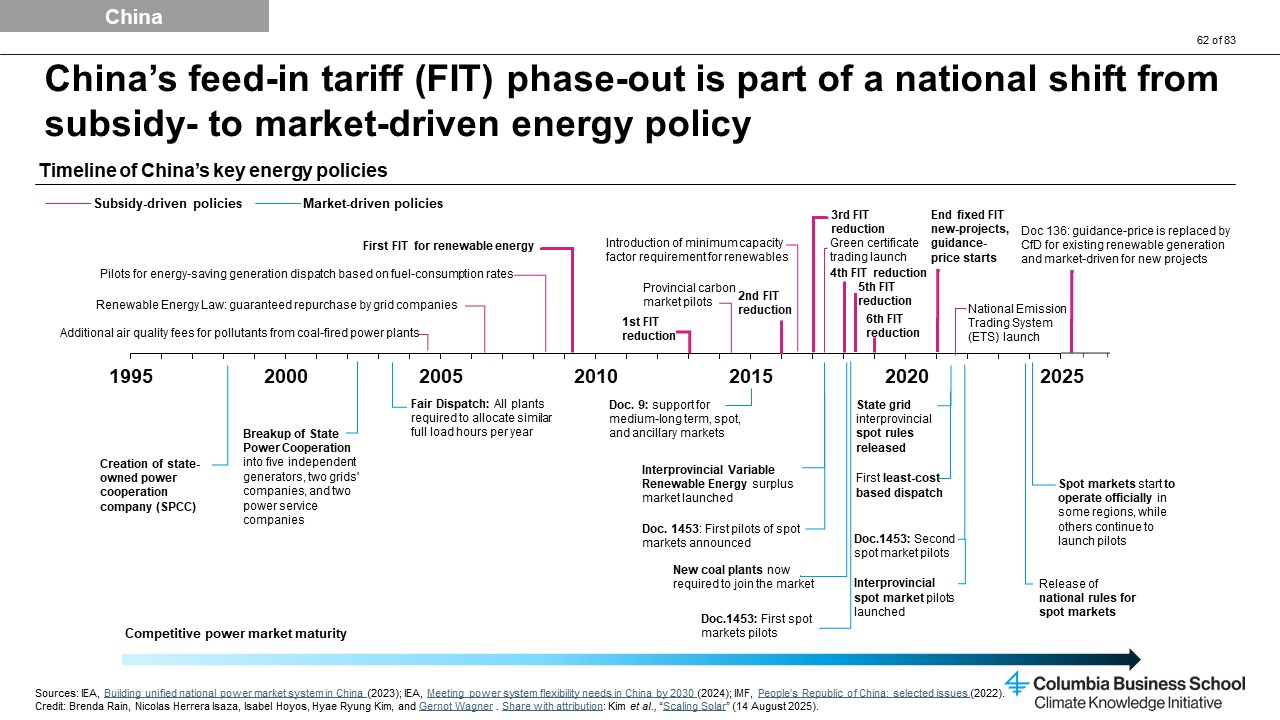
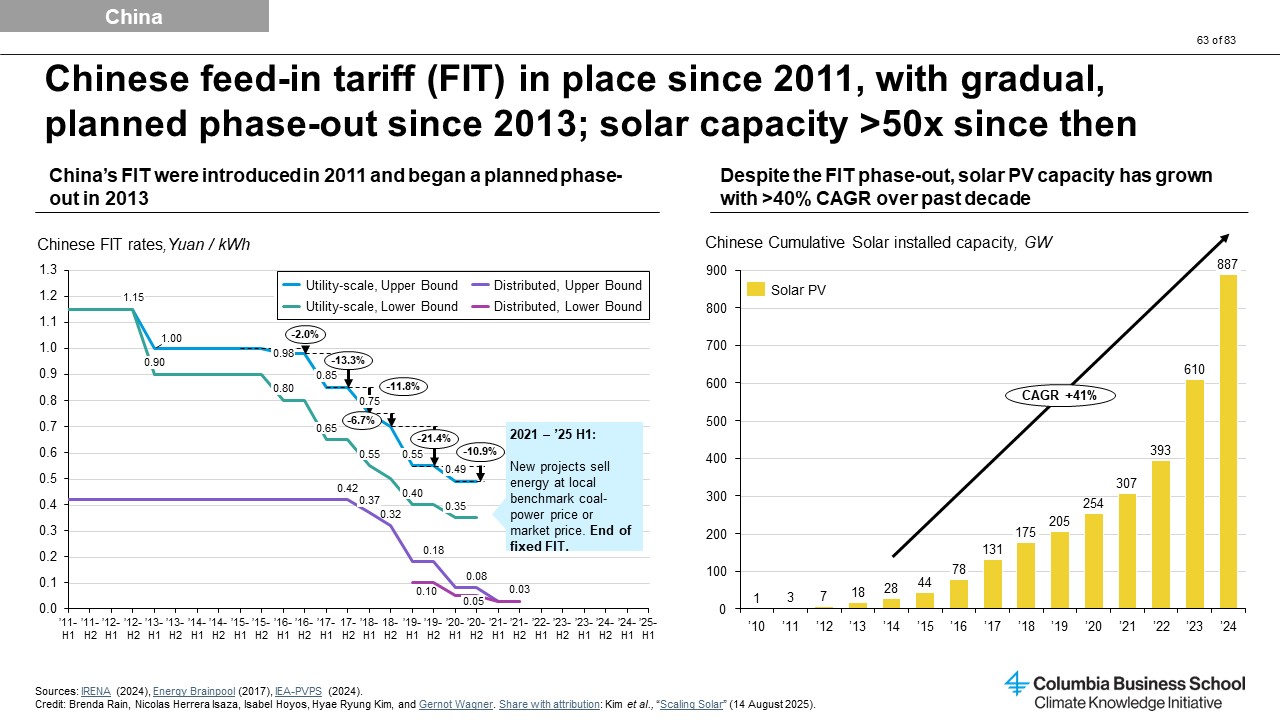
The phase-out of FITs wasn’t a sudden decision. China first introduced a national FIT of ¥1.15/kWh ($0.18/kWh) in 2011, following the successful adoption of earlier provincial pilots. This model was influenced by FITs pioneered by Germany in the early 2000s under its Renewable Energy Act (EEG). 

China first reduced its FITs in 2013 to between ¥0.9 and 1.0/kWh ($0.13-0.14/kWh), depending on the region. The 13th Five-Year Plan (2016) included generous FITs as part of its strategy to achieve renewable energy targets, and laid out a gradual further tapering from 2016 to 2020.

The 14th Five-Year Plan (2021) marked a pointed shift in China’s policies from a centrally planned, subsidy-driven model of support to a more competitive energy market. Along with subsequent notices, the new rules ordered a final (staggered) phase-out of national FITs for most solar PV and onshore wind projects.
Click to enlarge slide for further details

CKI Slide Analysis Image


To ease the shift away from FIT, China introduced a protective contracts-for-difference (CfD) policy in 2025 for projects placed in service after June 1, where developers are compensated for any difference between market price and a fixed "strike price." It also expanded clean energy obligations of large energy users, mandating, for instance, that data centers source at least 80 percent of their power from renewables.

Since 2015, China has been gradually developing medium- and long-term power contracts, spot markets, and ancillary service markets. Market-based electricity trading volume surged from 1.1 billion MWh in 2016 to 6.2 billion MWh in 2024, accounting for 63 percent of nationwide electricity consumption. Cross-provincial trading expanded tenfold in that time. By the end of 2025, the government aims to establish a nationwide power spot market.
Click to enlarge slide for further details

CKI Slide Analysis Image


While the June 1 phase-out of FITs had long been planned, it did lead to a spike in installations in both April and May, similar to when Germany gradually phased down its FITs between 2004 and 2006, each time beginning January 1.

But China, of course, is still building. Overall, solar PV installations are strong and gaining strength, with an increase of well over 50x since 2013. China installed over 270 GW of solar power in 2024 alone, more than the rest of the world combined.
Click to enlarge slide for further details

CKI Slide Analysis Image


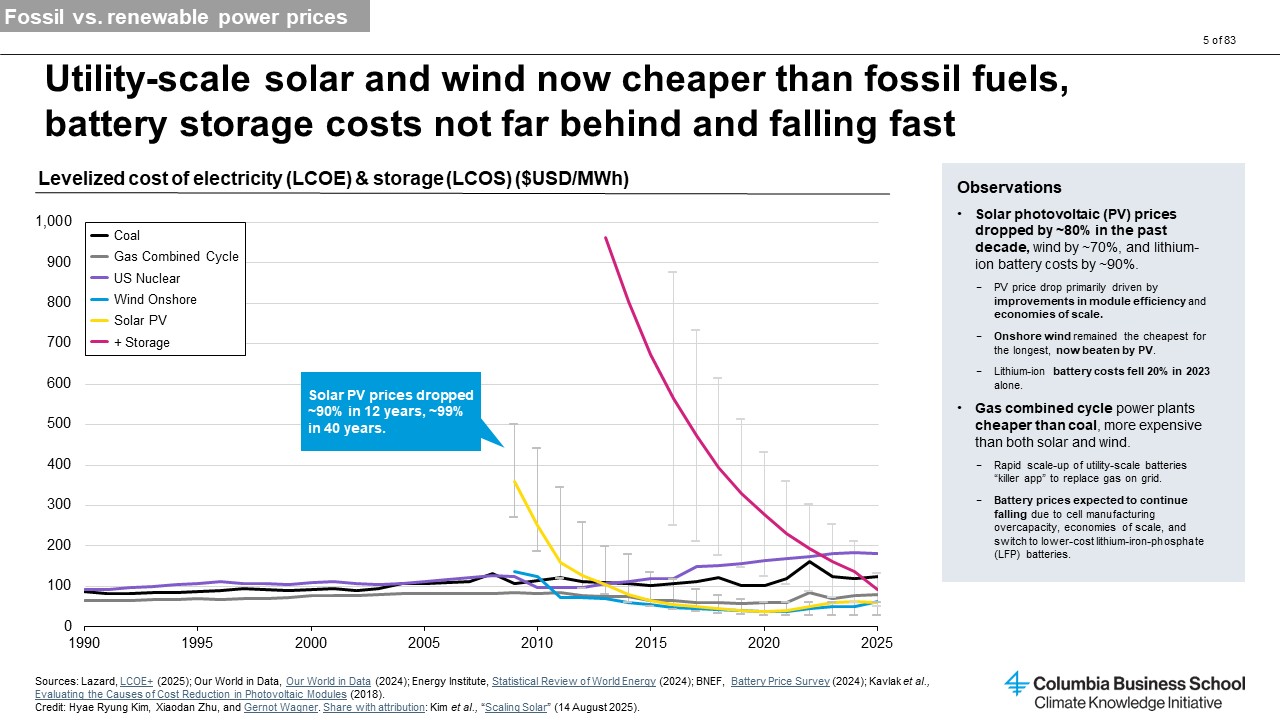
Solar and wind are no longer emerging technologies. They are mature and cost-competitive, and are still getting cheaper. That goes both for solar alone, and for solar plus storage. Lithium-ion battery prices dropped another 50 percent in just the past 18 months.

Solar can compete in the energy markets without the help of subsidies, as long as those energy markets are mature and complemented by robust energy infrastructure. China’s energy reform reflects just such maturity of the sector and echoes a broader trend toward market-driven clean energy policy.

Despite China’s solar dominance, the country is also still building coal capacity, with medium-to-long-term contracts locking in coal generation for decades to come. China’s push toward renewables and move toward market-driven energy policies does not absolve it of the need to price the negative carbon and broader pollution externalities of fossil energy.

Learn more about Columbia Business School’s Climate Knowledge Initiative: Solar

We thank Nicolas Herrera Isaza and Brenda Rain for research and analysis supporting this article.

Image removed.

About the Researcher(s)

Gernot Wagner

Gernot Wagner

Senior Lecturer in Discipline of Economics in the Faculty of Business
Economics Division
Faculty Director, Climate Knowledge Initiative
Tamer Institute for Social Enterprise and Climate Change
Faculty Fellow
CESifo
Board Member
CarbonPlan
Columnist
Project Syndicate
Senior Fellow
Jain Family Institute

You Might Like

Climate and Solutions, Climate and Technology, Climate Knowledge Initiative, Solar
Date
June 11, 2025
Workers installing solar panels
Climate and Solutions, Climate and Technology, Climate Knowledge Initiative, Solar

Trump Wants U.S. Energy Dominance; Solar Is the Way to Get There

Despite the administration’s push for fossil fuels, solar is faster, cheaper, more stable, and increasingly American-made. Here’s why it’s the smartest path to true energy leadership.
  • Read more about Trump Wants U.S. Energy Dominance; Solar Is the Way to Get There about Trump Wants U.S. Energy Dominance; Solar Is the Way to Get There
Business and Society, Climate and Solutions, Climate and Technology, Energy, Energy Solutions, Solar
Date
March 24, 2025
Solar rooftop panels in Texas
Business and Society, Climate and Solutions, Climate and Technology, Energy, Energy Solutions, Solar

How States Like Texas Are Driving the Clean Energy Boom in the Trump Era

Despite federal rollbacks, both red and blue states are using federal and state incentives to drive investment and upgrade energy infrastructure.Download Deck PDFDownload Deck PPT
  • Read more about How States Like Texas Are Driving the Clean Energy Boom in the Trump Era about How States Like Texas Are Driving the Clean Energy Boom in the Trump Era
Climate and Policy, Climate and Solutions, Climate and Technology
Date
August 11, 2025
Worker building photovoltaic solar panel system on rooftop of house.
Climate and Policy, Climate and Solutions, Climate and Technology

Climate Security Is Energy Security

If political conditions in the United States and elsewhere require a rebranding of technologies formerly known as “climate tech,” so be it. The larger economic, technological, and geopolitical forces propelling everyone toward cleaner energy remain as strong as ever.
  • Read more about Climate Security Is Energy Security about Climate Security Is Energy Security
Climate and Finance, Climate and Policy, Climate and Solutions, Climate and Sustainability
Date
July 23, 2025
CBS Article Magazine Image
Climate and Finance, Climate and Policy, Climate and Solutions, Climate and Sustainability

Trailblazers of the Climate Economy

Columbia Business School entrepreneurs are charting new territory in climate innovation. These pioneers are forging bold solutions, driving growth, scaling impact, and reshaping the path to a sustainable future.
  • Read more about Trailblazers of the Climate Economy about Trailblazers of the Climate Economy
Energy, Energy Solutions, Energy Transition
Date
February 04, 2025
White windmill photo – Free Energy Image Photo by Abby Anaday on Unsplash.
Energy, Energy Solutions, Energy Transition
Press Release

Green Energy Means More Green for American Workers

New Research finds Transition to Wind and Solar Energy Predicted to Lower Electricity Costs by Up to 80% and Increase Wages Nationwide
  • Read more about Green Energy Means More Green for American Workers about Green Energy Means More Green for American Workers
Save Article

Download PDF

More to Explore
Share
  • Share on Facebook
  • Share on Threads
  • Share on LinkedIn
Official Logo of Columbia Business School

Columbia University in the City of New York
665 West 130th Street, New York, NY 10027
Tel. 212-854-1100

Maps and Directions
    • Centers & Programs
    • Current Students
    • Corporate
    • Directory
    • Support Us
    • Recruiters & Partners
    • Faculty & Staff
    • Newsroom
    • Careers
    • Contact Us
    • Accessibility
    • Privacy & Policy Statements
Back to Top Upward arrow
TOP

© Columbia University

  • X
  • Instagram
  • Facebook
  • YouTube
  • LinkedIn

External CSS

Homepage Breadcrumb Block