
In sectors and regions across the world, intensifying climate risks threaten to outpace society’s capacity (or willingness) to respond. During Climate Week NYC 2025, Eurolife FFH chief executive Alexander Sarrigeorgiou told an audience gathered in Columbia Business School’s Cooperman Commons that in Europe today, only 25 percent of economic losses are insured against climate perils. That means 75 percent percent of those losses will be borne by an unprepared society, emphasized the head of the Greek insurance group.
This stark warning emerged as one theme across the week of panel discussions and presentations hosted by Columbia Business School in close partnership with the Tamer Institute for Social Enterprise and Climate Change. For their part, leaders from heavy industry noted that the production of foundational materials like cement and steel account for nearly 20 percent of global emissions, and remain some of the hardest-to-abate sectors because of real barriers that will only be lifted by new and creative approaches to scaling.
In the same vein, investors pointed to the dire funding gap looming like a pothole on the road to net zero.
“We’re falling behind not only in terms of meeting the targets around climate change, but we’re falling behind on climate finance as a whole, at a time when urgency and scale are needed more than ever before,” said Daniel Weiss, co-founder and managing partner of Angeleno Group, a firm that invests growth capital in clean energy and climate solutions companies. He added that societies will need to spend roughly $250 trillion to achieve net zero by 2050, leaving a shortfall in current spending of about $3.5 trillion a year.
Still, over the several days of Climate Week discussions, the assembled business leaders, technologists, investors, and educators agreed on reasons for optimism, too: climate-positive innovations are demonstrating they can find paths to cost parity — and, therefore, broader adoption — and they’re forging the partnerships necessary to get there.
CBS’s Climate Week events yielded three main takeaways:
1. Climate-smart solutions stick when the price is right — and patience has run out on “green premiums.”
Panelists across insurance, industry, finance, and technology agreed that across a backdrop of policy uncertainty and geopolitical tension, it’s more important than ever to double down on what’s always been true: “Sustainability progress happens when it makes economic sense,” said Amanda Rohrer, a principal at Blackhorn VC.
Promisingly, game-changing solutions in the hard-to-abate sectors of steel and cement production are moving closer toward business models that will allow them to offer their lower-emissions products at prices competitive with their traditional counterparts, explained Maria Persson Gulda, founding CTO of green-steel maker Stegra and Simon Brandler, vice president of policy and public affairs at low-carbon cement start-up Brimstone. As a show of confidence in this future cost parity, Mercedes is an early buyer of Stegra’s clean steel and the Amazon Climate Pledge Fund took an early stake in Brimstone’s low-emissions cement — not out of charity, but to lock in future supply.
Similarly investors in climate solutions insist that they’re sticking with the sector not out of pure commitment to impact but because their economic forecasting continues to suggest a bright future ahead for the right companies within the sector.
Weiss, of the Angeleno Group, acknowledged that while venture capital funding has dropped over the past two years, it’s important to zoom out and notice the larger trend: the decade between 2013 and 2023 saw a “massive super-cycle” of VC investment in climate tech — from $2 billion per year to $50 billion per year, which is a growth factor of 25x.
“Why is that relevant now, in 2025?” Weiss asked. “Because the seeds of innovation were planted by climate-tech VC, and, ironically, some of those seeds are growing in the very moment when this sector is profoundly out of favor.”
The current political and funding climate also create opportunities to back founders able to weather tough cycles, the investor agreed.
“At the end of the day, we’re backing entrepreneurs who are super steadfast in solving these problems, so they’re going to adapt no matter what the policy landscape is,” said Eliza Cushman ’23, partner at Congruent Ventures.
2. AI looms formidable as both a climate risk and as part of the solution.
The promise and peril of AI was a theme woven through nearly every panel discussion during CBS’s Climate Week, alternately as an enabler as a solution and a challenge to be contended with.
Sarrigeorgiou, CEO of Eurolife FFH, said that for insurers like his company, AI holds great promise as a means to lower premiums, expand protection, and improve fraud detection. After all, one of the most important tasks before an insurer is pricing risk accurately, which AI allows the company to do in much more precise and individualized ways.
“I think with the help of AI and other technologies that may come, risk will be very individualized,” Sarrigeorgiou said. “It takes into account my resilient home, my behavior, and it will be cheaper. I will have incentive to get insured.” He added that he’s optimistic that the “protection gap” — that chasm between who’s insured and who ought to be — can begin to narrow with the help of this AI-enabled approach to pricing.
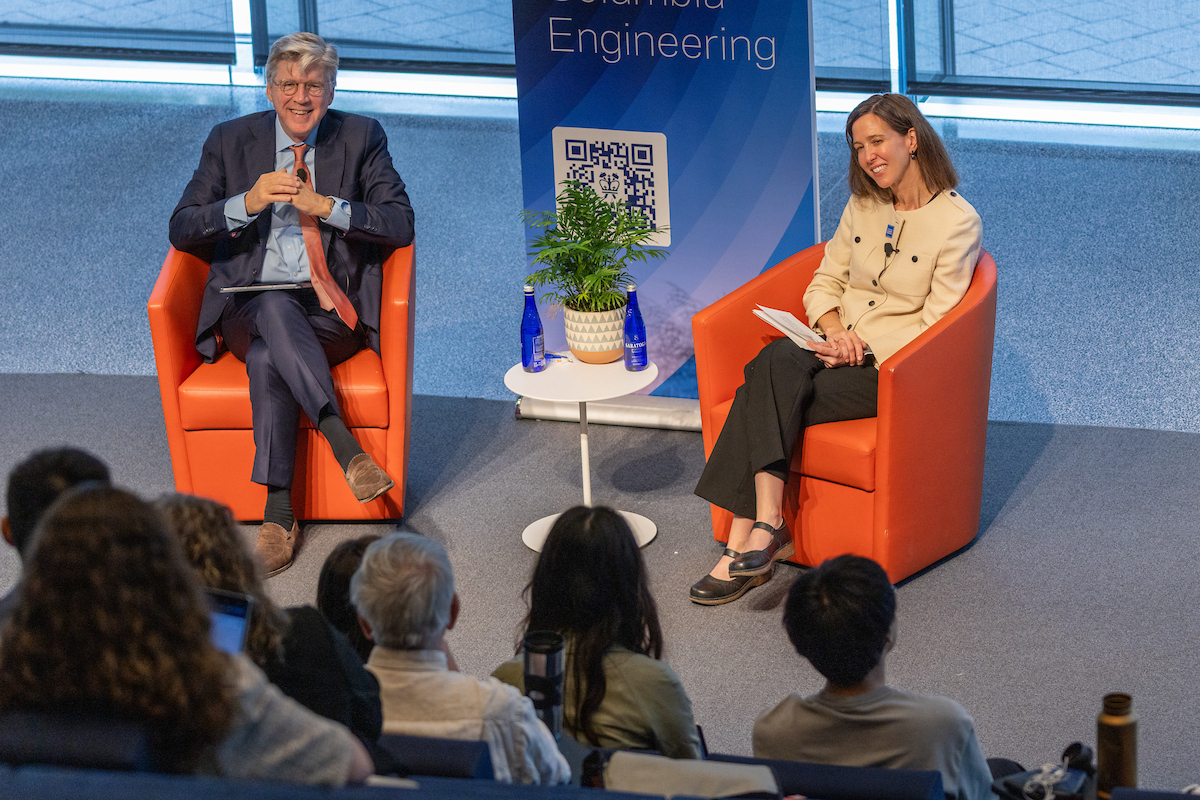
Investors like Blackhorn VC’s Rohrer said that when it comes to climate-saving solutions ushered in by AI, she’s most excited about “physical AI” — that is, the use of smart sensors embedded in physical things, like machines and robots.
“We think in 2026 and 2027, as AI models and agents are trained with better, more vertically-specific data sets, we'll begin to see the jump to AI autonomy and AI decision-making, which opens the door for physical AI that combines sensors, intelligent models, and robotic actuators that can perceive, reason, and act in real-world environments,” Rohrer said. Such solutions could be used to improve outdated power grids, for example, by using physics-informed AI to construct digital twins of the grid to understand what’s happening live.
At the same time, we can’t ignore the fact that the energy appetite of AI data centers is skyrocketing, warned Micheal Intrator, CEO and co-founder of AI cloud-computing company CoreWeave. The challenge is to ensure that AI reduces more emissions than it drives.
“We are seeing unbelievable improvements in the technology for computational power,” said Intrator. “It’s faster, it’s more energy efficient, the cooling has moved from air to liquid, which has caused a 60 percent decrease in energy. The strides are phenomenal.” Still, he added, the energy appetite is moving even more quickly than these improvements.
“The total energy being consumed is obviously roofing. We think about that as holistically as possible” – and the company is continuing to find ways to make the technology and its data centers even more efficient, he said.
In his conversation with Intrator, CBS Dean Costis Maglaras agreed that the tension presented by AI’s rapidly improving capabilities and its energy appetite will be one to monitor closely and carefully, always with an eye on climate goals.
“Aligning innovation in AI systems with climate responsibility will be critical,” Maglaras said.
3. Partnerships across sectors are essential to scale solutions.
Experts echoed the refrain that no single actor — whether governments, corporates, insurers, tech innovators, or investors — can drive decarbonization alone.
In fact, panelists agreed that the best outcomes appear to derive from actors partnering across as many of these sectors as possible.
Weiss of the Angeleno Group pointed to the effectiveness of what he called the “bump-set-spike” model: disruptive science (perhaps from a university lab) is nurtured by public-sector support and/or policy, and is scaled by private-sector funding. Take the catalytic converter as an example, he said: the technology spun out of CalTech, was bolstered when the California state legislature regulated auto emissions, and then major automotive companies did the work of scaling it.
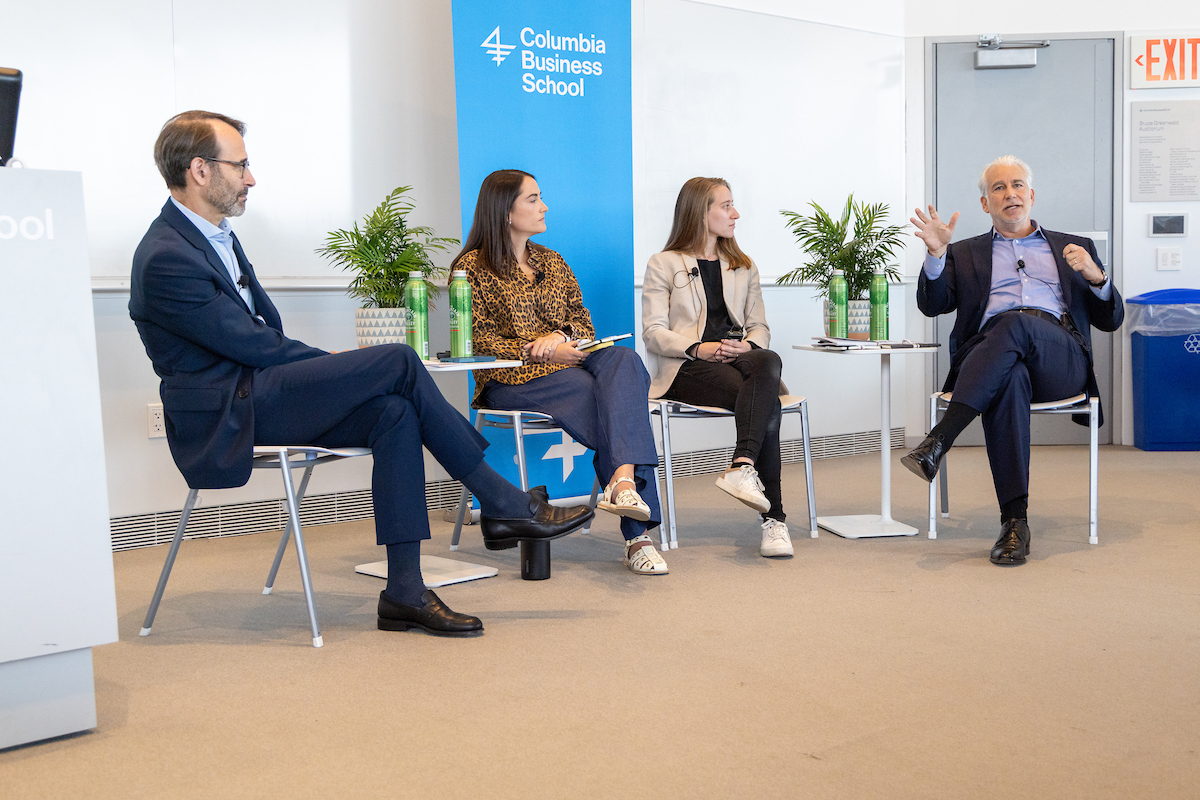
Public-private partnerships will be the likely answer to many wide-ranging solutions of this type, agreed Eurolife FFH’s Sarrigeorgiou. In the world of insurance, too, neither the public nor private sector can act alone. He celebrated an insurance partnership model in Spain, Consorcio de Compensación de Seguros (CCS), where a mandatory surcharge on most insurance policies funds a public body that covers damage from major climate-related disasters.
“The insurance industry in Spain has the money set aside on behalf of the government through [the CCS],” said Sarrigeorgiou. “That translates into a very fundamental concept, which is, if I'm a politician or if I'm in a society, do I want to set aside money for the stronger storms that we know are happening, or do I want to scramble after the event?”
The promise of partnerships can apply exclusively within the private sector too, where major incumbents can be a lifeline for leading-edge startup solutions. Mercedes’ stake in Stegra and Amazon’s commitments to Brimstone.
Gulda, founding CTO of low-carbon iron and steel producer Stegra, said that “partnerships” may be the most important word in her company’s past and future.
“The way that Stegra started was partnerships,” she said. “In order to make investments in the very beginning, to earn credibility – but also with a lot of these customer off-takes. All of that was done from partnerships.”
Going forward, she also thinks Stegra stands to partner with traditional steelmakers, to make the low-carbon iron necessary as an input for steel production.
Collaboration is also opening new doors in climate education within higher education. One panel delved deep into the Open Climate Curriculum, a platform launched by CBS to share teaching materials across institutions and thereby accelerate education on climate change.
Cornelius Pieper, managing director and senior partner at BCG, echoed many panelists' sentiments during Climate Week when he emphasized that the shrewdest corporate players understand that forging these climate-smart partnerships represents much more than virtuous green-signaling; they’re taking a stake in where the future is headed.
“This is not about ‘being green,’” Pieper said, “this is about strategy. And if you want to retain your competitiveness for the next 5 to 10 years, or even the next 3 to 5 years, you’d better get on this train.”
FAQs
Q: What were the key takeaways from Columbia Business School’s Climate Week 2025?
A: The main takeaways were that climate risks are accelerating faster than society’s response, AI poses both opportunities and energy challenges, and cross-sector partnerships are essential for scaling climate solutions.
Q: How does AI impact climate change according to CBS Climate Week discussions?
A: Speakers noted that AI can help insurers, investors, and industry improve efficiency and reduce emissions, but its rapidly growing energy demand could offset progress unless aligned with climate goals.
Q: Why are partnerships critical for climate action?
A: Panelists stressed that governments, corporations, investors, and innovators must work together. Public-private models and corporate-startup collaborations are vital to scaling technologies like clean steel, low-carbon cement, and grid innovations.