Official Logo of Columbia Business School
Academics
  • Visit Academics
  • Degree Programs
  • Admissions
  • Tuition & Financial Aid
  • Campus Life
  • Career Management
Faculty & Research
  • Visit Faculty & Research
  • Academic Divisions
  • Search the Directory
  • Research
  • Research Resources
  • Teaching Excellence
Executive Education
  • Visit Executive Education
  • For Organizations
  • For Individuals
  • Program Finder
  • Online Programs
  • Certificates
About Us
  • Visit About Us
  • CBS Directory
  • Events Calendar
  • Leadership
  • Our History
  • The CBS Experience
  • Newsroom
Alumni
  • Visit Alumni
  • Update Your Information
  • Lifetime Network
  • Alumni Benefits
  • Alumni Career Management
  • Women's Circle
  • Alumni Clubs
Insights
  • Visit Insights
  • AI & Transformative Tech
  • Climate
  • Business & Society
  • Entrepreneurship
  • Finance & Investing
  • Magazine

The Future of Work and Real Estate

Watch Columbia Business School Professor Stijn Van Nieuwerburgh describe his research into the impact of remote work on the commercial office sector, and the seismic economic challenges brought about by the work-from-home revolution.

Published
October 5, 2023
Publication
Finance and Investing
Category
Thought Leadership
Topic(s)
Entrepreneurship and Innovation, Real Estate

About the Researcher(s)

Photo of Professor Stijn Van Nieuwerburgh

Stijn Van Nieuwerburgh

Earle W. Kazis and Benjamin Schore Professor of Real Estate
Finance Division
Earle W. Kazis and Benjamin Schore Professor of Real Estate
Paul Milstein Center for Real Estate
Co-Director
Paul Milstein Center for Real Estate

0%

In the video above, Columbia Business School Professor Stijn Van Nieuwerburgh describes his research into the impact of remote work on the commercial office sector, and the seismic economic challenges brought about by the work-from-home revolution.

The COVID-19 pandemic triggered a remote work revolution that is transforming cities and the commercial real estate market.

With only 5 percent of office work done from home pre-pandemic, now approximately half of office worker days are remote, according to Columbia Business School Professor Stijn Van Nieuwerburgh. This dramatic shift in location flexibility has led to plummeting demand for office space.

Professor Van Nieuwerburgh's research shows leasing revenues have already dropped around 19 percent since early 2020, and only one-third of office leases have come up for renewal so far. With vacancy rates at all-time highs, his analysis finds a stunning 40 percent value decline for New York City's office stock, mirrored in many other U.S. cities.
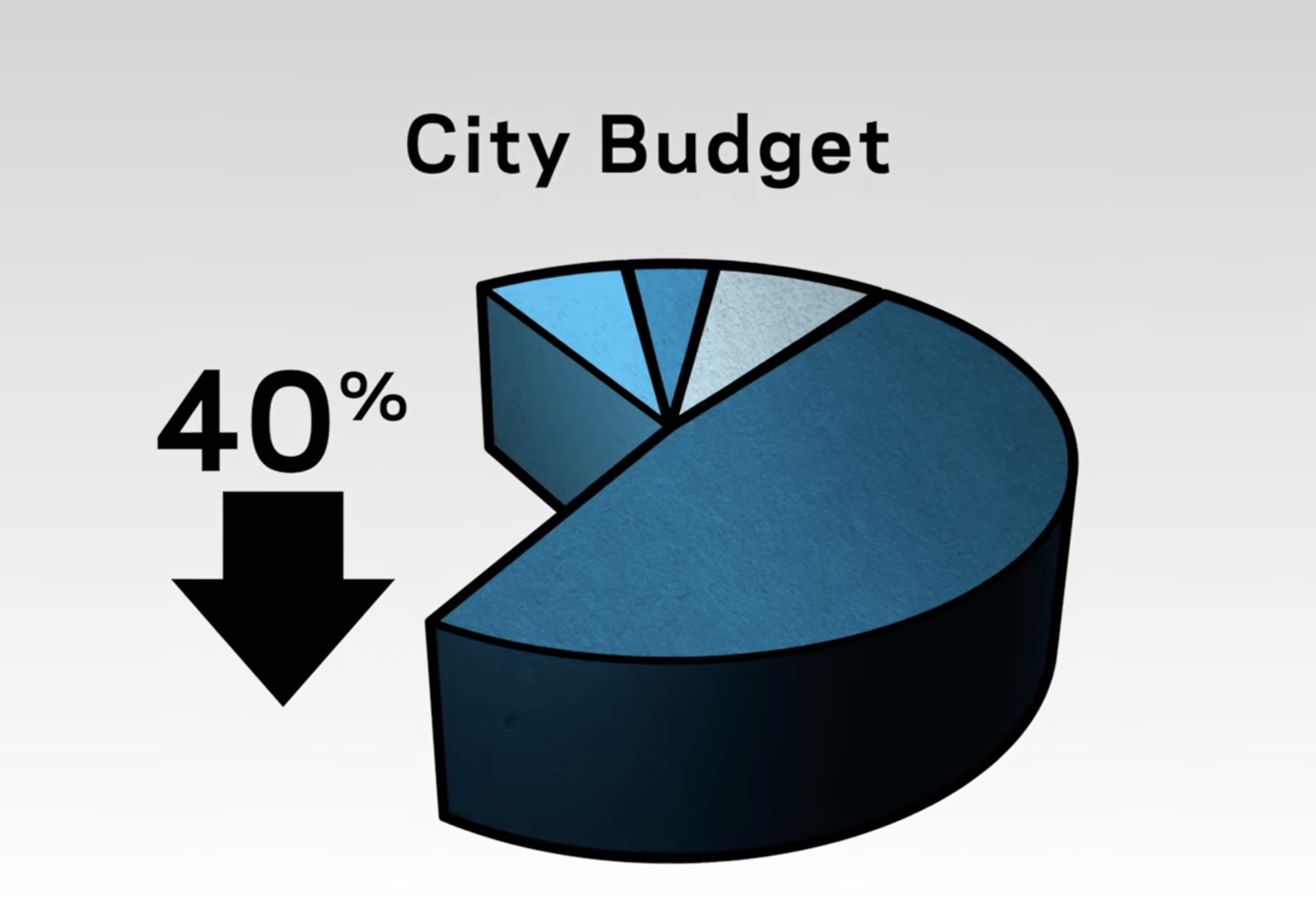
Pie chart of city budget

What does this mean for urban economies?

With cities reliant on property taxes for budget revenue, Professor Van Nieuwerburgh warns falling property values could prompt a dangerous "doom loop." Lower tax income would force cities to either raise other taxes or cut spending on services like education and infrastructure. This urban decline would then deter residents and accelerate office vacancy, requiring even more tax hikes and service cuts—a downward spiral.

However, Professor Van Nieuwerburgh points to a promising solution in converting obsolete offices into much-needed housing.

While not all spaces allow for residential retrofits, pre-war office buildings tend to be prime for conversion. This approach could simultaneously ease the office glut, create housing, and—by upgrading aging structures for sustainability—help the climate.

The work-from-home revolution has sparked a period of profound adaptation for cities, workers, and employers. But as Professor Van Nieuwerburgh's research shows, the flexibility of remote work also presents opportunities to reimagine urban spaces in ways that support resilience, equity, and quality of life.

About the Researcher(s)

Photo of Professor Stijn Van Nieuwerburgh

Stijn Van Nieuwerburgh

Earle W. Kazis and Benjamin Schore Professor of Real Estate
Finance Division
Earle W. Kazis and Benjamin Schore Professor of Real Estate
Paul Milstein Center for Real Estate
Co-Director
Paul Milstein Center for Real Estate

You Might Like

Business and Society
Type
Finance and Investing
Date
April 17, 2026
Business and Society

The Botanist-Turned-Investor Democratizing Access to Hedge Fund Strategies

Bob Elliott rose from an unlikely background to the C-suite of renowned asset manager Bridgewater Associates. Now, as the Co-Founder of Unlimited Funds, he’s using proprietary machine learning to replicate elite hedge-fund strategies for a fraction of their costs.
  • Read more about The Botanist-Turned-Investor Democratizing Access to Hedge Fund Strategies about The Botanist-Turned-Investor Democratizing Access to Hedge Fund Strategies
Business and Society
Date
March 10, 2026
Photo Image of George Bitar
Business and Society

George Bitar '91 on Private Equity, Entrepreneurship, and the Future of Software

Bitar, Managing Partner of Rho Acceleration, shared insights from more than three decades of experience across private equity, global investing, and board leadership.
  • Read more about George Bitar '91 on Private Equity, Entrepreneurship, and the Future of Software about George Bitar '91 on Private Equity, Entrepreneurship, and the Future of Software
Entrepreneurship, Finance and Economics
Date
March 06, 2026
Four Insights from Alleycon 2026
Entrepreneurship, Finance and Economics

Four Insights from Alleycon 2026

At Columbia Business School’s Alleycon 2026, faculty, founders, and investors argued that in an era of exponential AI and technological acceleration, the biggest risk is hesitation.
  • Read more about Four Insights from Alleycon 2026 about Four Insights from Alleycon 2026
Business and Society, Economics and Policy, Finance, Strategy
Date
February 20, 2026
Shutterstock Rent Index Photo Image
Business and Society, Economics and Policy, Finance, Strategy

What do Cutting-Edge Rent Indices Tell Us About the US CRE Market?

A new rent index methodology from Columbia and CompStak uses detailed lease data to track rent changes for comparable CRE space across locations and over time, avoiding the composition biases that distort traditional measures.Stijn Van NieuwerburghEarle W. Kazis and Benjamin Schore Professor of Real Estate, Finance Division Wayne YuSVP of Data, CompStak
  • Read more about What do Cutting-Edge Rent Indices Tell Us About the US CRE Market? about What do Cutting-Edge Rent Indices Tell Us About the US CRE Market?
Save Article

Download PDF

More to Explore
Share
  • Share on Facebook
  • Share on Threads
  • Share on LinkedIn
Official Logo of Columbia Business School

Columbia University in the City of New York
665 West 130th Street, New York, NY 10027
Tel. 212-854-1100

Maps and Directions
    • Centers & Programs
    • Current Students
    • Corporate
    • Directory
    • Support Us
    • Recruiters & Partners
    • Faculty & Staff
    • Newsroom
    • Careers
    • Contact Us
    • Accessibility
    • Privacy & Policy Statements
Back to Top Upward arrow
TOP

© Columbia University

  • X
  • Instagram
  • Facebook
  • YouTube
  • LinkedIn

External CSS

Homepage Breadcrumb Block