Official Logo of Columbia Business School
Academics
  • Visit Academics
  • Degree Programs
  • Admissions
  • Tuition & Financial Aid
  • Campus Life
  • Career Management
Faculty & Research
  • Visit Faculty & Research
  • Academic Divisions
  • Search the Directory
  • Research
  • Research Resources
  • Teaching Excellence
Executive Education
  • Visit Executive Education
  • For Organizations
  • For Individuals
  • Program Finder
  • Online Programs
  • Certificates
About Us
  • Visit About Us
  • CBS Directory
  • Events Calendar
  • Leadership
  • Our History
  • The CBS Experience
  • Newsroom
Alumni
  • Visit Alumni
  • Update Your Information
  • Lifetime Network
  • Alumni Benefits
  • Alumni Career Management
  • Women's Circle
  • Alumni Clubs
Insights
  • Visit Insights
  • AI & Transformative Tech
  • Climate
  • Business & Society
  • Entrepreneurship
  • Finance & Investing
  • Magazine

Why Lower Interest Rates Might Cool Inflation Instead of Fueling It

As the Fed considers a September rate cut, new Columbia Business School research shows that lower interest rates may reduce rents, cooling one of the biggest drivers of U.S. inflation.

Published
September 3, 2025
Publication
Milstein Center
Focus On
Business & Society, Economy & Policy, Finance, Real Estate
Jump to main content
Article Author(s)
Boaz Abramson

Boaz Abramson

Assistant Professor of Business
Finance Division
Federal Reserve Chair Jerome Powell

Federal Reserve Chair Jerome Powell

Category
Thought Leadership
In Collaboration With
Milstein Center for Real Estate
Topic(s)
Economics and Policy, Finance, Finance and Economics, Real Estate

About the Researcher(s)

Boaz Abramson

Boaz Abramson

Assistant Professor of Business
Finance Division

0%

All eyes are on the September Federal Open Market Committee meeting. At his Jackson Hole, Wyoming, speech, Federal Reserve Chair Jerome Powell opened the door to a potential rate cut, indicating that deteriorating labor market conditions might warrant a change in the Fed’s policy stance. Markets reacted strongly to the dovish comments: the Dow, S&P 500, and Nasdaq all surged, while Treasury yields plummeted. However, many economists, including Fed officials, are wary of cutting rates at a time when inflation is still well above its 2 percent target. Indeed, despite high interest rates, inflation remains stubbornly above what the Fed would like it to be. Powell himself stressed the need to "proceed carefully" given the continued inflationary risks.
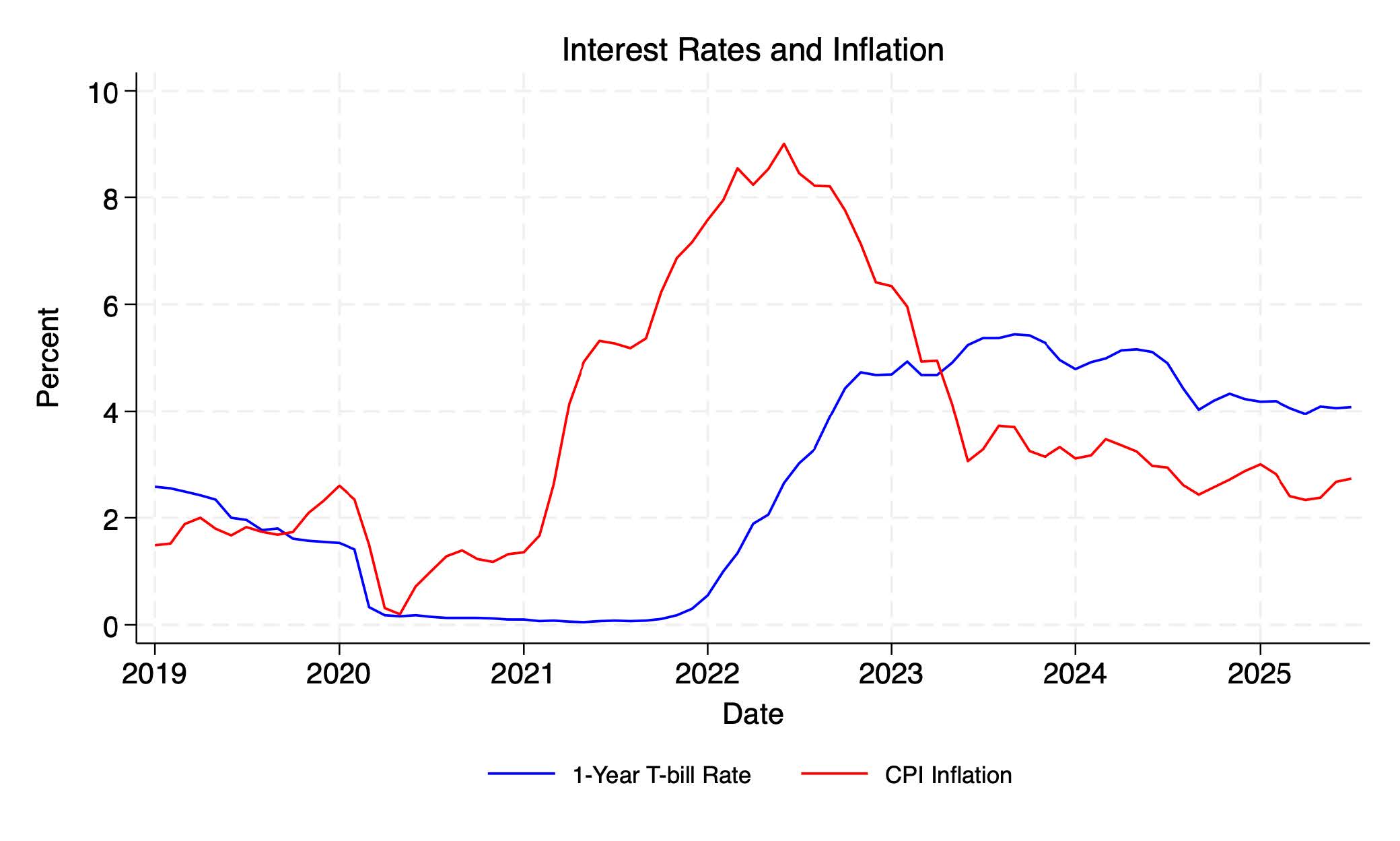
Interest rates and inflation
Figure 1, above, plots the yield on the 1-year T-bill (in blue) and the annual inflation rate according to the Consumer Price Index (in red). 


A key component of overall inflation is rent. The consumer price index (CPI), which is compiled by the Bureau of Labor Statistics (BLS) and tracks price movements of a representative basket of goods and services, is composed of eight major components. The shelter component, which measures the cost of housing, is the largest component and accounts for roughly 35 percent of the CPI. The CPI shelter index reflects the price of housing for both renters and homeowners but, importantly, is based entirely on rental data. The cost of housing for owner-occupiers is measured as the rent that homeowners would have paid had they rented their home and is imputed from BLS rental data as an “owner-equivalent rent.” This means that more than one-third of overall inflation in the U.S. is due to rent inflation. The extent to which interest rate cuts translate into higher inflation therefore crucially depends on how interest rates impact rents. 

The fear is that by lowering interest rates, the Fed may stimulate the economy and increase inflation. The surprising finding in new research from Columbia Business School is that lower interest rates can lower rents instead of increasing them. The study, which I have coauthored with Pablo De Llanos of Columbia University and Lu Han of University of Wisconsin, finds that a 0.25 percentage point drop in the 30-year fixed mortgage rate leads to a 1.4 percent decrease in nominal rents and a 1.6 percent decrease in real rents. In other words, by lowering rents, expansionary monetary policy can actually cool inflation. 
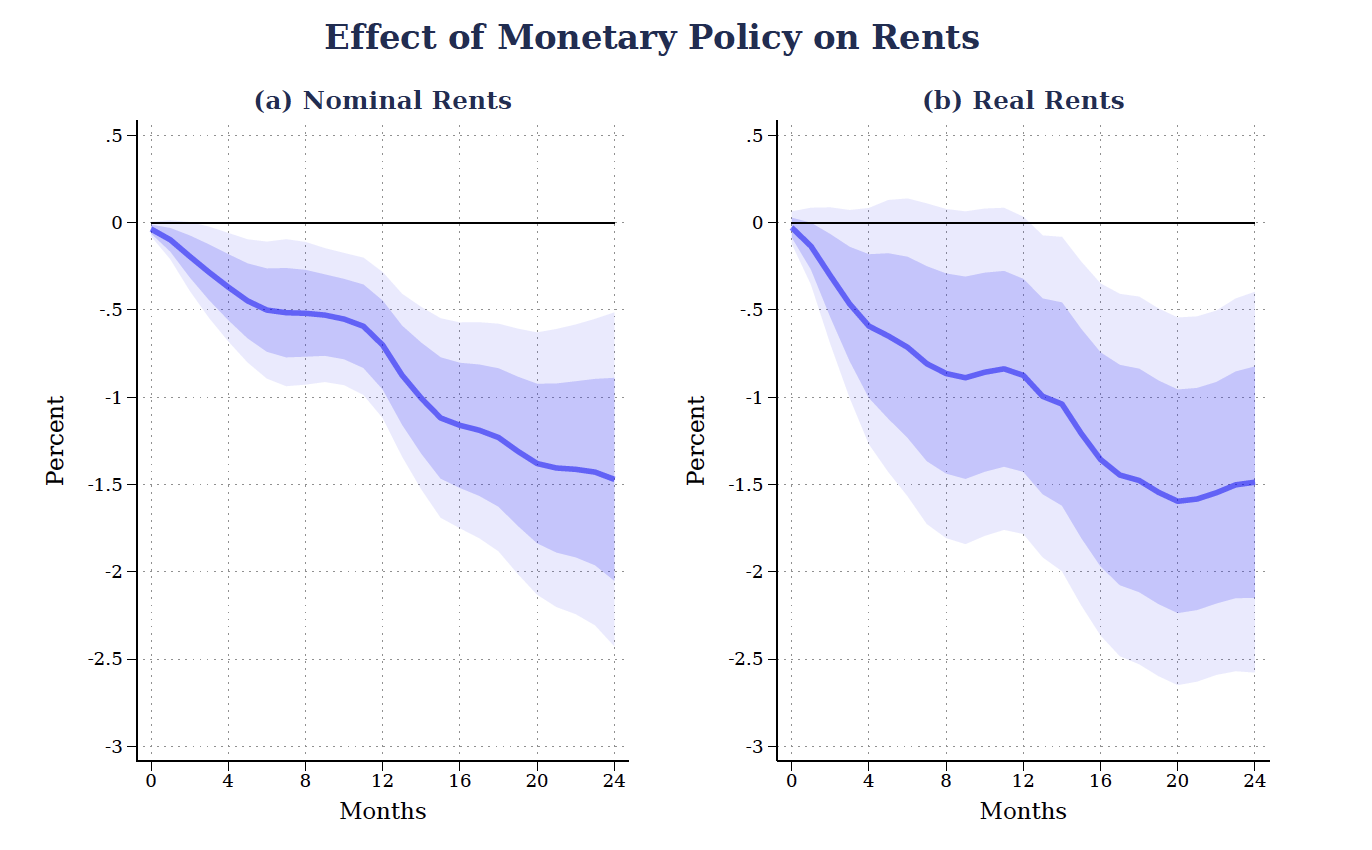
Monetary policy and rents
Figure 2, above, shows the effect of a 25 basis points decrease in the 30-year fixed rate mortgage on nominal rent inflation (a) and real rent inflation (b), 0-24 months following the expansionary monetary policy shock. Shaded areas represent confidence intervals. Nominal rent inflation is measured according to the ADH Repeat-Rent Index (Abramson, De Llanos, Han, 2025). Real rent inflation is measured as nominal rent inflation deflated by the non-shelter CPI inflation. 


Why do rents drop in response to expansionary monetary policy? When interest rates drop, borrowing becomes less expensive, making it easier for many households — especially first-time and lower-income buyers — to purchase homes. As a result, more people exit the rental market, lowering demand for rental housing and placing downward pressure on rents. Our results show that as demand for owner-occupied housing increases and demand for rental housing drops, real estate investors sell homes to owner-occupier households. The homeownership rate increases, house prices increase, and rents decrease. 

To conduct our analysis, we developed a new residential rent index, the ADH Repeat-Rent Index, which measures changes in rent prices over time on a quality-adjusted basis. We compiled a dataset of more than 30 million rental listings, covering over 5,000 ZIP codes across the United States. Using this data, and applying a statistical technique known as local projections, we estimate how rents change in response to monetary policy shocks—unexpected changes in interest rates. Figure 2 illustrates our main results. It plots how a 25-basis-point decrease in the 30-year fixed rate mortgage impacts rent inflation 0-24 months going forward. A drop in mortgage rates lowers nominal rent inflation by 0.7 percent 12 months following the rate cut, and by 1.4 percent 24 months following the cut. In the paper, we also find that following a drop in interest rates, the inventory of rental units increases, and units remain listed on the market for longer. This indicates a drop in demand in the rental market and rationalizes why lower rates lead to lower rents. 

With the next FOMC meeting in sight, policymakers will be monitoring how tariff policies are transmitted into prices and whether deteriorating labor market conditions persist. A key indicator that policymakers should also be tracking is rent inflation. In its most recent July reading, annual rent inflation according to the CPI shelter index was 3.7 percent — well above the Fed’s 2 percent target. Overall inflation might increase if the Fed decides to cut rates, but our analysis shows that expansionary policy can cool rent inflation, softening the blow. 


References: 

Abramson, Boaz, Pablo De Llanos, and Lu Han. 2025. “Monetary Policy and Rents.”  Working paper, Columbia Business School and University of Wisconsin-Madison 

About the Researcher(s)

Boaz Abramson

Boaz Abramson

Assistant Professor of Business
Finance Division

You Might Like

Business and Society, Real Estate, Social Impact
Date
July 29, 2025
New York City skyline
Business and Society, Real Estate, Social Impact

The Mamdani Rent Freeze and Its Impact on New York City’s Multifamily Market

The rent-stabilized multifamily sector, once a bastion of stability, now faces an unprecedented confluence of legislative shifts, political pressures, and capital market turbulence, pushing it to the brink of uninvestability.
  • Read more about The Mamdani Rent Freeze and Its Impact on New York City’s Multifamily Market about The Mamdani Rent Freeze and Its Impact on New York City’s Multifamily Market
Climate and Consumer Behavior, Climate and Policy, Climate and Solutions, Real Estate, Social Impact
Date
January 17, 2025
LA wildfires
Climate and Consumer Behavior, Climate and Policy, Climate and Solutions, Real Estate, Social Impact

Why Home Buyers Ignore the Climate Risk in Danger Zones

The recent wildfires in Los Angeles highlight how suppressed insurance premiums and government policies incentivize Americans to settle in areas with a high climate risk, exacerbating economic and environmental disasters.
  • Read more about Why Home Buyers Ignore the Climate Risk in Danger Zones about Why Home Buyers Ignore the Climate Risk in Danger Zones
Business and Society, Finance, Finance and Economics, Real Estate, Social Impact
Date
January 02, 2025
A for rent sign outside a house
Business and Society, Finance, Finance and Economics, Real Estate, Social Impact

Could Rent Guarantee Insurance Help Solve the Housing Crisis?

Professors Boaz Abramson and Stijn Van Nieuwerburgh investigate whether insurance for missed rent payments could help individuals and the broader economy.
  • Read more about Could Rent Guarantee Insurance Help Solve the Housing Crisis? about Could Rent Guarantee Insurance Help Solve the Housing Crisis?
Climate and Finance, Climate and Policy, Climate and Solutions, Real Estate
Date
July 23, 2025
Jonathan Rose, 2025 Climate Business and Investment Conference
Climate and Finance, Climate and Policy, Climate and Solutions, Real Estate

How Climate Is Reshaping Real Estate

At the 2025 Climate Business and Investment Conference, experts explored how rising temperatures, severe storms, and shifting regulations are reshaping the way we build, invest, and live.
  • Read more about How Climate Is Reshaping Real Estate about How Climate Is Reshaping Real Estate
Real Estate, Research
Date
June 17, 2025
Low angle view of building photo – Photo by Brandon Griggs on Unsplash
Real Estate, Research
Press Release

The Surprising Profits in Affordable Housing

New research from Columbia Business School reveals low-income rental units generate higher returns for landlords – inviting more competition could help lower rents
  • Read more about The Surprising Profits in Affordable Housing about The Surprising Profits in Affordable Housing
Save Article

Download PDF

More to Explore
Share
  • Share on Facebook
  • Share on Threads
  • Share on LinkedIn
Official Logo of Columbia Business School

Columbia University in the City of New York
665 West 130th Street, New York, NY 10027
Tel. 212-854-1100

Maps and Directions
    • Centers & Programs
    • Current Students
    • Corporate
    • Directory
    • Support Us
    • Recruiters & Partners
    • Faculty & Staff
    • Newsroom
    • Careers
    • Contact Us
    • Accessibility
    • Privacy & Policy Statements
Back to Top Upward arrow
TOP

© Columbia University

  • X
  • Instagram
  • Facebook
  • YouTube
  • LinkedIn

External CSS

Homepage Breadcrumb Block