
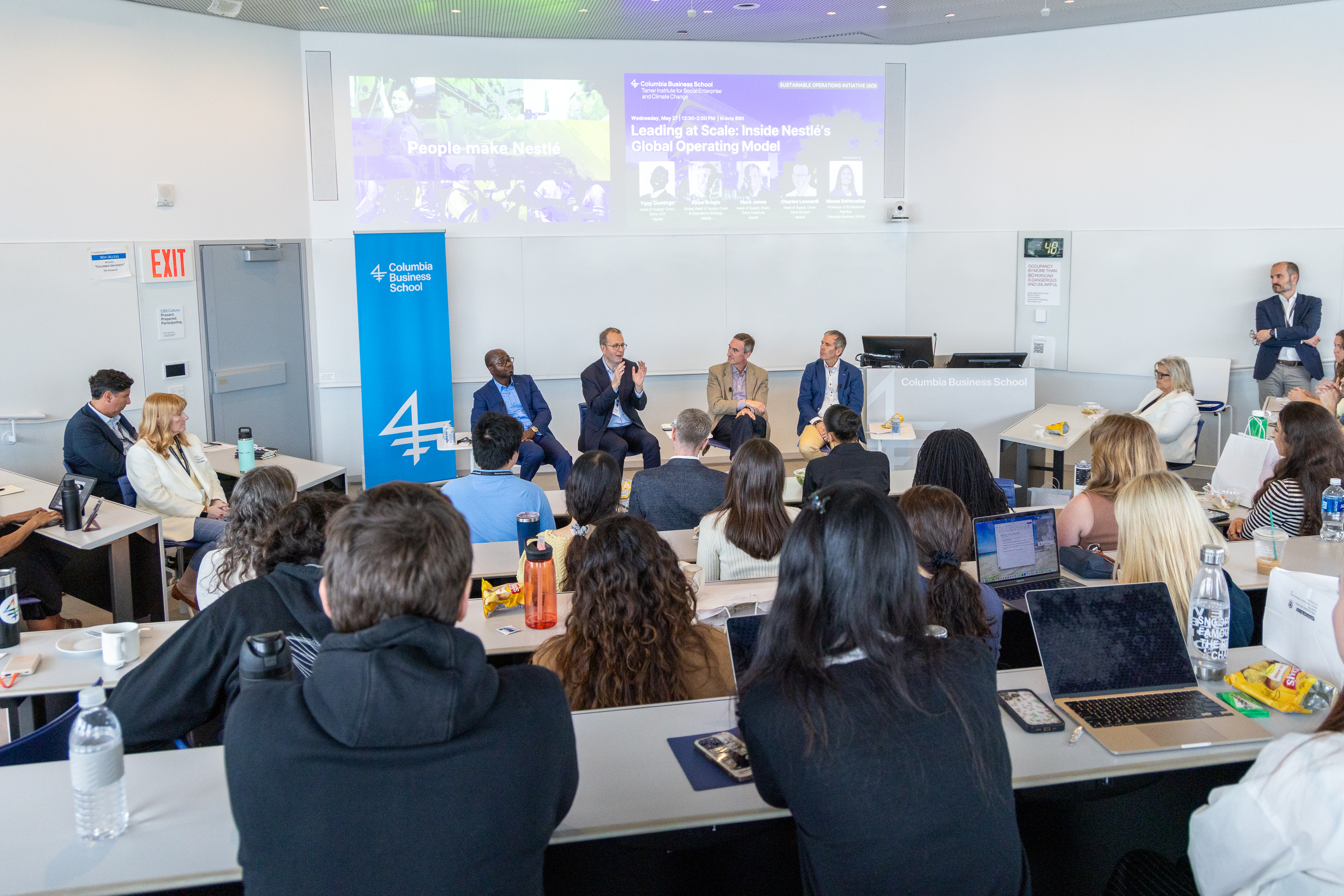
The goal, Aksel Eroglu will tell you, is simple. Nestlé’s Global Head of Supply Chain & Operations Strategy says that every time a shopper walks into a store—or opens an app, or asks a voice assistant to reorder something—a Nestlé product should be there waiting, ready and fresh. That mandate has guided the company's supply chain for at least two decades; it has not changed. “It’s just that it’s getting increasingly complicated to achieve.” Eroglu said at a recent panel hosted by the Tamer Institute for Social Enterprise and Climate Change’s Sustainable Operations Initiative.
The panel brought together four of Nestlé’s top supply chain and operational leaders for a conversation with CBS students about how the world’s largest food and beverage company designs and evolves its operating model. Joining Eroglu were Mark Jones, Head of Supply Chain for Zone Americas; Charles Leonardi, Head of Supply Chain for Zone Europe; and Tony Domingo, Head of Supply Chain for Zone AOA (Asia, Oceania, and Africa). The event was moderated by Professor Nicole DeHoratius, who leads the Sustainable Operations Initiative—an effort that brings together researchers, practitioners, and students to examine how operating decisions drive (or impede) progress on climate and sustainability.
What emerged over the course of the 90-minute discussion was less a corporate showcase than an honest reckoning with complexity. Nestlé’s leaders acknowledged that the questions they raise are the sort that don’t necessarily resolve neatly, and that the next generation of operations leaders will have to confront.
Scale as context
Nestlé sells roughly one billion products every day in 185 countries, manufactured across 335 factories and more than 1,500 co-manufacturers, stored in over 830 distribution centers, and supported by a workforce of more than 150,000 people in operations alone. The company draws on over 130,000 raw and packaging materials from nearly 10,000 raw material suppliers and more than 100,000 service and materials suppliers.
Eroglu emphasized that Nestlé’s complexity is structured, not chaotic. Nestlé operates through a layered organizational model with global, zone, and country-level supply chain leaders, each with distinct responsibilities that are designed to complement, not duplicate, one another. The three zone heads who sat on the panel each oversee supply chains that cut across Nestlé’s many product categories within their regions, reporting to a zone CEO. Below them, every country has its own supply chain head.
Eroglu described the system’s design using a word he returned to often: complementarity.
“It’s impossible for one person to do everything,” he said. “What is important is to define an organization where every layer is clear on their responsibility and how they contribute.” The model is neither purely centralized nor decentralized; it is, in his framing, deliberately both. “The Nestlé supply chain is local, regional, and global,” he said. “It can’t be one or the other.”
Five forces making operations more difficult
Eroglu identified five converging pressures that are steadily intensifying the difficulty of orchestrating Nestlé’s multiple layers and vast scale to achieve the supply chain’s long-term goal: delivering consistently to consumers.
- The proliferation of channels. Consumers no longer just shop at supermarkets, he pointed out. They want products available on demand, online and offline, delivered in hours in some cities and in ten minutes in parts of India. “That’s very complex from a supply chain point of view,” Eroglu said. “It’s one thing to deliver it, and another thing to have a business model that works, because it costs money to do that.”
- Shifting retail formats. Smaller stores are now growing faster than large-format retailers. This is a reversal of the pattern that dominated for years, and one that changes how products need to be packaged, delivered, and replenished.
- Proliferating customization demands. Major retailers increasingly want differentiated assortments; consumer preferences vary sharply across Europe, Asia, and Africa. The challenge is meeting that demand without allowing complexity to spiral into higher costs.
- Geopolitical instability. Tariffs, trade tensions, and economic uncertainty have added a layer of volatility that defies planning efforts. Supply chains designed for efficiency are being stress-tested in ways they were not built to absorb.
- Sustainability. For years, Nestlé balanced three operational imperatives: availability, cost, and working capital. Now a fourth has been added. “You need to manage your cash, and now we’re adding a fourth element: it needs to be sustainable,” Eroglu said. The addition is not cosmetic, he added. It reshapes trade-offs at every level of the chain, from how raw materials are sourced to how finished goods are transported.
Farm to fork, and back again
With this growing complexity comes new conceptions of textbook operational terms. DeHoratius asked the panel to define what “end-to-end” supply chain visibility actually means to Nestlé, and Tony Domingo, Head of Supply Chain in Asia, Oceania, and Africa, acknowledged it’s about a flow of far more than just materials.
“The spirit of end to end is from the farm to chopstick,” he said. “All organizations, all partners are part and parcel of this value chain—from the farmer, from an agricultural point of view, to consumption point. It’s a flow of data. It’s a flow of insights and a flow of physical goods end to end—because once she’s consumed it, I need to know what she’s consuming, why she’s consuming it, why she’s buying from a particular point.”
Charles Leonardi extended the idea in both directions. New channels, like direct-to-consumer and e-commerce, are generating consumer data that flows upstream to inform how products are designed and made. Simultaneously, Nestlé is reaching further back into its supply chain, working directly with farmers rather than just commodity suppliers.
“We can go much more into granularity and understanding from really farm to fork,” he said. For Leonardi, the sustainability dimension of this data revolution is what makes it genuinely exciting.
“We are used to managing physical goods with information flows,” he said. “Now we’ll manage more and more sustainability topics. It is new data, new standards, new ways of working, and probably a new system we’ll have to implement. Twenty-five years ago we were starting with very simple data. Now we can handle much more complex data which, for our planet, is even more important.”
Leonardi offered a concrete example of where that logic leads in practice. Nestlé is now paying farmers to provide data on their fields and practices—not because the company knows exactly what it’s looking for, but because it recognizes that future sustainability decisions will depend on data it does not yet have.
“We don’t know yet what will be the right data to determine the most sustainable upstream supply chain for the future,” he said. “But the more we get data, the more we’ll be prepared.” The priority, he added, is not to drown in analysis but to stay oriented toward a clear north star, and let the models reveal correlations that human planners might never have anticipated.
Sustainability without waiting for permission
An audience member put a pointed question to the panel: given shareholder pressure and the need to remain competitive, how much does Nestlé actually rely on government regulation to drive sustainability—and how active is the company in shaping that regulation?
“We do the two things in parallel,” Leonardi said. There are areas, he explained, where waiting for regulation is not an option, and where the business logic of sustainability is self-evident enough to compel action regardless of what governments require. Soil preservation is one. If the farmland that produces Nestlé’s ingredients degrades, for instance, the company’s factories eventually stop working.
“We have been working with farmers on soil preservation without waiting for any regulation,” he said.
But individual action, however well-intentioned, has limits—especially for a company that may represent only a fraction of any given farmer’s output. Nestlé might purchase ten percent of what a French farmer produces; if the other buyers hold different standards, the farmer faces contradictory incentives and little capacity to invest in transition.
“We need the finance system behind it, the banking system behind it, the right regulation to help this happen,” Leonardi said. “Because we will not be able to do it alone.”
This dual posture—acting unilaterally where the business case is clear, pushing for systemic change where it isn’t—reflects an understanding of what large companies can and cannot accomplish on sustainability. Nestlé’s scale gives it unusual leverage to share what it learns with policymakers.
“We see certain things that can help governments make the right decisions,” Leonardi said. That position comes with responsibility, which these executives take seriously: as the world’s largest food company, Nestlé has an industry-shaping role that extends well beyond its own supply chain.

