

In September 2024, Columbia Business School Professor Modupe Akinola received an unexpected email from the California State Prison at Sacramento. The note, sent by prison psychologist Dr. Michael Milin, was an appeal for help. He asked Akinola to lead a workshop to support the California Department of Corrections and Rehabilitation (CDCR) staff manage their stress through mindfulness, understanding stress responses, and building healthier habits.
“When Dr. Milin reached out to me, I was particularly inspired,” Akinola said. “Here’s a psychologist committed to helping corrections officers and incarcerated individuals with their stress—it felt pressing and meaningful. I teach these skills to students, senior leaders, and global executives, so why not extend this to those who deal with vulnerable populations?”
Akinola, who studies how stress can impact workplace performance and identifies practical interventions that can reduce its negative influence, told Dr. Milin she would be delighted to help.
“I understood some of the challenges Dr. Milin was interested in addressing,” she explained. “My doctoral dissertation focused on the stress experienced by police officers, which gave me a deeper understanding of the daily pressures civil servants encounter.”
After several conversations with Dr. Milin and the CDCR team, Akinola designed a session tailored to the needs of the prison staff.
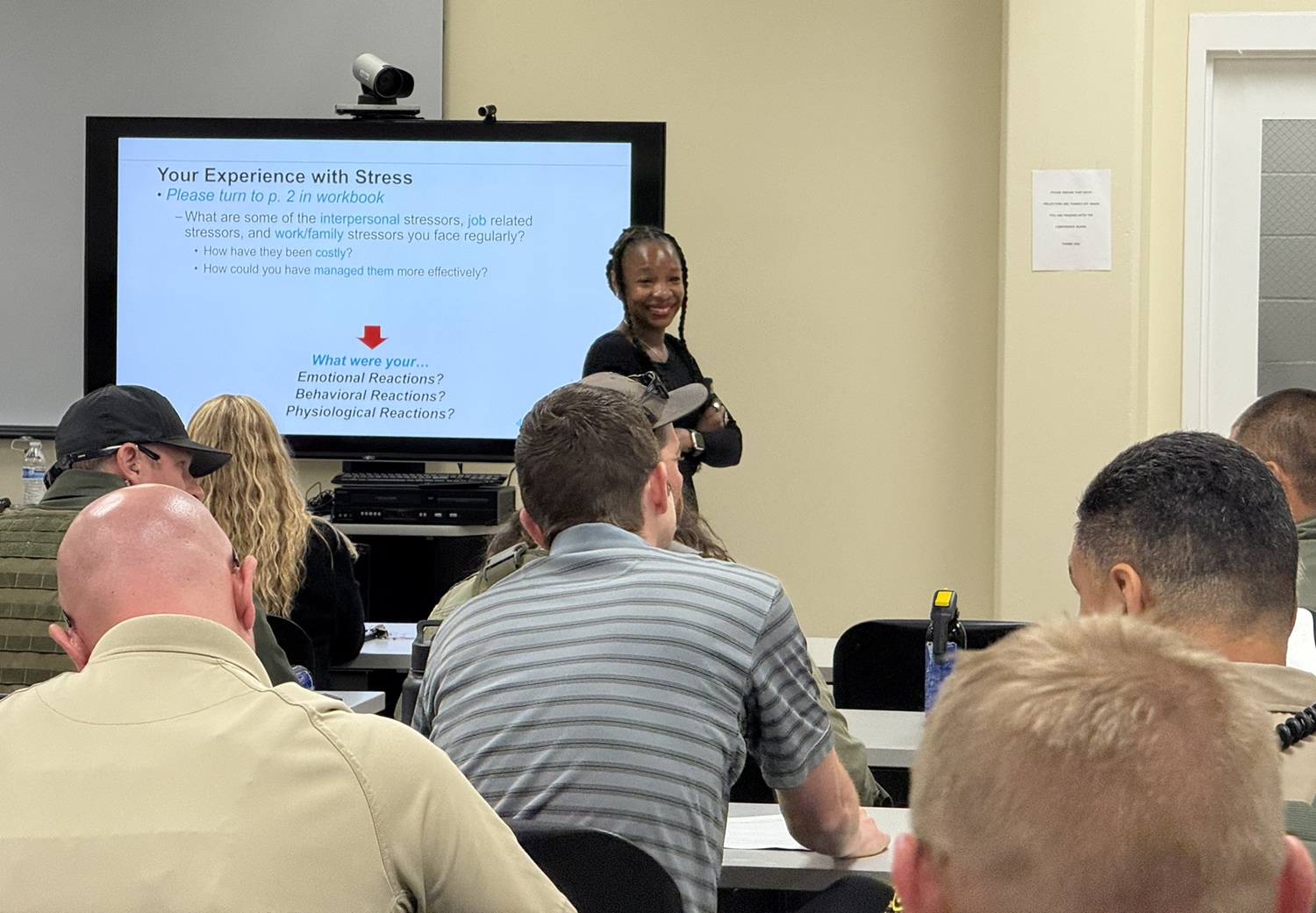
Correction officers often operate in environments marked by unpredictability and danger. While the physical threats are significant, Akinola notes that uncertainty is often the greatest source of stress—whether it’s unexpected double shifts, last-minute emergencies, or personal stressors outside the workplace. This context informed her approach.
Nearly a year after Dr. Milin’s initial outreach, Akinola conducted four workshops focused on harnessing the beneficial properties of stress. Through interactive exercises rooted in psychological research, she encouraged officers to not only acknowledge and get to know their stress, but to welcome it, and, given its ever-present nature, use it to improve their performance and well-being.
“When people are better equipped to manage stress, everyone benefits. The more tools we have to address our stress, the more compassion we can exhibit toward ourselves and others.”
This initiative, jointly sponsored by Columbia Business School’s Bernstein Center for Leadership and Ethics and the Tamer Institute for Social Enterprise and Climate Change, builds on the School’s ongoing commitment to working with the prison system. One of those efforts, the ReEntry Acceleration Program (REAP), trains MBA students to deliver business training to incarcerated individuals, helping them gain skills and employment opportunities upon release. Akinola’s work at CDCR expands this impact, extending support to the staff who supervise and interact with incarcerated individuals every day. This holistic approach addresses the needs of the entire prison system.
“Dr. Akinola’s training provided our staff with practical tools and valuable insights to better understand and manage the stress that comes with working in a high-security environment,” Crystal Alcazar, Health Care Access Associate Warden at California State Prison, Sacramento, said. “SAC is a Level IV institution, and our team faces unique challenges every day. This training helped staff recognize how stress impacts their bodies and minds; and, more importantly, how to use that awareness to their advantage. It reinforced that not all stress is harmful; when managed effectively, it can become a source of motivation and resilience, helping our team not only endure but excel in demanding situations.
After her time at the facility, Akinola began thinking more broadly about working with the institution to implement sustainable, systemic changes.
“Having no control over something like your schedule makes it difficult to develop the habits that help counteract stress, like eating well, sleeping well, and exercising,” she said. “This got me thinking … there must be structural, schedule-related changes that can be adopted by California State Prison at Sacramento to offer greater certainty.”
Looking forward, Akinola hopes to explore longer-term partnerships with institutions like CDCR, to develop customized interventions for the unique challenges corrections officers face.
“When people are better equipped to manage stress, everyone benefits—the staff, the incarcerated population, and the larger system,” said Akinola. “The more tools we have to address our stress, the more compassion we can exhibit toward ourselves and others.”
Modupe Akinola is the the Barbara and David Zalaznick Professor of Business at Columbia Business School and the Faculty Director of the Bernstein Center for Leadership and Ethics.
She blends her experience in the business world with cutting-edge research on the biology of leadership. Professor Akinola explores how stress can impact workplace performance and identifies practical interventions that can reduce its negative influence. She also studies workforce diversity, including the biases that affect the recruitment and retention of women and people of color in organizations.