Official Logo of Columbia Business School
Academics
  • Visit Academics
  • Degree Programs
  • Admissions
  • Tuition & Financial Aid
  • Campus Life
  • Career Management
Faculty & Research
  • Visit Faculty & Research
  • Academic Divisions
  • Search the Directory
  • Research
  • Research Resources
  • Teaching Excellence
Executive Education
  • Visit Executive Education
  • For Organizations
  • For Individuals
  • Program Finder
  • Online Programs
  • Certificates
About Us
  • Visit About Us
  • CBS Directory
  • Events Calendar
  • Leadership
  • Our History
  • The CBS Experience
  • Newsroom
Alumni
  • Visit Alumni
  • Update Your Information
  • Lifetime Network
  • Alumni Benefits
  • Alumni Career Management
  • Women's Circle
  • Alumni Clubs
Insights
  • Visit Insights
  • AI & Transformative Tech
  • Climate
  • Business & Society
  • Entrepreneurship
  • Finance & Investing
  • Magazine

Participating in a Climate Prediction Market Increases Concern About Global Warming

Globally, there is a massive gap between concern for climate change and the support needed to address these concerns, including to meet important sustainability goals. Participation in a climate prediction market—where individuals forecast future climate outcomes and have the opportunity to place bets and earn money along the way—shows promise as a way to change attitudes, knowledge, and behavior related to climate change.

Based on Research by
Moran Cerf, Sandra Matz, Malcolm A. MacIver
Published
September 7, 2023
Publication
Research In Brief
Jump to main content
Article Author(s)
Moran Cerf

Moran Cerf

Academic Director in Executive Education
Executive Education
Photo of Prof. Sandra Matz

Sandra Matz

Lulu Chow Wang Professor of Business
Management Division
A figurine of a tree with coins growing from its branches

Key Takeaways

  • When people participate in a climate prediction market—where they bet on future climate-related outcomes and earn money when they are correct—they become more concerned about climate issues, supportive of climate action, and knowledgeable about climate change.
  • Climate prediction markets can also act as a polling mechanism, helping scientists, activists, and politicians to accurately aggregate public opinion about trends, policy preferences, risks, and future scientific predictions at any point in time.
  • Climate prediction markets offer a way to infuse private money into climate efforts—where money earned through betting can be used to subsidize important policies that help combat climate change.
  • Beyond climate, prediction markets can be used to influence knowledge and understanding of other controversial topics, allowing people to reflect their views, anonymously, through market economics rather than publicly stated opinions.
Category
Thought Leadership

About the Researcher(s)

Moran Cerf

Moran Cerf

Academic Director in Executive Education
Executive Education
Photo of Prof. Sandra Matz

Sandra Matz

Lulu Chow Wang Professor of Business
Management Division

View the Research

Participating in a climate prediction market increases concern about global warming

0%

The paper “Participating in a Climate Prediction Market Increases Concern About Global Warming,” published in June 2023 in the journal Nature Climate Change, explores how individual participation in climate prediction markets influences attitudes and knowledge about climate change. The study was co-authored by Moran Cerf and Sandra C. Matz of Columbia Business School and Malcolm A. MacIver of Northwestern University.

Research

Climate change is one of the most pressing issues of our time. However, modifying individual and collective attitudes and behaviors related to climate change is extremely challenging in a world where the subject is increasingly politicized. Many previous attempts have achieved only limited success. One of the challenges in comprehending the potential magnitude of climate change has to do with a limitation of the human brain: We often find it difficult to contemplate events that may occur in the distant future. Further, for many people, there is no immediate cost to rejecting climate change’s existence.

This research explores whether participation in a climate prediction market can shift people’s attitudes on climate change. The market encourages individuals to make bets on future climate-related events, effectively putting their money where their mouth is with respect to their views about climate change.

Across two studies, research participants bet on the out- comes of various climate events that dominated the news, such as the magnitude of the California wildfires, as well as lesser known topics like changes in the Air Quality Index (AQI). The researchers surveyed participants’ views on climate change before and after their engagement with the climate market to see how the betting experience influenced their views and knowledge.

Results

The research demonstrates that engaging in a climate prediction increases:

  • Concern about the consequences of climate change
  • Support for direct and indirect climate action
  • Knowledge about climate change

While the effects were dependent on the extent to which people were successful in their betting in the smaller pilot study, they equally applied to all participants—irrespective of earnings—in the larger, more robust study.

Notably, the effects not only held true regardless of participants’ success in the market, but also regardless of their political ideology or initial stance on climate change.
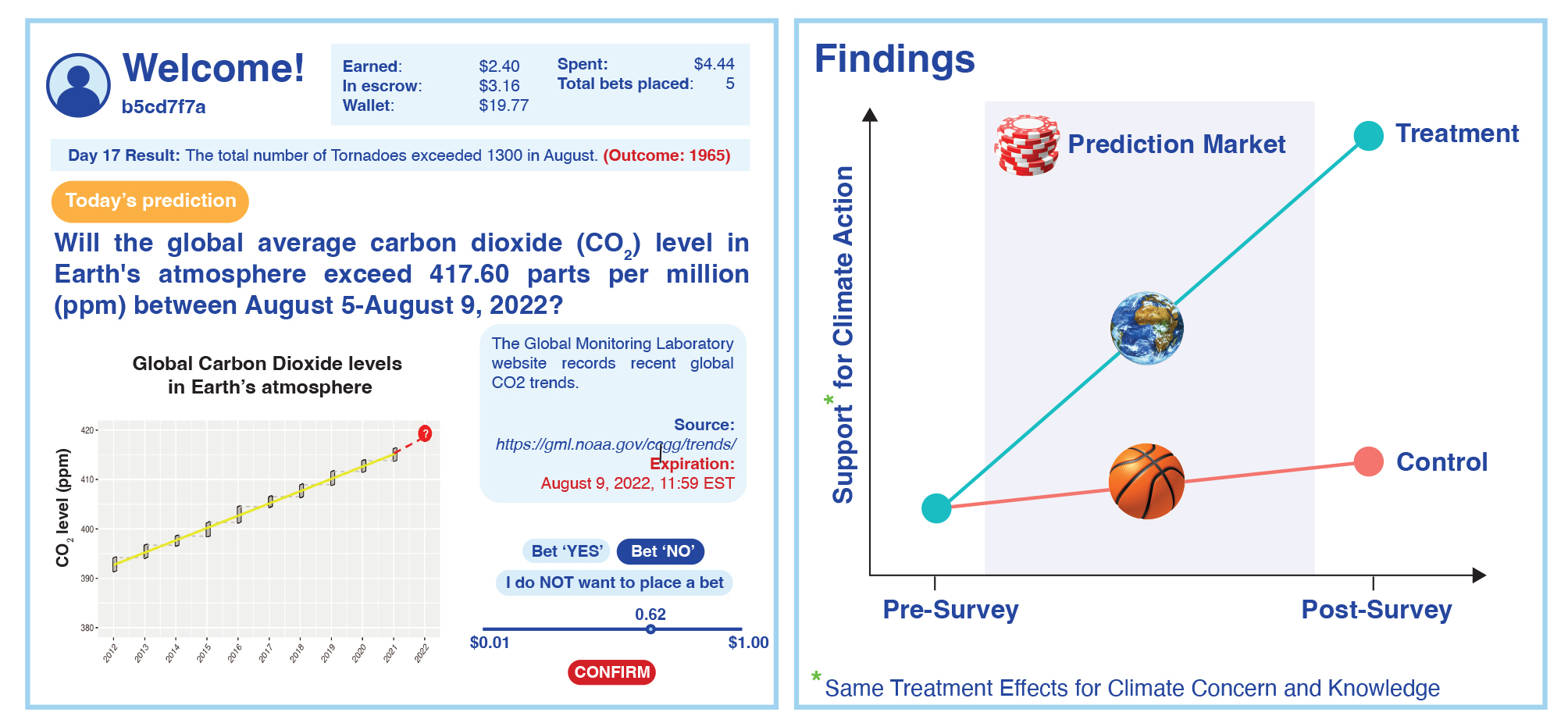
Graph depicting the effects of participation in a climate predictions market (more details in caption)
Climate Prediction Market and Public Support

Participation in a climate prediction market (left) increases support for action (right), concern, and knowledge about climate change. Participants in the treatment group engaged in a climate prediction market, and participants in the control group engaged in a sports and entertainment prediction market.

Conclusion

In the United States, more than a third of the population believe climate change is exaggerated, and more than half do not believe that climate change is caused by humans. This persistent skepticism makes it challenging to garner support for climate action and policies.

The research offers empirical evidence that participating in climate prediction markets may change people’s attitudes about climate change. The research can be used by policymakers, scientists, and activists as a practical and accurate tool for assessing public opinion on climate issues, to test potential policies, and to inject private money into climate solutions. Further, as the authors suggest in the paper, the prediction market can be used as a mechanism to infuse private money into a financial instrument that rewards accuracy and allows those whose beliefs align with reality to use the earned income towards improving civilization, at the expense of those who perpetuate falsehoods.


Download the Research in Brief

About the Researcher(s)

Moran Cerf

Moran Cerf

Academic Director in Executive Education
Executive Education
Photo of Prof. Sandra Matz

Sandra Matz

Lulu Chow Wang Professor of Business
Management Division

View the Research

Participating in a climate prediction market increases concern about global warming

You Might Like

Artificial Intelligence, Business and Society, Faculty Views, Financial Institutions, Innovation, Machine Learning, Strategy
Date
November 03, 2025
Shutterstock Photo Image
Artificial Intelligence, Business and Society, Faculty Views, Financial Institutions, Innovation, Machine Learning, Strategy

AI Can Read the Room Better Than You Think

AI can decode thousands of online reviews to reveal what customers really care about—and what businesses should fix first.
  • Read more about AI Can Read the Room Better Than You Think about AI Can Read the Room Better Than You Think
Business and Society, Financial Institutions, Leadership, Strategy, World Business
Date
October 29, 2025
Shutterstock Photo Image
Business and Society, Financial Institutions, Leadership, Strategy, World Business

Why Business Rivals Join Forces

Alliances between fierce competitors are quietly setting innovation standards, influencing regulation, and shaping society itself. A new framework by Columbia Business School Professor Lori Yue is helping us to understand how.
  • Read more about Why Business Rivals Join Forces about Why Business Rivals Join Forces
AI and Transformative Tech, Artificial Intelligence, Business and Society, Management, Technology
Date
October 09, 2025
laptop with applications open and AI concept overlaid on it
AI and Transformative Tech, Artificial Intelligence, Business and Society, Management, Technology

AI Is Making You Boring

AI agents make our choices more predictable and less varied—raising serious questions about human individuality in an age of automation, according to new research by Columbia Business School’s Sandra Matz.
  • Read more about AI Is Making You Boring about AI Is Making You Boring
Business and Society, Entertainment, Marketing, Social Impact
Date
September 24, 2025
Concert attendee
Business and Society, Entertainment, Marketing, Social Impact

3 Keys to Creating Memorable Consumer Experiences

Columbia Business School research reveals why some moments stay with us while others fade, uncovering the three psychological pillars behind meaningful, memorable, and authentic consumer experiences.
  • Read more about 3 Keys to Creating Memorable Consumer Experiences about 3 Keys to Creating Memorable Consumer Experiences
Save Article

Download PDF

More to Explore
Share
  • Share on Facebook
  • Share on Threads
  • Share on LinkedIn
Official Logo of Columbia Business School

Columbia University in the City of New York
665 West 130th Street, New York, NY 10027
Tel. 212-854-1100

Maps and Directions
    • Centers & Programs
    • Current Students
    • Corporate
    • Directory
    • Support Us
    • Recruiters & Partners
    • Faculty & Staff
    • Newsroom
    • Careers
    • Contact Us
    • Accessibility
    • Privacy & Policy Statements
Back to Top Upward arrow
TOP

© Columbia University

  • X
  • Instagram
  • Facebook
  • YouTube
  • LinkedIn

External CSS