
In a New York Times essay, "A Friedman doctrine," famed economist Milton Friedman argued that the single point of social responsibility for any business is to “increase its profits so long as it stays within the rules of the game.”
Friedman's opinion, though not without controversy at the time, was largely understandable given his essay was published in 1970, a time when in large American businesses was relatively high while trust in government efficiency was low. As a result, the theory of shareholder primacy was born, disrupting boardrooms across America. The idea was simple: Corporate managers owe a duty only to shareholders, not to any social initiatives, though shareholders could pursue social issues on their own if they liked.
But much time has passed since Friedman's essay. Today, faith in corporations and government to solve pressing social issues, such as climate change, is lower than ever. Business leaders are scrambling to figure out when, why, and how to act.
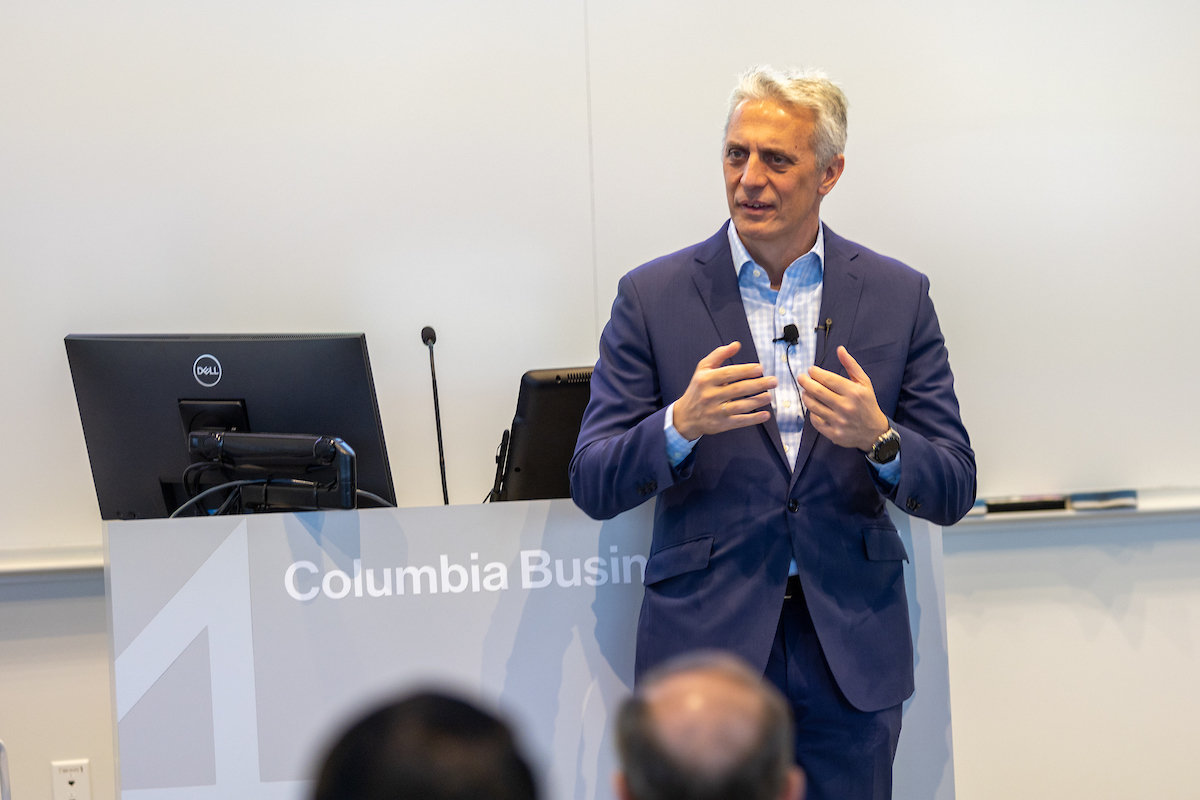
As part of Columbia Business School's Business and Society Conference in November, Glenn Hubbard, dean emeritus and the Russell L. Carson Professor of Finance and Economics, analyzed Friedman's essay, arguing that maximizing shareholder value should remain the focus of successful corporations but that this shareholder primacy should be focused through a prism of stakeholder interests.
Hubbard, who was joined by Luigi Zingales, professor of entrepreneurship and finance at the University of Chicago Booth School of Business, and Gillian Tett, provost of King's College at the University of Cambridge, shared his research on the shareholders vs. stakeholders debate and how business leaders can get off the sidelines.
Long-Term Welfare and Long-Term Value
The popularity of stakeholderism — the idea that corporate managers consider shareholder value along with the welfare of employees, customers, suppliers, the greater society, and the environment as independent but also important — has been on the rise. Those who support stakeholderism are often critical of Friedman's essay, arguing that it is incompatible with corporate social responsibility.
“What I think Friedman missed were some social aspects. … The first is that business can actually be a problem-solver,” Hubbard said.
He highlighted Pfizer's decision to give away its intellectual property in the creation and distribution of the COVID-19 vaccine. The move may have cost the company revenue in the short term but vastly increased its public recognition and social standing in the long term, allowing it to rise above the pack in a highly regulated industry.
As Hubbard and Tett pointed out, corporate social responsibility can be a long-term value creator for many large corporations, an idea Friedman would likely endorse today. Why Friedman did not explicitly endorse the stakeholder movement can be tied to the context of 1970, a time when both government and corporate policy differed greatly compared with today.
“Much of what Freeman was or was not saying has to be seen within the context of what government was or was not doing,” Tett said. “And the context today has changed quite significantly from 1970.”
For one, corporations in the 1960s were incredibly opaque, with regulators, policymakers, and greater society getting information about a company only through its quarterly statements, according to Tett. Today, thanks to the Internet, companies are being tracked through myriad public databases, such as Glassdoor.
Related to this newfound corporate transparency is the fact that trust in authority figures, including in the government and corporations, has “collapsed,” Tett said. Meanwhile, trust in one's peer groups has increased dramatically thanks to new digital platforms and the ability for groups to easily coalesce on the Internet.
“If Milton Friedman were alive today, he would be endorsing a lot of the points made by the stakeholder movement and saying, 'Actually, protecting shareholder value is also about protecting stakeholder interests as well,'” Tett said.
Hubbard stressed that future business leaders should focus on the framework of long-term value maximization and identify externalities, such as competition, regulation, and society. Additionally, they should identify the tradeoffs of long-term value creation and how they can “use a social lens to tilt those issues toward long-term value maximization.”
Rules for Thee and Not for Me
While Friedman's line of thinking may be reasonable for midsized companies operating in stable governments today, expecting larger companies to maximize long-term shareholder value may often be a net negative for society, according to Zingales. This is due to the fact that larger corporations, especially those operating in countries with less competent governments, often skirt long-term value in exchange for short-term profits or because they are motivated by certain political ideologies.
Zingales noted this was the case when ExxonMobil, beginning in the 1970s, lobbied against the acceptance of climate change, undermining public opinion to increase short-term shareholder value. “The shareholders were very happy, but there were devastating effects on the planet and also on US democracy,” Zingales said.
He cautioned it would be “intellectually naive” to assume large corporations would interpret Friedman's rule, adding that business leaders should expect new forms of corporate governance designed to take power from these corporations. Looking toward the future, the speakers agreed that companies with outsized impact, such as Boeing or SpaceX, need to be regulated at the board level and made to disclose any issues that might affect society at large.
“I don't think we need to tinker with the corporate governance of Chuck E. Cheese,” Zingales said. “But when it comes to companies that can literally change the course of the world ... I think that that's really an enormous amount of power that I'm afraid is in the hands of a few people.”

