
Ask executives to describe their company culture and you’ll often hear some version of the same word: nice. At Hachette Book Group, that word makes the leadership team nervous.
“Being nice means you’re probably being agreeable,” said Carrie Bloxson, Hachette Book Group’s Chief People Officer. “For a company that’s built on creative output, to have everybody think that the culture is about being nice and agreeing means that we’re probably not challenging each other and thinking about things that go beyond the status quo. And I feel like that’s the ultimate killer in a creative industry.”
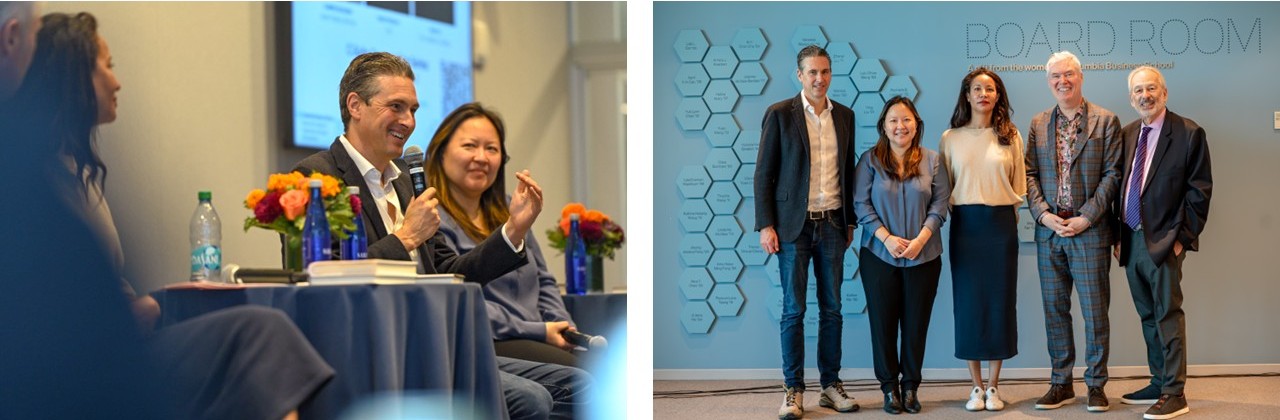
Bloxson joined CEO David Shelley and General Counsel Min Lee for the C-Suite Conversation Series, presented by the Reuben Mark Initiative for Organizational Character and Leadership. Moderated by Paul Ingram, the Kravis Professor of Business at Columbia Business School, the conversation featured a candid look at how a leadership team handles real tension, from controversial authors to the pull between structure and creative freedom.
‘Publishing for All’
Working on an executive leadership team often requires disagreement, but what sets businesses apart from one another is how they handle tension when it arises.
Hachette’s mission is “Publishing for All,” and Shelley acknowledged that living up to it creates friction inside the company. Book publishing is among the most progressive industries anywhere, he said, which can tip into a monoculture of opinion. Staff are united against book banning, a fight Lee leads on the legal front. But when Hachette publishes a book by a right-wing figure, some employees argue the company shouldn’t give that person a platform.
Shelley doesn’t budge. “I don’t think arguments go away or points of view go away if you don’t platform them,” he said. “I think they go underground, I think they go to other places.” His only caveat is that a book must be legal and factually accurate.
“You’re not going to agree with the views of all 3,000 authors, and you do need to work on books that you disagree with. And if you are involved in this business, you need to be signed up to this mission for publishing for all.” He continues, “I’ve published books I vehemently disagree with. I’ve worked with authors that I could not disagree with more. But that for me is one of the sacred things about what we do because once you start narrowing, you’re cutting off a really wide range of views.”
It is precisely this productive disagreement that continues to fuel a culture of transparency and trust in the workplace. Hachette aims to challenge and complicate traditional modes of thinking to continuously evolve and transform.
Hachette builds the principle into hiring. Candidates are asked whether they would work on books they disagree with, and anyone who says no isn’t a fit. When controversy does flare, Shelley said, “the storms always pass, I’ve found, if you’re really clear with people.”
“I’ve published books I vehemently disagree with. I’ve worked with authors that I could not disagree with more. But that for me is one of the sacred things about what we do because once you start narrowing, you’re cutting off a really wide range of views.”
At Hachette, a firm, mission-driven framework allows the team to have constructive disagreements. “One thing that we do well as an executive team is to disagree well,” Bloxson said, because “we have a really strong framework with our mission and pillars.” When she pushes back on a decision, she measures it against what serves the company as a whole. In the brainstorms and committee meetings she runs, she draws on a method called appreciative inquiry: challenges should move the work forward, not defend the way things have always been done.
Bloxson offers employees who feel uneasy about an author a simple reframe: “Curiosity does not mean that you’re abandoning your principles.” Working on a book in an editorially responsible way, even one you disagree with, is in her view some of the most meaningful work the company does.
No Room for Yes People
That same willingness to disagree runs through the executive team. “I really, really believe in healthy challenge as a kind of guiding principle,” Shelley said. He recalled leadership teams, including one he inherited, where everyone simply agreed with one another, a pattern he called a sign of an unhealthy organization.
But challenge only works on a foundation of trust. “To have healthy challenge, you actually have to have trust and you have to have a relationship that’s built up,” Shelley said, admitting he has pushed people too hard before that trust existed, and it backfired. His team builds it through off-sites where leaders speak candidly about their year and compare their personal values, and through more time together in person. Senior leaders are now in the office four days a week, up from two immediately after the pandemic.
Flexibility in the Workplace
How do leaders structure a large-scale creative organization that maintains order without compromising freedom?
Contrary to popular belief, the publishing industry is one of the largest creative industries in the world. Shelley noted it is larger than both the music and movie industries, and Hachette itself is a billion-dollar business in the U.S., with roughly 1,800 employees. But this doesn’t mean the company follows the same structures and workflows as other major organizations. In fact, Hachette takes on an unconventional approach to publishing that allows staff members at all levels to thrive creatively and professionally.
Diversity of thought is also woven into the company’s DNA. Hachette is a collection of imprints, each with its own editorial identity. “We don’t want to think alike,” Lee said. “We are diverse in our imprints by design.” Shelley allows Hachette imprints to bid against one another for the same book, as long as an outside publisher is in the running.
Hachette creates the space for its staff to seek out creative solutions, opening up a wide breadth of opinions and mediums of expression. Successful leadership, according to them, is not about habitual consensus or easy answers. Rather, it is derived from diversity of thought, expression, and adaptability.
