
Social movements have been catalysts for numerous institutional changes throughout modern history: the eight-hour work day movement in the 19th century, the suffragettes in the early 1900s, the civil rights movements in the 1950s, and the green movement in recent decades, to name just a few. But to succeed and ultimately facilitate institutional change, social movements must effectively build consensus among often-diverse members, as well as mobilize actions that may involve uncertain outcomes and high costs for some individuals.
In both consensus building and mobilization, movement leaders play critical roles, yet empirical evidence of the impact of leaders has generally remained scarce. However, a new study co-authored by Columbia Business School Professor Laura Boudreau, a Chazen Senior Scholar, presents the first experimental evidence of leaders’ roles as coordinators in both consensus building and mobilization.
The study, “Union Leaders: Experimental Evidence from Myanmar,” was also co-authored by Rocco Macchiavello and Virginia Minni of the London School of Economics, and Mari Tanaka of Hitotsubashi University. It was conducted in collaboration with the Confederation of Trade Unions in Myanmar (CTUM), the largest confederation of labor unions at the national level, during the months preceding the revision of the national minimum wage.
The researchers’ findings suggest that the presence and specific actions of union leaders can have clear, measurable impacts on both consensus building and mobilization among union members.
The research: The study examined the role of union leaders within Myanmar’s burgeoning labor movement, one that is broadly representative of struggles in organizing labor in newly industrializing countries. In an initial experiment, researchers looked at whether and how line leaders built consensus around the union’s objectives regarding minimum wage. A second experiment explored how important these leaders are in mobilizing workers around a collective action and the channels through which they achieve mobilization, such as motivating worker turn out, coordinating workers’ actions to achieve a high level of participation, and enforcing social sanctions on workers who do not participate.
The experiments were implemented among workers employed at garment factories with a CTUM-affiliated union in the Yangon and Bago regions, which are home to the majority of garment factories in Myanmar, from December 2019 to March 2020. The researchers invited 28 garment factories that had a union affiliated with the CTUM in these regions to participate; due to COVID-19, the study needed to be cut short, and 17 of these unions fully completed the data collection activities, while two unions partially completed them.
Sampling involved a stratified random selection of approximately 90 workers per factory. Final participants included 19 union presidents, 170 line leaders, and 916 workers, including 594 union members and 322 non-union members.
What the researchers found: Union leaders were found to be distinct from union members and non-members along key traits that psychologists and organizational sociologists associate with the ability to influence collective outcomes, as well as other traits that economists identify as relevant for political selection. Union leaders are more extroverted, less neurotic, more conscientious and more altruistic compared to workers, and they have greater grit, greater locus of control and more work experience. However, they earn substantially less than workers who share similar demographics, ability, skills and personality traits, suggesting that union leadership roles may come at significant private costs.
In terms of building consensus, embedding “line leaders” (non-executive, lower-level, typically non-elected leaders) within worker discussion groups was found to measurably increase the degree to which workers’ views were aligned with those of their unions. Rather than simply aggregating workers’ views and building consensus around the median worker’s view, embedded leaders effectively built consensus that was in alignment with union leadership’s objectives. This effect was present whether or not the line leader had existing relationships with members of the worker group in which they were embedded.
As for mobilization, certain specific interactions with line leaders were found to impact worker mobilization more significantly than others. In this experiment, workers were invited to participate in an unannounced survey on living costs. Participating in the survey was a costly action in the public good because the CTUM would use the results to determine its position on the minimum wage. The research team provided incentives for the discussion groups from the first experiment to participate in the second by making a donation to a skills-training center if the entire group participated.
The researchers found that workers who were informed that a leader would be made aware of their decision to participate in the unannounced survey were more likely to take the survey. Simply being invited to take the survey by a union leader did not have a significant impact on whether the member did so. But moving from being informed that most of a member’s discussion group would not be invited by the leader to take the survey, to learning that most of a member’s discussion group would be invited by the leader to take the survey, did significantly increase the likelihood that the worker participated in the survey.
Why the research matters: Leaders are critical for both coordinating views and driving collective actions. The identification of a positive correlation between consensus building and mobilization in a social movement suggests that achieving consensus is the first step needed to mobilize individuals. As the first known documentation of this link within an experimental setting, this paper highlights the importance of grassroots leadership in the cultivation of collective action in labor movements.
Figure 1: Average Convergence to Union Minimum Wage Preference & Share Mobilized
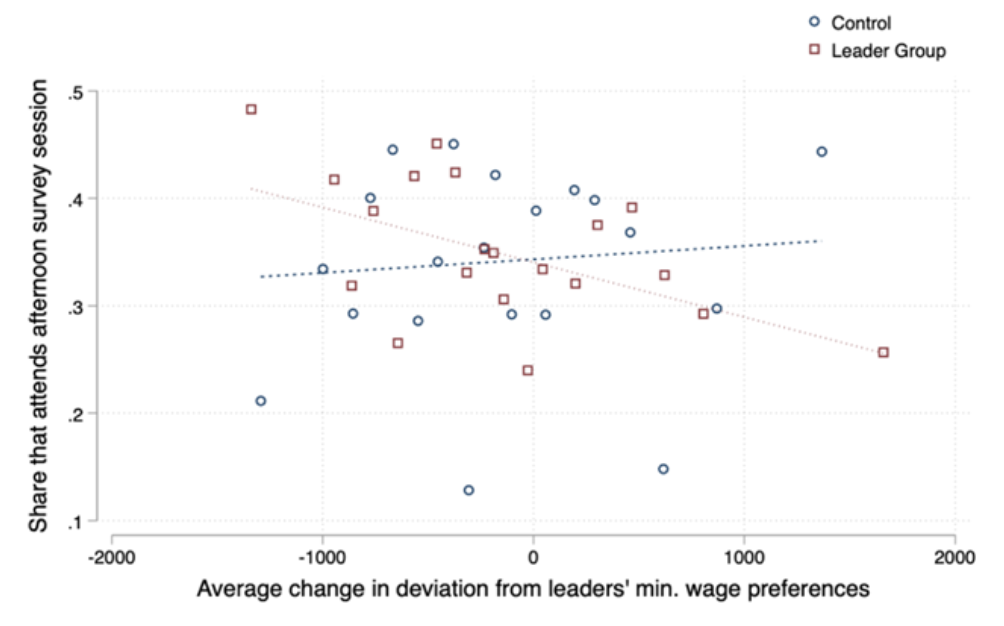
Figure 1 (above) shows that discussion groups with higher convergence to leaders’ views (i.e., minimum wage preferences) also experience a higher degree of mobilization (i.e., attendance at the survey session). Most notably, this pattern only holds for groups that were exposed to a leader during the discussion (“Leader Group”), while no such evidence is detected in control groups. This pattern suggests that consensus-building may play an important role in mobilizing individuals.
