Official Logo of Columbia Business School
Academics
  • Visit Academics
  • Degree Programs
  • Admissions
  • Tuition & Financial Aid
  • Campus Life
  • Career Management
Faculty & Research
  • Visit Faculty & Research
  • Academic Divisions
  • Search the Directory
  • Research
  • Research Resources
  • Teaching Excellence
Executive Education
  • Visit Executive Education
  • For Organizations
  • For Individuals
  • Program Finder
  • Online Programs
  • Certificates
About Us
  • Visit About Us
  • CBS Directory
  • Events Calendar
  • Leadership
  • Our History
  • The CBS Experience
  • Newsroom
Alumni
  • Visit Alumni
  • Update Your Information
  • Lifetime Network
  • Alumni Benefits
  • Alumni Career Management
  • Women's Circle
  • Alumni Clubs
Insights
  • Visit Insights
  • AI & Transformative Tech
  • Climate
  • Business & Society
  • Entrepreneurship
  • Finance & Investing
  • Magazine
Insights
  • AI & Transformative Tech
  • Climate
  • Business & Society
  • Entrepreneurship
  • Finance & Investing
  • Magazine
  • More 

America's Clean Energy Transition Will Continue Despite the One Big Beautiful Bill Act

While the OBBBA guts renewable energy incentives, undercuts US manufacturing, and hands a long-term advantage to China, economics will continue to drive clean energy growth.

Download PDF

Download PPT

Published
July 16, 2025
Publication
Climate
Focus On
Climate, Economy & Policy
Jump to main content
Article Author(s)
Photo Image of Isabel Hoyos

Isabel Hoyos Arango

Senior Staff Associate I in the Faculty of Business
Economics Division
Hyae Ryung (Helen) Kim

Hyae Ryung (Helen) Kim

Senior Staff Associate II in the Faculty of Business
Economics Division
Gernot Wagner

Gernot Wagner

Senior Lecturer in Discipline of Economics in the Faculty of Business
Economics Division
Faculty Director, Climate Knowledge Initiative
Tamer Institute for Social Enterprise and Climate Change
Faculty Fellow
CESifo
Board Member
CarbonPlan
Columnist
Project Syndicate
Senior Fellow
Jain Family Institute
US Capitol building
Category
Thought Leadership
Topic(s)
Carbon, Climate and Policy, Climate Knowledge Initiative, Elections, Energy

About the Researcher(s)

Gernot Wagner

Gernot Wagner

Senior Lecturer in Discipline of Economics in the Faculty of Business
Economics Division
Faculty Director, Climate Knowledge Initiative
Tamer Institute for Social Enterprise and Climate Change
Faculty Fellow
CESifo
Board Member
CarbonPlan
Columnist
Project Syndicate
Senior Fellow
Jain Family Institute

0%

Click to enlarge slide for further details

OBBBA Chart Analysis Image (CKI)

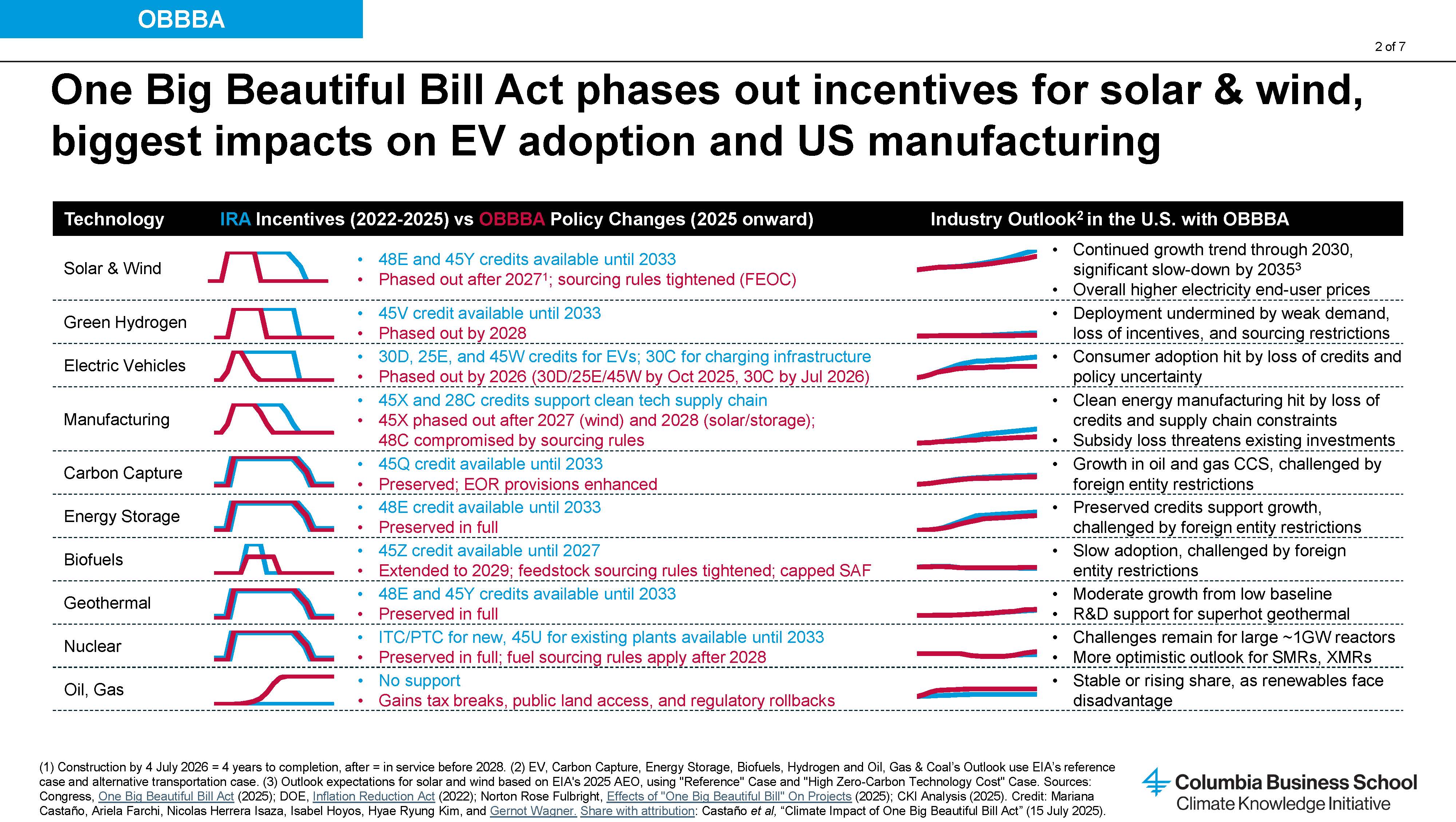
President Donald Trump signed the One Big Beautiful Bill Act (OBBBA) into law on July 4, radically reforming the American energy and industrial policies shaped by his predecessor’s 2022 Inflation Reduction Act (IRA).

While the new bill delivers targeted wins for clean energy technologies like geothermal and nuclear—largely by not rolling back IRA provisions—it slashes key IRA tax incentives for solar and wind generation, green hydrogen production, electric vehicles (EVs), and home electrification. It also tightens restrictions around foreign investment and procurement, which threatens domestic clean tech manufacturing and disrupts already strained supply chains.

The one energy sector the OBBBA unequivocally supports? Fossil fuels, with expanded access to public lands, tax breaks, credits, and regulatory rollbacks—not to mention a handicap on their biggest competitors, solar, wind, and electric vehicles.

The Legacy and Lost Potential of the IRA: Clean Energy Deployment, Electrified Homes, Job Creation, and On-Shored Supply Chains
Click to enlarge slide for further details

OBBBA Chart Analysis Image (CKI)

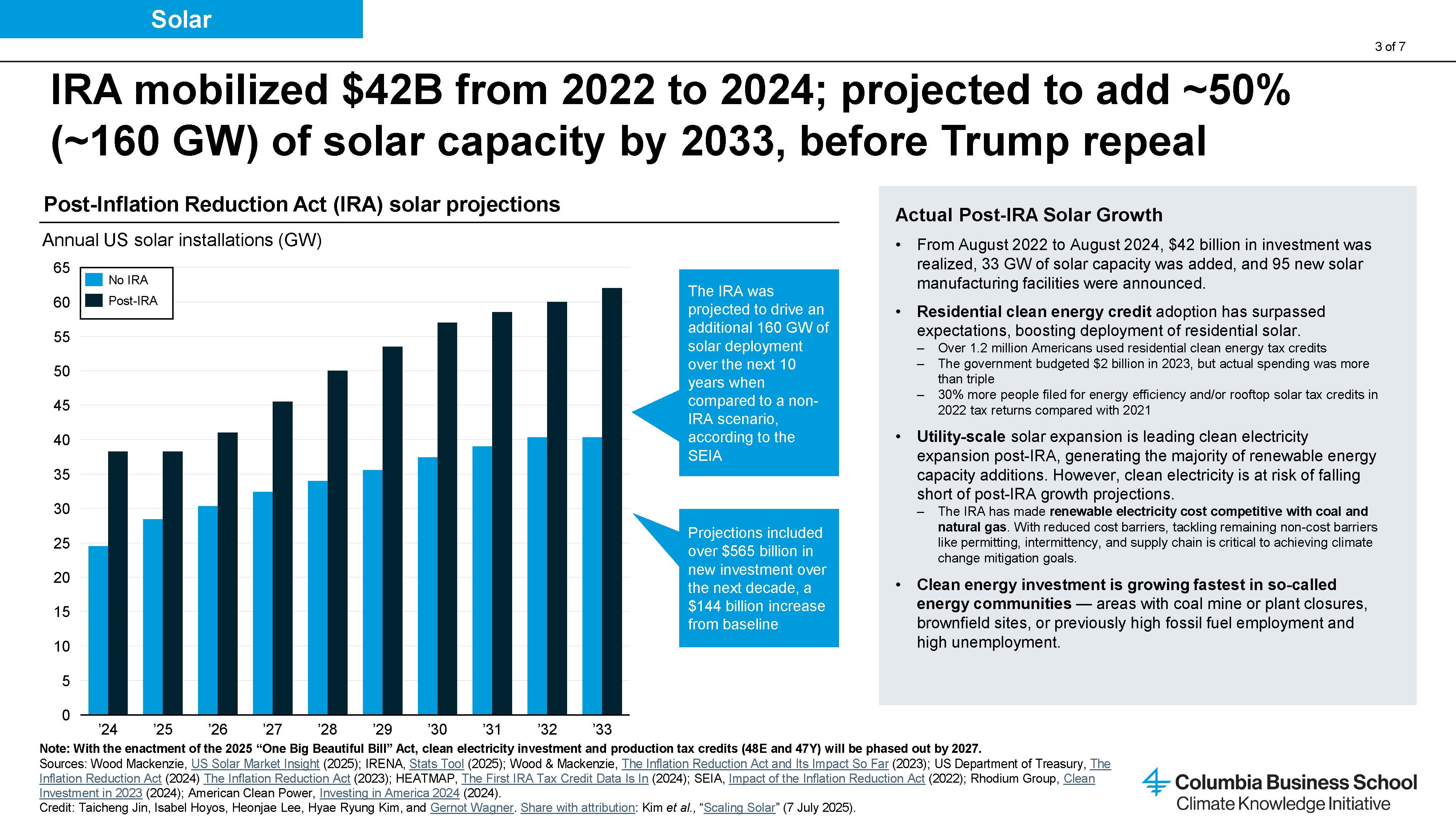
To fully grasp the significance of the IRA (and by extension, the impact of the OBBBA) we need to revisit the scale of the repealed legislation. Innocuously titled “Inflation Reduction Act,” and passed through the fast-tracked legislative process of budget reconciliation, the bill delivered the single largest federal push for decarbonization in US history.

It offered broad production and investment tax credits for clean energy, plus targeted support for green hydrogen, carbon capture, nuclear, and consumer incentives for EVs and residential solar.
Click to enlarge slide for further details

OBBBA Chart Analysis Image (CKI)


Learn more about Columbia Business School’s Climate Knowledge Initiative

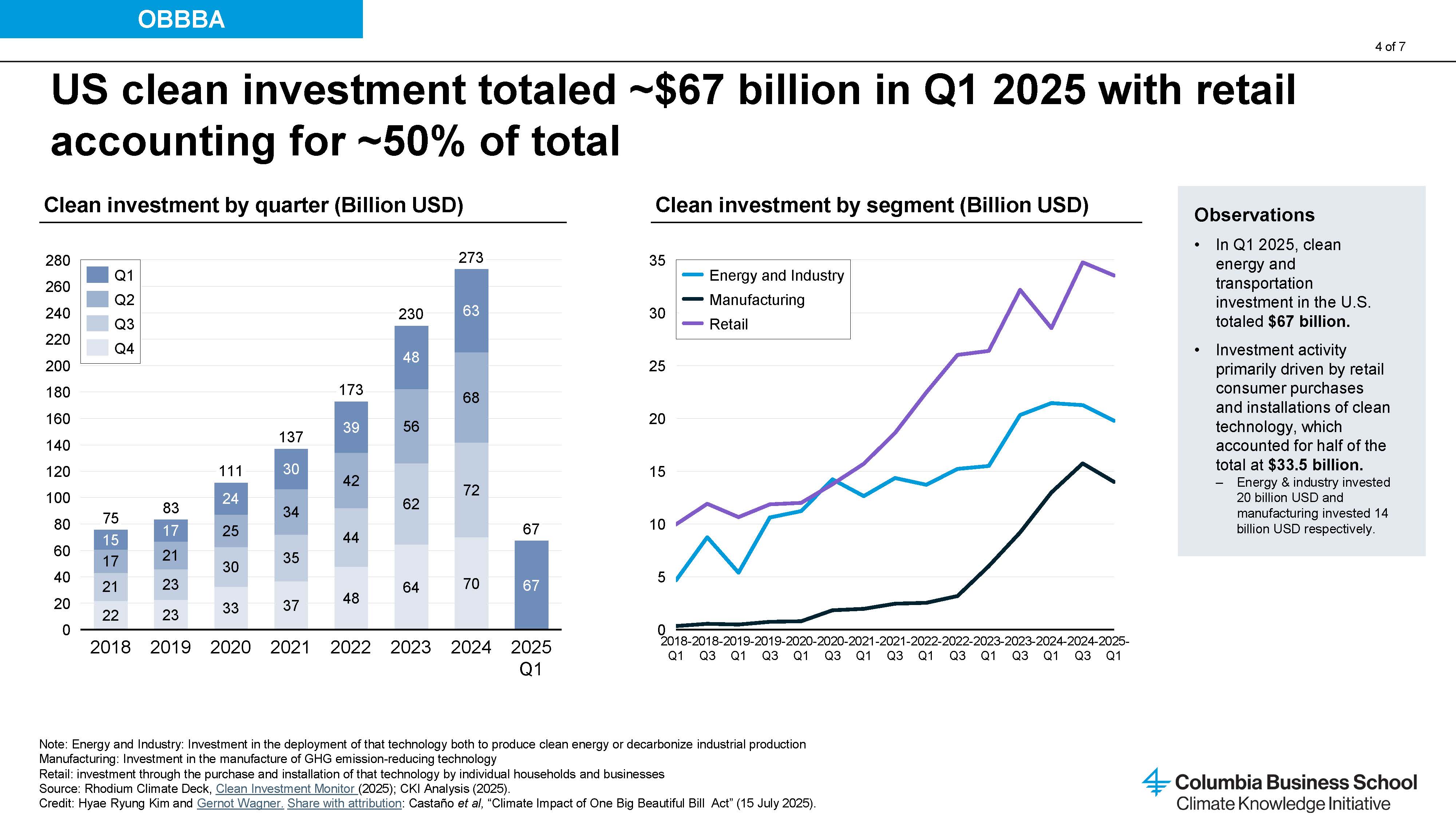
The IRA spurred capital investment and generation buildout in the already-thriving solar and wind industries. And for less mature technologies like green hydrogen, carbon capture, and next generation nuclear, the IRA meant an opportunity to achieve cost-competitiveness. 

Increased renewable energy generation means less climate change-inducing greenhouse gas emissions, but the impact of the bill went beyond climate. It helped re-shore manufacturing, created jobs—especially in Republican-led states—and laid the groundwork for secure, domestic supply chains across energy sectors.
Click to enlarge slide for further details

OBBBA Chart Analysis Image (CKI)

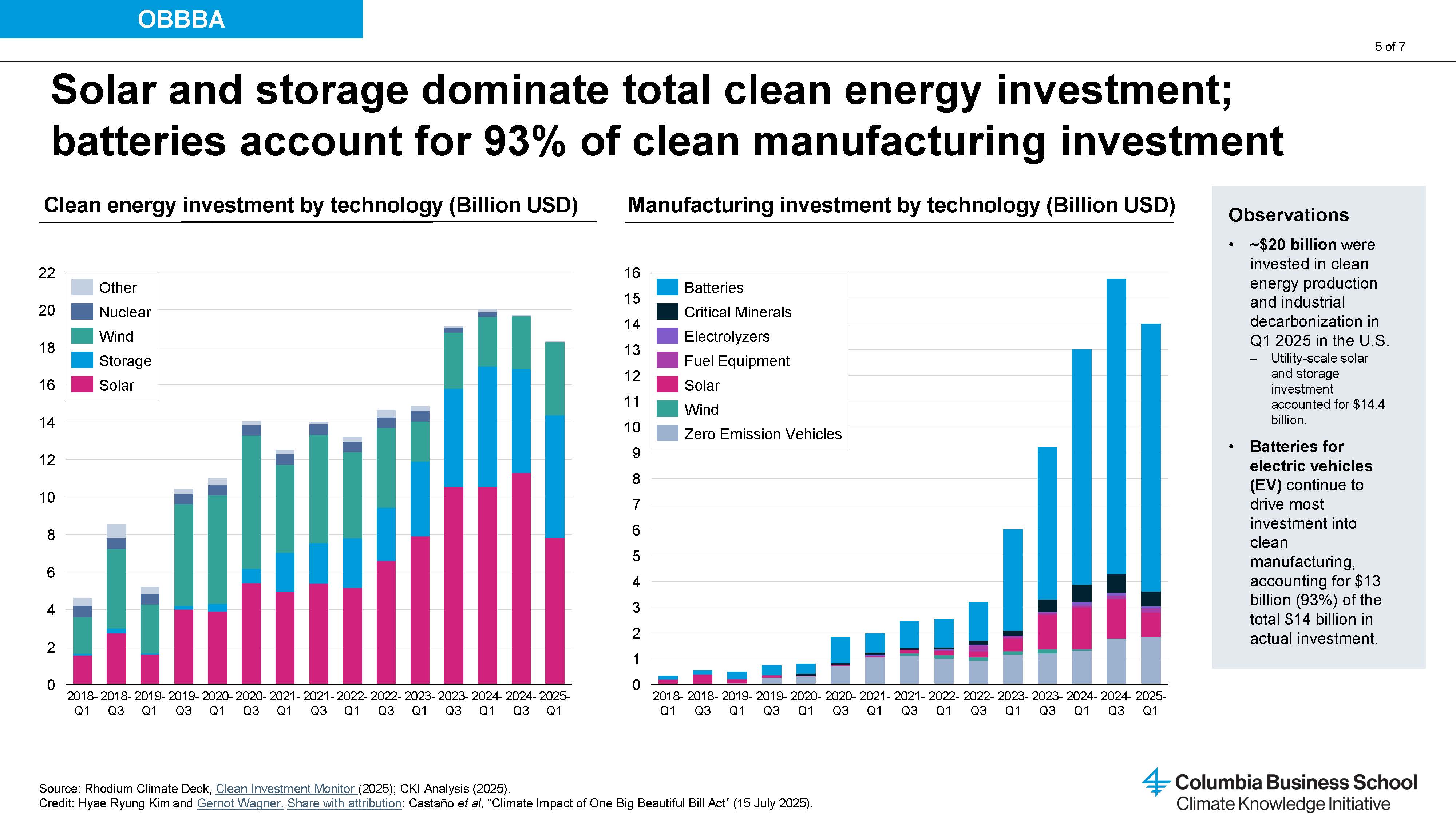
At the time, Goldman Sachs Research estimated demand for federal tax credits to the tune of $1.2 trillion spurring $2.9 trillion in total spending over the first decade and over $10 trillion by 2050. Those investments, in turn, represent a win-win-win for the climate, the US economy, and the world.

What Comes Next for the Clean Energy Transition?

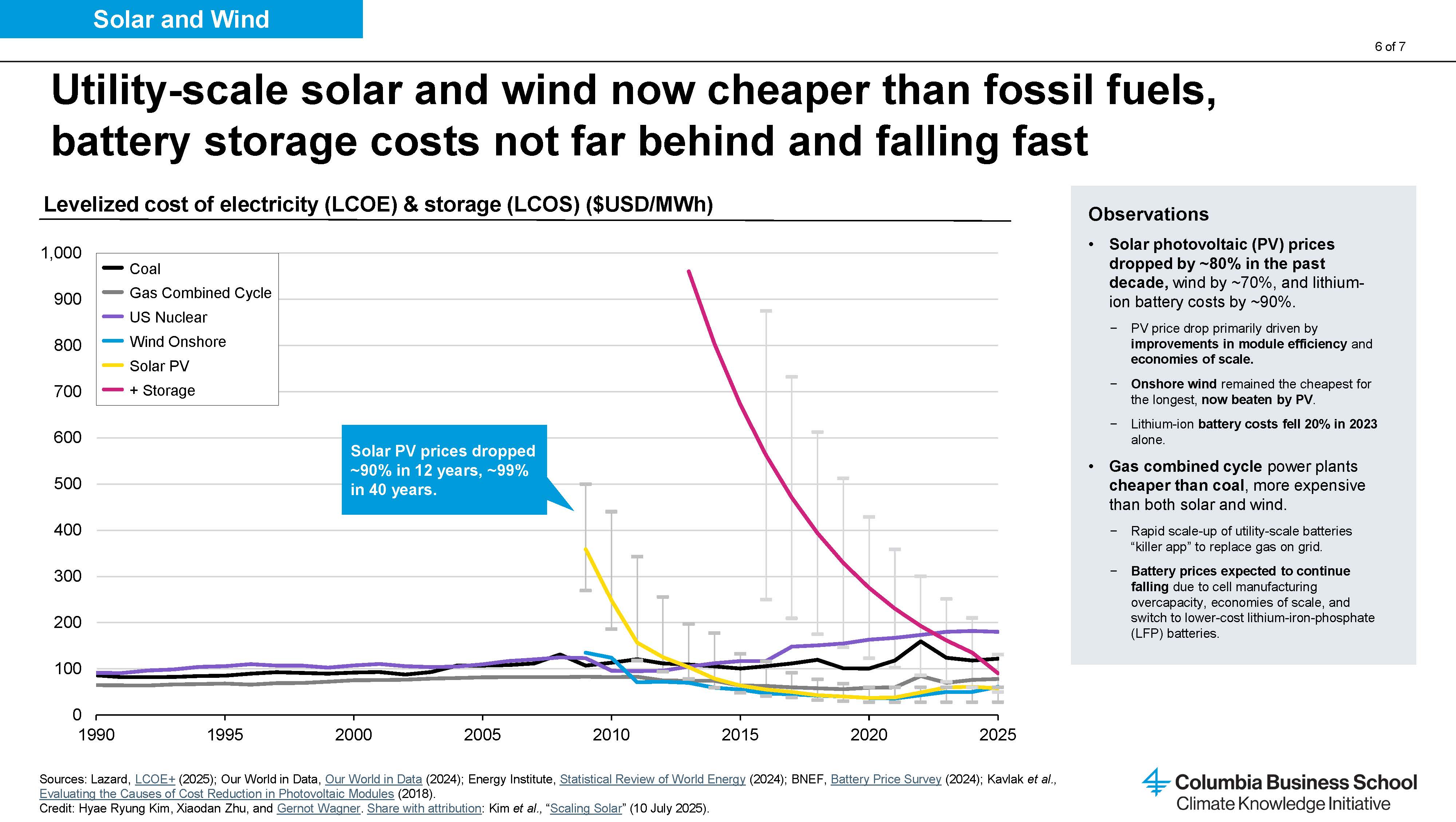
Even without federal support, solar and wind are economically unstoppable. Pre-IRA, these technologies were already cost-competitive with fossil fuels and being deployed at scale, fast.
Click to enlarge slide for further details

OBBBA Chart Analysis Image (CKI)


Learn more about Columbia Business School’s Climate Knowledge Initiative

Batteries, too, are quickly becoming cost competitive, in part climbing the learning curve faster than even solar power of late. Even—or especially—a look at Texas’s rapidly transforming power mix confirms this picture.

With the Investment and Production Tax Credits (ITC and PTC) for solar and wind being phased out by 2026, we will likely see a brief spike in projects for the next 18 months as they race to be placed while still eligible, then a deceleration.

The silver lining on the clean-energy front: Both nuclear and geothermal, long trailing behind solar and wind, get a lifeline under the OBBBA. Unlike for other renewables, ITC and PTC incentives are fully preserved for new nuclear and geothermal, as well as the nuclear production credit for existing nuclear plants.

Battery storage also retains its ITC incentives under the OBBBA, marking a partial reprieve for solar and wind technologies. But all three will face new barriers from the “foreign entity of concern” (FEOCs) limitations, which restrict access to critical materials—key inputs in battery production and other renewables.

The 45Q tax credit for carbon sequestration is also preserved under the OBBBA, with increased support for enhanced oil recovery (EOR). While technically a form of carbon storage, EOR keeps fossil infrastructure alive longer and can crowd out support for carbon capture deployment for hard-to-abate sectors like cement, steel, and chemicals, where it could be truly transformational.

The Big Loser: Manufacturing and, by Proxy, American Competitiveness
Click to enlarge slide for further details

OBBBA Chart Analysis Image (CKI)

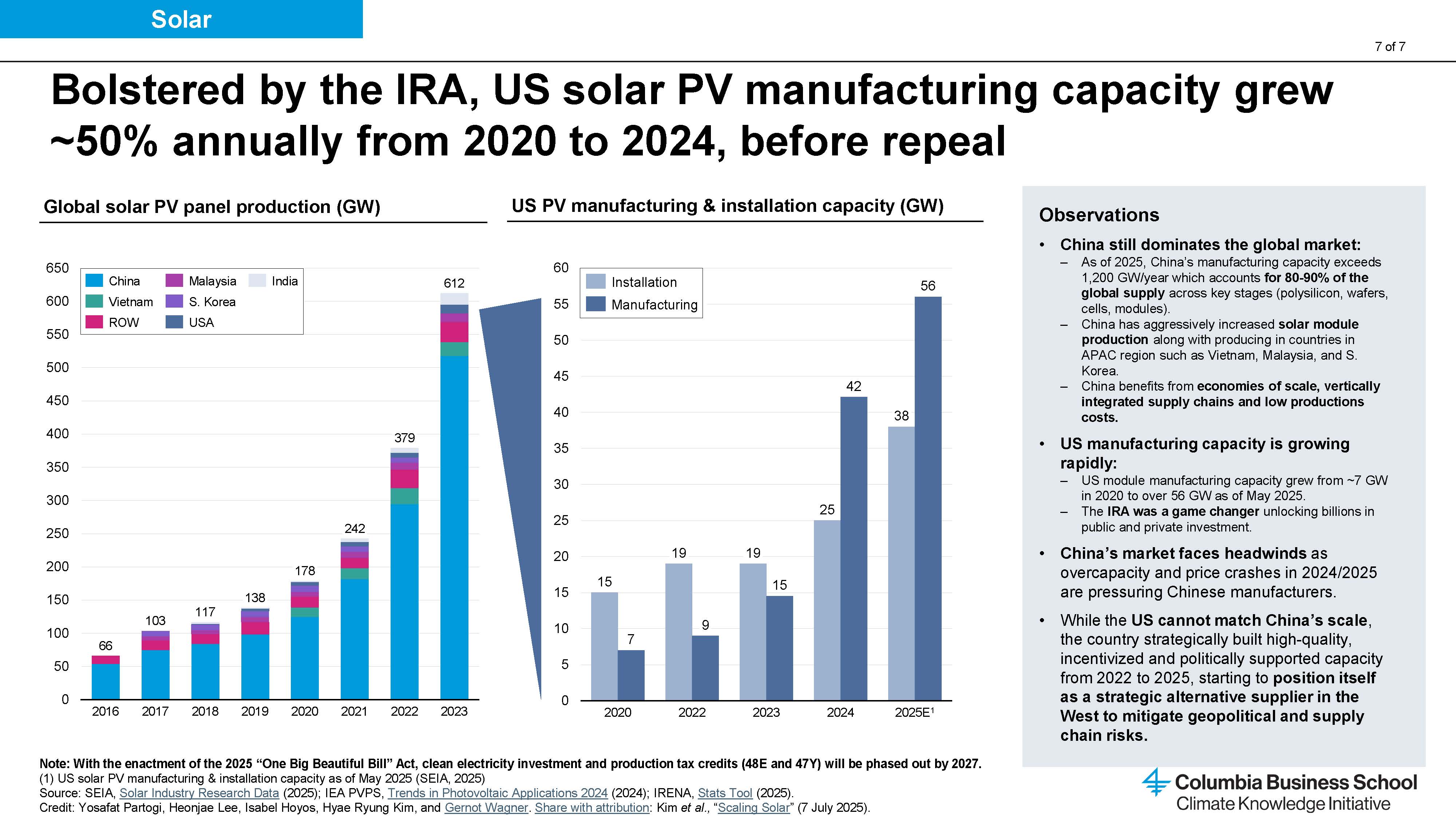
The OBBBA deals its biggest blow to US manufacturing. The IRA’s Advanced Manufacturing and Advanced Energy Project Credits jumpstarted domestic battery, solar panel, and wind turbine production, creating jobs, protecting supply chains, and decreasing reliance on Chinese imports. 

By sidelining clean tech in favor of fossil fuel interests, American competitiveness and energy security is another casualty of the current administration’s energy policy. While the OBBBA supports deployment of nuclear, geothermal, and carbon capture, it lacks direct funding for research and development of next-generation technologies, a gap formerly filled by Department of Energy (DOE) grants for First-of-a-Kind (FOAK) projects. With cuts to funding for these initiatives, the United States will only fall further behind in the global clean energy race.

The Big Winner: China

In 2024, China invested $818 billion of the $2.1 trillion that went into the energy transition. That represents 40% of the total, and more than the US, EU, and UK combined. It got a head start in the development and deployment of technologies, and remains the uncontested leader. The IRA gave the United States a much-needed boost. But without it, the country will likely fall further behind.

This policy seesaw alone will cause further harm to the US investment climate. Companies will be hesitant to invest given shaky policy grounds. Global investors will look to Europe, where the Green Deal remains largely intact, or to China, where subsidies are consistent and massive.

Raw economics favor clean energy, decisively. The Trump Administration putting its thumb on the scale of fossil fuels will mean short-term profits for polluting industries, but it also means long-term harm to the US economy. The global clean-energy transition will continue, leaving the United States further behind.

We thank Mariana Castaño, Nicolas Herrera Isaza, and Ariela Farchi Behar for research and analysis supporting this article.

Image removed.

About the Researcher(s)

Gernot Wagner

Gernot Wagner

Senior Lecturer in Discipline of Economics in the Faculty of Business
Economics Division
Faculty Director, Climate Knowledge Initiative
Tamer Institute for Social Enterprise and Climate Change
Faculty Fellow
CESifo
Board Member
CarbonPlan
Columnist
Project Syndicate
Senior Fellow
Jain Family Institute

You Might Like

Climate and Finance
Date
April 13, 2026
Maintenance workers service a solar panel.
Climate and Finance

Solving the World’s Most Perfect Problem

Professor Gernot Wagner explains how behavioral science can bridge the gap between what we know and what we actually do to fight climate change.
  • Read more about Solving the World’s Most Perfect Problem about Solving the World’s Most Perfect Problem
Climate Knowledge Initiative
Date
April 10, 2026
mining minerals
Climate Knowledge Initiative

Mining for the Energy Transition

Securing the supply of key minerals is mission critical for the clean energy transition.Minerals Deck PPTMinerals Deck PDF
  • Read more about Mining for the Energy Transition about Mining for the Energy Transition
Climate and Sustainability, Climate and Technology, Climate Knowledge Initiative
Date
March 10, 2026
geothermal power plant
Climate and Sustainability, Climate and Technology, Climate Knowledge Initiative

Geothermal Energy: Five Key Insights from Industry Leaders

Geothermal is a proven, clean source of baseload power. Yet despite decades of operational success, it accounts for less than 1% of global electricity generation. That's about to change.Conventional hydrothermal systems are ready to deploy today, and next-generation technologies like enhanced geothermal systems (EGS), closed-loop systems, and superhot geothermal will unlock heat resources beyond naturally occurring reservoirs, dramatically expanding geothermal potential.With federal support in the United States and unprecedented private investment, we've entered geothermal's breakout decade.Geothermal Power Deck (PDF)Geothermal Heating & Cooling Deck (PDF)
  • Read more about Geothermal Energy: Five Key Insights from Industry Leaders about Geothermal Energy: Five Key Insights from Industry Leaders
Climate and Finance, Climate and Policy, Climate and Solutions
Date
January 23, 2026
Data center and wind turbines
Climate and Finance, Climate and Policy, Climate and Solutions

The Race to Power Data Centers

The power-hungry data centers that train large AI models are driving investments in electricity generation. Whether this locks in new fossil fuel capacity for decades to come or propels the energy transition will depend on how fast developers can deliver new clean electrons.Download Deck (PDF)Download Deck (PPT)
  • Read more about The Race to Power Data Centers about The Race to Power Data Centers
Save Article

Download PDF

More to Explore
Share
  • Share on Facebook
  • Share on Threads
  • Share on LinkedIn
Official Logo of Columbia Business School

Columbia University in the City of New York
665 West 130th Street, New York, NY 10027
Tel. 212-854-1100

Maps and Directions
    • Centers & Programs
    • Current Students
    • Corporate
    • Directory
    • Support Us
    • Recruiters & Partners
    • Faculty & Staff
    • Newsroom
    • Careers
    • Contact Us
    • Accessibility
    • Privacy & Policy Statements
Back to Top Upward arrow
TOP

© Columbia University

  • X
  • Instagram
  • Facebook
  • YouTube
  • LinkedIn

External CSS

Homepage Breadcrumb Block