Official Logo of Columbia Business School
Academics
  • Visit Academics
  • Degree Programs
  • Admissions
  • Tuition & Financial Aid
  • Campus Life
  • Career Management
Faculty & Research
  • Visit Faculty & Research
  • Academic Divisions
  • Search the Directory
  • Research
  • Research Resources
  • Teaching Excellence
Executive Education
  • Visit Executive Education
  • For Organizations
  • For Individuals
  • Program Finder
  • Online Programs
  • Certificates
About Us
  • Visit About Us
  • CBS Directory
  • Events Calendar
  • Leadership
  • Our History
  • The CBS Experience
  • Newsroom
Alumni
  • Visit Alumni
  • Update Your Information
  • Lifetime Network
  • Alumni Benefits
  • Alumni Career Management
  • Women's Circle
  • Alumni Clubs
Insights
  • Visit Insights
  • AI & Transformative Tech
  • Climate
  • Business & Society
  • Entrepreneurship
  • Finance & Investing
  • Magazine

Beyond Belief: How Religious Diversity Shapes Our Trust in Science

A research program from Columbia Business School suggests a link between religious intolerance and science denial.

Published
November 1, 2024
Publication
Research In Brief
Focus On
Business & Society, Inclusion & Belonging
Jump to main content
Article Author(s)

Matt Keeley

Affiliated Author
Diverse group practicing religion

Key Takeaways

The theory is that living with religious diversity engenders openness to the legitimacy of other faiths and to the validity of science.

Across the thousands of US counties, greater adherence to COVID-19 social distancing protocols correlated with greater religious diversity. 

Across the countries in the world, higher rates of innovation and science attainment correlate with greater religious diversity. 

The link holds across countries and across believers from different majority religions: American Christians, Indian Hindus, and Pakistani Muslims who believe their own religion to be the only valid one are more likely to reject science and scientific findings.

Category
Thought Leadership
Topic(s)
Business and Society, Research

About the Researcher(s)

Gita Johar

Gita Johar

Meyer Feldberg Professor of Business
Marketing Division
Michael Morris

Michael Morris

Chavkin-Chang Professor of Leadership
Management Division

0%

Science and religion are never far from the public square, but the ways they interact are not always evident. Some say religion and science need not be entirely separate affairs, pointing to scientists who are ardent religious believers such as Newton and Galileo, whereas others affirm that religious believers don’t appreciate science’s insights. 

But Gita Johar, the Meyer Feldberg Professor of Business at Columbia Business School, says the relationship between religious belief and science is more nuanced than that. 

With her colleagues, including Michael Morris, the Chavkin-Chang Professor of Leadership at CBS, Johar decided to investigate what aspects of religious belief might contribute to a distrust of science and why. As she explains, “We wanted to go beyond ‘it’s just that religion and science don’t mix.’” 

Morris believes that combatting science denial is vital to both academia and to society at large: “Not only is that dangerous socially, we also thought that science denial is an existential threat to the research university, because the research university is premised on innovation, science, and discovery.”

Johar and Morris, along with then-PhD student Yu Ding, examined religious belief and trust of science in US counties during the peak of the COVID-19 pandemic. Subsequent investigations examined the effects of religious intensity, diversity, and tolerance on science belief or denial in countries around the world. 

The research team’s findings paint a complicated, but ultimately encouraging, picture.

How the research was done: The authors analyzed several sources of data. For the study of COVID-19 social distancing in the United States, the authors used aggregated cell phone location data to determine to what extent social distancing protocols were followed. They correlated this with county-level data from the US Religion Census and a computed diversity index to determine what correlation, if any, existed between relative religious homogeneity and science denial. 

For the second study, which looked across the world’s countries, the researchers used country scores from the Programme for International Student Assessment (PISA) test and an innovation index based on patents. They analyzed these metrics against Pew Research data on country-level religious diversity. 

A third study used World Values Survey data to further examine country-level beliefs. For a fourth study, the authors examined the degree of adherence by US Christians to science-based social distancing recommendations during Easter of 2020. 

One particularly notable study tested causation between religious intolerance and science denial. The team recruited 400 Evangelical Protestants and randomly exposed half of them to a New Testament verse that discounts the validity of other religions. They then surveyed the participants on how strongly they agreed or disagreed with various science-denying statements.

What the researchers found: Ding, Johar, and Morris discovered that people who live in religiously homogeneous areas, regardless of what faith they practiced, were more likely both to deem their own faith more valid than others (i.e., to be intolerant of other religions) and to disregard scientific findings and ignore science-based advice. 

The researchers theorize that much religious intolerance stems from lack of exposure to and experience coexisting with believers of other faiths. These insular religious communities are also more likely to find science — another rival belief system — to be implicitly untrustworthy. Significantly, the research team was able to show causation, not just correlation: In the study involving Protestant Evangelicals, those adherents who were “primed” with scripture dismissive of other faiths agreed more strongly with anti-science sentiments than the control group.

On the other hand, people who are religiously tolerant, whether or not they personally practice any faith, are more likely to “follow the science” when it comes to issues like vaccines. As Johar notes, Singapore’s government works to ensure that people in government housing live side-by-side with others of different beliefs. This policy likely leads to “tolerance of each other and hence tolerance of science, as seen in the country’s high PISA scores.”

Why the research matters: The study demonstrates that religious belief and trust in science are not mutually exclusive. “There isn’t any one religion by itself that causes science denial. We think what causes science denial is the lack of diversity,” Morris says.

The findings have implications for public policy and for managing compliance with scientific guidance such as public health recommendations. They also highlight the importance of dialogue across faiths and cultures, which can foster greater understanding and trust in one another and in science. According to Ding, “it may be unrealistic to ask for less intense beliefs, but we can still seek greater tolerance toward others.”

Morris's new book, Tribal, expands on these findings and broadens the conversation surrounding low religious diversity and the rise of extremist beliefs and actions.


Adapted from “When the one true faith trumps all: Low religious diversity, religious intolerance, and science denial” in PNAS Nexus, by Yu Ding of Stanford University’s Graduate School of Business, Gita Venkataramani Johar of Columbia Business School, and Michael W. Morris of Columbia Business School.
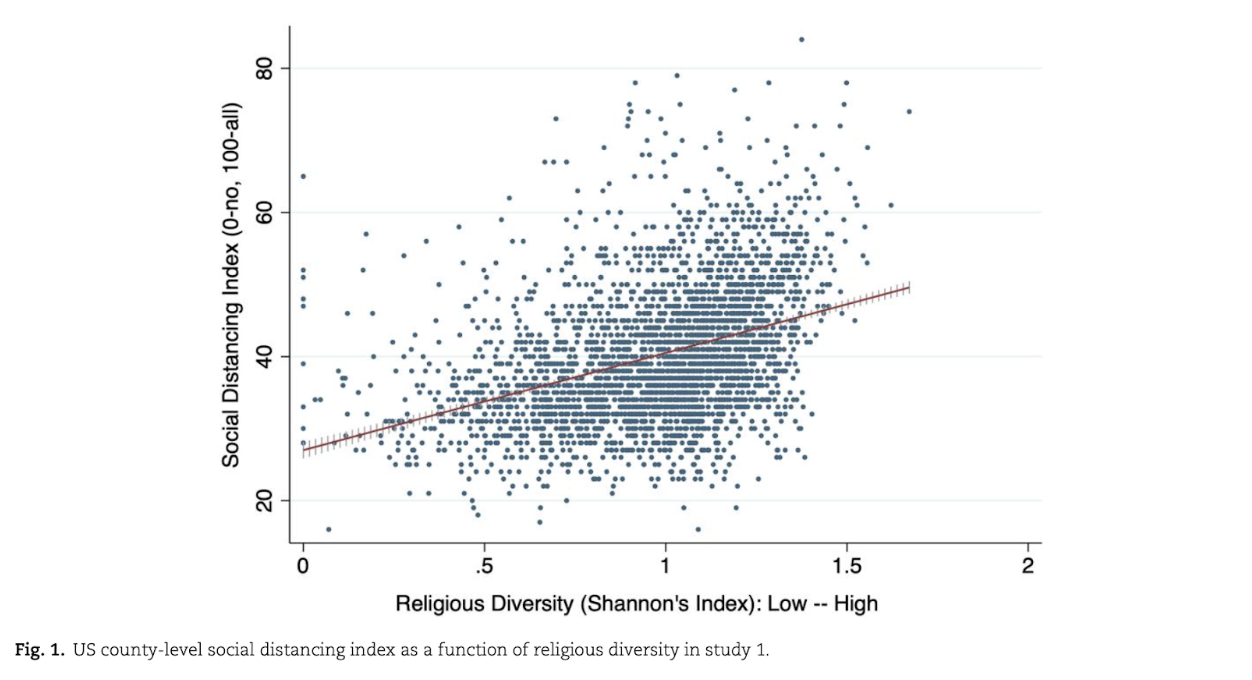
 

Fig. 1: US county-level social distancing index as a function of religious diversity in study 1

About the Researcher(s)

Gita Johar

Gita Johar

Meyer Feldberg Professor of Business
Marketing Division
Michael Morris

Michael Morris

Chavkin-Chang Professor of Leadership
Management Division

You Might Like

Artificial Intelligence, Business and Society, Faculty Views, Financial Institutions, Innovation, Machine Learning, Strategy
Date
November 03, 2025
Shutterstock Photo Image
Artificial Intelligence, Business and Society, Faculty Views, Financial Institutions, Innovation, Machine Learning, Strategy

AI Can Read the Room Better Than You Think

AI can decode thousands of online reviews to reveal what customers really care about—and what businesses should fix first.
  • Read more about AI Can Read the Room Better Than You Think about AI Can Read the Room Better Than You Think
Business and Society, Financial Institutions, Leadership, Strategy, World Business
Date
October 29, 2025
Shutterstock Photo Image
Business and Society, Financial Institutions, Leadership, Strategy, World Business

Why Business Rivals Join Forces

Alliances between fierce competitors are quietly setting innovation standards, influencing regulation, and shaping society itself. A new framework by Columbia Business School Professor Lori Yue is helping us to understand how.
  • Read more about Why Business Rivals Join Forces about Why Business Rivals Join Forces
AI and Transformative Tech, Artificial Intelligence, Business and Society, Management, Technology
Date
October 09, 2025
laptop with applications open and AI concept overlaid on it
AI and Transformative Tech, Artificial Intelligence, Business and Society, Management, Technology

AI Is Making You Boring

AI agents make our choices more predictable and less varied—raising serious questions about human individuality in an age of automation, according to new research by Columbia Business School’s Sandra Matz.
  • Read more about AI Is Making You Boring about AI Is Making You Boring
Business and Society, Entertainment, Marketing, Social Impact
Date
September 24, 2025
Concert attendee
Business and Society, Entertainment, Marketing, Social Impact

3 Keys to Creating Memorable Consumer Experiences

Columbia Business School research reveals why some moments stay with us while others fade, uncovering the three psychological pillars behind meaningful, memorable, and authentic consumer experiences.
  • Read more about 3 Keys to Creating Memorable Consumer Experiences about 3 Keys to Creating Memorable Consumer Experiences
Save Article

Download PDF

More to Explore
Share
  • Share on Facebook
  • Share on Threads
  • Share on LinkedIn
Official Logo of Columbia Business School

Columbia University in the City of New York
665 West 130th Street, New York, NY 10027
Tel. 212-854-1100

Maps and Directions
    • Centers & Programs
    • Current Students
    • Corporate
    • Directory
    • Support Us
    • Recruiters & Partners
    • Faculty & Staff
    • Newsroom
    • Careers
    • Contact Us
    • Accessibility
    • Privacy & Policy Statements
Back to Top Upward arrow
TOP

© Columbia University

  • X
  • Instagram
  • Facebook
  • YouTube
  • LinkedIn

External CSS