Official Logo of Columbia Business School
Academics
  • Visit Academics
  • Degree Programs
  • Admissions
  • Tuition & Financial Aid
  • Campus Life
  • Career Management
Faculty & Research
  • Visit Faculty & Research
  • Academic Divisions
  • Search the Directory
  • Research
  • Research Resources
  • Teaching Excellence
Executive Education
  • Visit Executive Education
  • For Organizations
  • For Individuals
  • Program Finder
  • Online Programs
  • Certificates
About Us
  • Visit About Us
  • CBS Directory
  • Events Calendar
  • Leadership
  • Our History
  • The CBS Experience
  • Newsroom
Alumni
  • Visit Alumni
  • Update Your Information
  • Lifetime Network
  • Alumni Benefits
  • Alumni Career Management
  • Women's Circle
  • Alumni Clubs
Insights
  • Visit Insights
  • AI & Transformative Tech
  • Climate
  • Business & Society
  • Entrepreneurship
  • Finance & Investing
  • Magazine

Geoeconomic Pressure

This research highlights the impact of the ongoing trade war on American firms, which report negative effects from current and potential future tariffs imposed by the U.S. government. In response, these firms plan to increase prices and reorganize their supply chains. The study introduces a novel LLM-based approach that effectively measures geoeconomic pressure, enabling the observation of threats that may not materialize if compliance occurs. It notes that firm responses to such pressures differ; companies are more inclined to exit markets due to financial sanctions and export controls, while they tend to adjust pricing strategies in reaction to tariffs. Additionally, the Geoeconomic Monitor provides interactive, regularly updated estimates that allow users to explore how global firms are discussing the effects of geoeconomic pressures.

Based on Research by
Christopher Clayton, Antonio Coppola, Matteo Maggiori, Jesse Schreger
Published
May 2, 2025
Publication
Columbia Business
Jump to main content
Article Author(s)

Christopher Clayton

Affiliated Author

Antonio Coppola

Affiliated Author

Matteo Maggiori

Affiliated Author
Stephan Meier

Jesse Schreger

Associate Professor of Business
Economics Division
GME Stock Chart on Robinhood App! Photo by Tech Daily on Unsplash.
Category
Thought Leadership

About the Researcher(s)

Stephan Meier

Jesse Schreger

Associate Professor of Business
Economics Division

View the Research

Geoeconomic Pressure

0%

Identifying the Response to Pressure

The Global Capital Allocation Project has released a new paper “Geoeconomic Pressure”, which leverages recent advances in large language models (LLMs) to identify the areas of the global economy that are particularly vulnerable to geoecoomic pressure and examine how targeted entities respond. We apply the methodology to focus on the 2025 trade war and track firm responses.

A defining characteristic of the modern global system is that major powers increasingly use economic and financial power for geopolitical ends. Using our LLM-based approach, we can distinguish between future versus present geoeconomic pressure and negative versus positive impact on firms, and we also observe firm responses to pressure.

We use these advantages to track and analyze firm responses to the ongoing trade war. In Fig. 1, we decompose the share of American firms reporting effects from current or anticipated tariffs into firms which report a negative impact and firms which report a positive impact.

Self-reported effects of tariffs on American firms
Figure 1: Self-reported effects of tariffs on American firms. Data from this brief is updated regularly. Visit the Geoeconomic Monitor to explore.

Leveraging Tools from AI

Measuring geoeconomic pressure is inherently challenging because many threats never materialize once the targeted party complies, leaving little visible evidence. Moreover, the nuanced phrasing often obscures the measure, making it more difficult for traditional NLP approaches to capture these subtle signals.

LLMs are more suited to this task as they can provide sophisticated analysis of temporal distinctions and discussions of context. However, that comes with a substantial computational requirement. We take a multi-step approach in measuring whether firms are affected by geoeconomic pressure, the nature of the pressure, and, finally, how they respond to this pressure (Fig. 2).
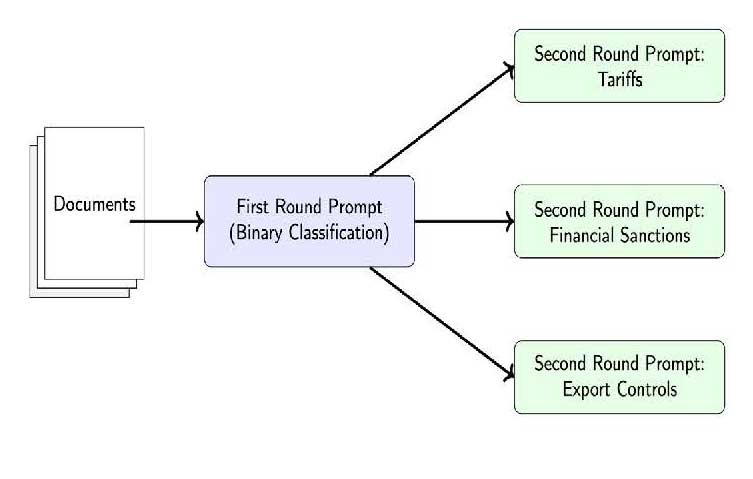
Multi-step LLM prompting procedure
Figure 2: Multi-step LLM prompting procedure

A first-stage prompt is applied to the entire text corpora to identify the subsample of firms that are affected by geoeconomic pressure at all. A second-stage prompt, which requires significantly longer run-time, is only evaluated on the subsample identified by the first-stage prompt, so as to avoid running the more computationally heavy inference on hundreds of thousands of firm-level documents.
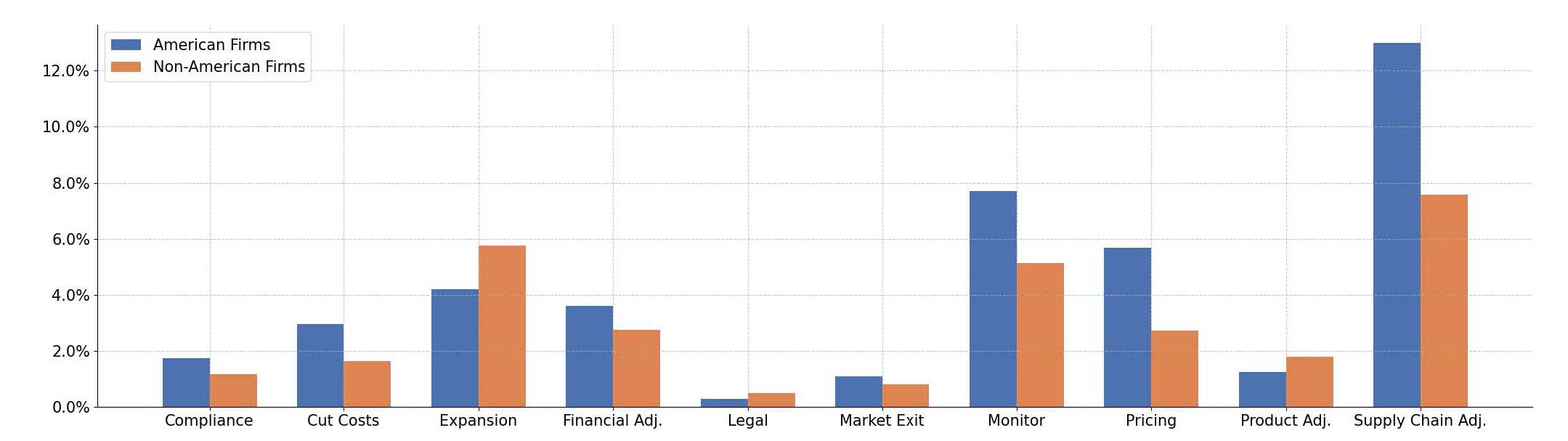
Responses to tariffs of American and non-American firms, 2025
Figure 5: Responses to tariffs of American and non-American firms, 2025

Excerpted from the non-technical brief (PDF). Visit The Global Capital Allocation Project Research Brief site to read the full brief.

About the Researcher(s)

Stephan Meier

Jesse Schreger

Associate Professor of Business
Economics Division

View the Research

Geoeconomic Pressure

You Might Like

Algorithms, Analytics, Artificial Intelligence, Business and Society, Business Economics and Public Policy, Data and Business Analytics, AI and Transformative Tech, Digital IQ, Finance, Marketing, Marketplace
Date
April 17, 2025
Close-up computer monitor with trading software
Algorithms, Analytics, Artificial Intelligence, Business and Society, Business Economics and Public Policy, Data and Business Analytics, AI and Transformative Tech, Digital IQ, Finance, Marketing, Marketplace

Designing Smarter Economic Systems: A New Approach to Mechanism Design

Award-winning research from Professor Laura Doval tackles the “limited commitment” problem in economics, offering a model that helps governments and firms adjust rules and strategies based on new information over time.
  • Read more about Designing Smarter Economic Systems: A New Approach to Mechanism Design about Designing Smarter Economic Systems: A New Approach to Mechanism Design
Artificial Intelligence, Data and Business Analytics, Data/Big Data, AI and Transformative Tech, Digital IQ, Marketing, Technology
Date
April 08, 2025
A woman shopping in a grocery store
Artificial Intelligence, Data and Business Analytics, Data/Big Data, AI and Transformative Tech, Digital IQ, Marketing, Technology

How Gen AI Is Transforming Market Research

Generative AI is revolutionizing market research by offering unprecedented ways to understand customers, assess competitors, and extend data-driven decision-making organizationally. Research with pioneering companies reveals four key opportunities: gen AI supports existing practices by making them faster and more scalable; replaces traditional methods with synthetic data that can match conventional results with greater accuracy; fills insight gaps by providing evidence for decisions previously based on intuition; and creates innovative applications like digital twins for testing customer interactions. Survey data shows 45% of market researchers already use gen AI, with most employing it to analyze transcripts and data. While acknowledging limitations around bias and representativeness, this framework helps business leaders navigate gen AI's transformative potential in gathering customer and market insights more efficiently and effectively than ever before.
  • Read more about How Gen AI Is Transforming Market Research about How Gen AI Is Transforming Market Research
Save Article

Download PDF

More to Explore
Share
  • Share on Facebook
  • Share on Threads
  • Share on LinkedIn
Official Logo of Columbia Business School

Columbia University in the City of New York
665 West 130th Street, New York, NY 10027
Tel. 212-854-1100

Maps and Directions
    • Centers & Programs
    • Current Students
    • Corporate
    • Directory
    • Support Us
    • Recruiters & Partners
    • Faculty & Staff
    • Newsroom
    • Careers
    • Contact Us
    • Accessibility
    • Privacy & Policy Statements
Back to Top Upward arrow
TOP

© Columbia University

  • X
  • Instagram
  • Facebook
  • YouTube
  • LinkedIn

External CSS

Homepage Breadcrumb Block