
While AI-based innovation continues to explode, generating around $1 trillion in investment and sparking new, never-before-seen efficiencies in business, healthcare, and culture, the true extent of the technology’s impact is only just beginning.
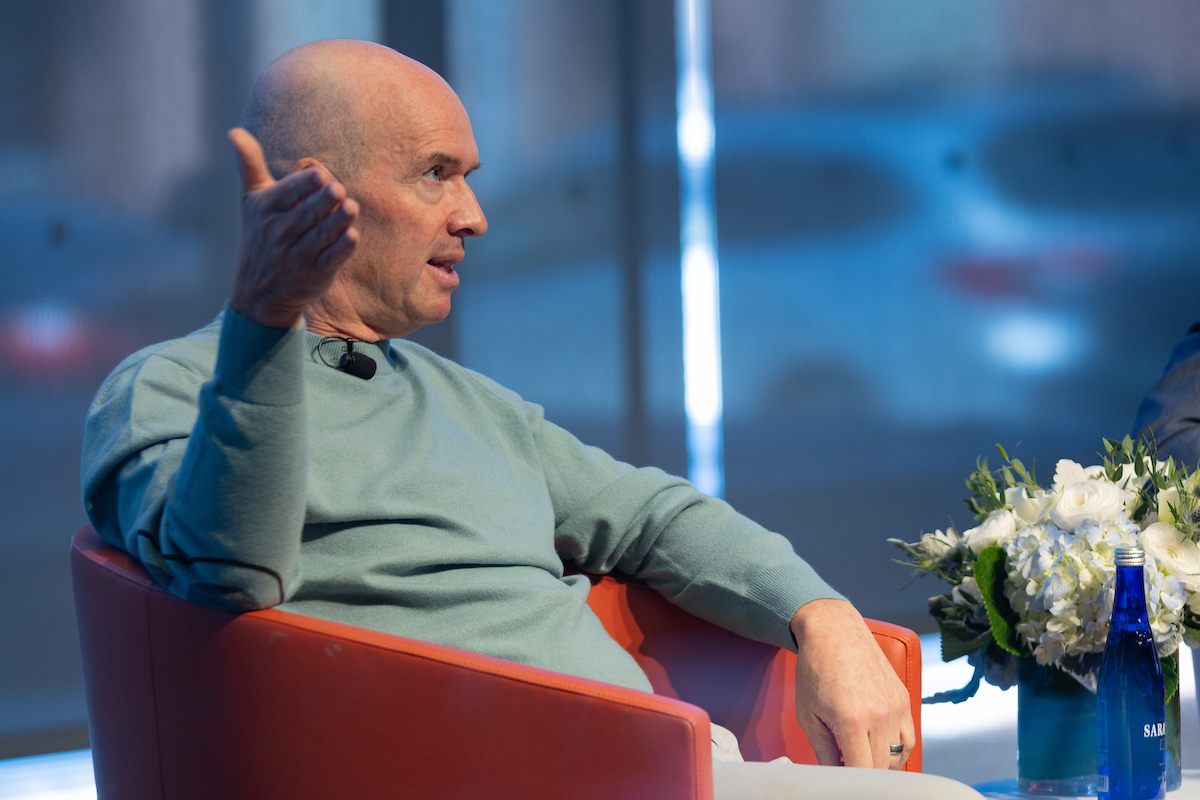
That is, according to venture capitalist Ben Horowitz (CC ’88), who spoke with Columbia Business School Dean and David and Lyn Silfen Professor of Business Costis Magalaras as part of the School’s Silfen Leadership Series. Horowitz, the co-founder and general partner of Andreessen Horowitz, also known as a16z, stressed that technology cycles play out over decades, not years.
This means that while the breakthroughs powering today’s AI applications are remarkable, the most transformative advances may still lie ahead — adopted into our economy more gradually and unpredictably than expected.
"Things are going to change. I think it's going to affect every single sector, but not in ways that you would easily anticipate,” Horowitz said.
The uncertainty around AI makes this moment both exciting and precarious for leaders. Horowitz noted that the future of AI could mean gradual improvements in existing tools or unleash entirely new industries and forms of work that we cannot yet imagine, requiring not only technical innovation but also strong leadership cultures capable of adapting to rapid change.
In his role at a16z, one of Silicon Valley’s most influential venture firms, Horowitz has spent the last 15 years backing many of the startups shaping this transformation. Those experiences shaped the perspective he shared during his conversation at CBS: that the AI technology cycle is still in its infancy, and why the U.S.’s openness in sharing such technology would be part of its greatest competitive strength.
How AI Could Reshape Industries
Horowitz explained that business leaders should be thinking about AI’s ripple effects, rather than short-term, direct impacts. He compared the current moment in AI’s lifecycle to the invention of the spreadsheet, whichwhich which helped give rise to the entire private equity industry. Just as most 18th-century workers could not have imagined roles like “graphic designer” or “marketing executive,” he argued, the most important AI-driven industries of the future are likely to be ones we cannot conceive of today.
“It's [AI’s] kind of both overrated and underrated in terms of the dislocation. If you look at the long arc of automation, going back to the 1750s when everybody worked in agriculture, nobody from 1750 would think any of the jobs we have now make any sense,” Horowitz said.
Already, these ripple effects are visible. Horowitz noted that in Hollywood, directors are experimenting with open-source video models to generate alternate takes of a scene, dramatically cutting production costs. Similarly, writers are quietly using AI to polish dialogue, accelerating workflows rather than eliminating jobs.
These shifts, Horowitz suggested, are less about outright replacement and more about expanding the boundaries of what creative professionals can do.
However, he stressed that AI’s broader impact will not be confined to the media. From finance to manufacturing, the technology is beginning by automating mundane tasks, but it could ultimately spark entirely new forms of value creation. Leaders, he warned, should therefore prepare not just for efficiency gains but also for industries that don’t yet exist.
Openness, Secrecy, and the Global AI Race
According to Horowitz, open-source AI models and their underlying technology infrastructure (e.g., blockchain) will be critical for enabling AI's future development and economic uses. However, the U.S. has quickly fallen behind countries like China in open-source AI leadership, which poses strategic risks.
That is because open-sourcing can lead countries to have an outsized impact on cultural power. AI models, Horowitz noted, encode values and perspectives, meaning that whoever leads in open source will have an outsized influence on global culture.
He dismissed the idea that secrecy can secure U.S. leadership. Even the Manhattan Project, he noted, could not prevent espionage. In today’s world, where information spreads instantly and adversaries excel at surveillance, clamping down on AI research only slows domestic innovation. Instead, the U.S. should play to its strengths by enabling broad participation in technological development.
"The way for the U.S. to compete is the way the U.S. always competes. We're an open society, which means everybody can contribute, everybody can work on things. We're not top down. And the way to get everybody to work on things is to have the technology be open and give everybody a shot at it,” Horowitz said.
Horowitz added that the same technology that underpins cryptocurrency could become an essential infrastructure for AI, providing systems for digital identity, transactions, and data security. In a world where AI agents might need to purchase goods or prove authenticity, blockchain offers tools that traditional systems like credit cards cannot.
Driving Culture in a Time of Disruption
Horowitz explained that culture and organizational behavior are key factors in building successful companies. They require thoughtful design of specific cultural norms and practices rather than just high-level value statements.
Beyond technology, Horowitz argued that leadership and culture will determine whether organizations thrive amid disruption. Drawing from his book, What You Do Is Who You Are, he stressed that culture must be defined in concrete behaviors rather than abstract values.
"Culture is not a set of beliefs. It's a set of actions,” Horowitz said, adding that at a16z, this philosophy takes the form of strict practices. Partners who show up late to meetings with entrepreneurs pay a $10-per-minute fine—a rule designed to signal respect for founders’ time.
“Why did I do that? Well, I want you to think that nothing is more important in your job or day than being on time for that meeting with that entrepreneur, because what they're doing is extremely hard. And you have to respect that. And you have to respect it by showing up on time,” he said.
Horowitz also shared a counterintuitive lesson for future CEOs: leaders cannot “develop” their executives the way managers can train their teams. Because CEOs hire specialists in areas they don’t personally master, trying to coach them is both ineffective and a distraction. Instead, leaders must focus on setting direction, making critical decisions, and ensuring that the right people are in place.
Horowitz emphasized that in moments of technological disruption, culture—not strategy decks or vision statements—determines whether organizations endure.
FAQs:
Q: What did Ben Horowitz say about the future of AI?
A: He argued that AI is in its early stages and will reshape industries in unpredictable ways, creating entirely new sectors, not just automating existing jobs.
Q: How does Horowitz believe U.S. companies should compete in AI?
A: By embracing openness. He stressed that open-source models and broad participation are more effective than secrecy in maintaining U.S. leadership.
Q: Why did Horowitz emphasize culture for leaders?
A: He said culture is about concrete actions, not abstract values. Strong cultural practices help organizations adapt and thrive during disruption.


