
Carbon Capture
Carbon capture, utilization, and storage (CCUS) is a critical technology for addressing climate change. It involves capturing carbon dioxide (CO₂) from industrial facilities or directly from the atmosphere through direct air capture (DAC), followed by its utilization or secure storage.


CCUS's Role in the Path to Net-Zero
Carbon Capture, Utilization, and Storage (CCUS) captures CO2 at the source from industrial facilities (point-source capture) or directly from the atmosphere (direct air capture).
CCUS can abate up to 6 gigatons of CO2 annually and play a strategic role in decarbonizing hard-to-abate sectors like cement, steel, and chemicals.
Download our CCUS deep dive slide deck to learn how this technology works and its role in achieving net-zero emissions by 2050.
Five Key Insights
The fundamental question facing carbon capture deployment is not whether the technology works, but when it makes economic sense. Levelized costs vary dramatically across sectors, calling for strategic, targeted deployment where economics are most favorable, instead of blanket support for CCUS.
For instance, the economics of ammonia production are compelling: High-purity (95-99%) CO₂ streams enable capture costs of just $15 to $20 per ton, and the captured carbon can be utilized directly in the production process. This represents true commercial viability where CCUS improves rather than penalizes the economics of production.
.jpg)
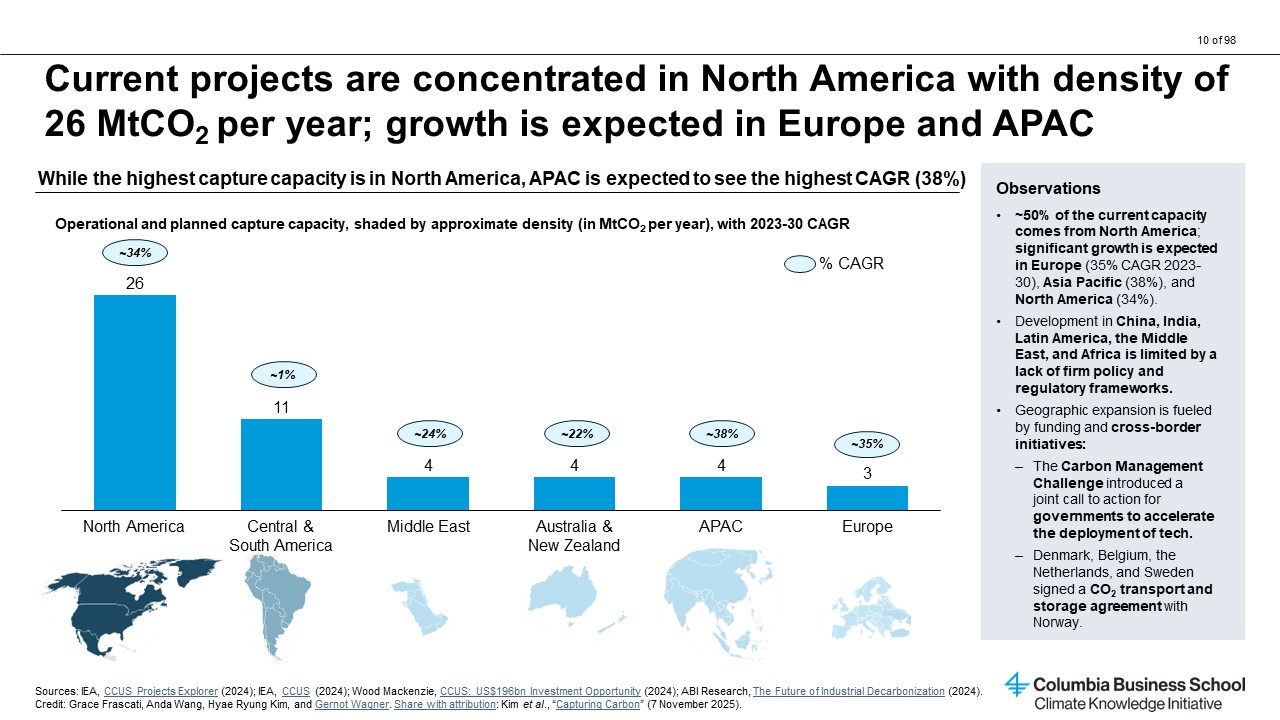
Current global CCUS capacity stands at around 50 MtCO₂ per year, or just about 0.1% of global emissions. By IEA accounting, reaching net zero by 2050 would require a 20-fold increase by 2030 and 100-fold by 2050.
North America has the definitive head start in CCUS deployment, followed by Central and South America. Asia Pacific, meanwhile, is expected to grow the fastest by 2030, with Europe — driven by the EU’s emissions trading system — close behind.
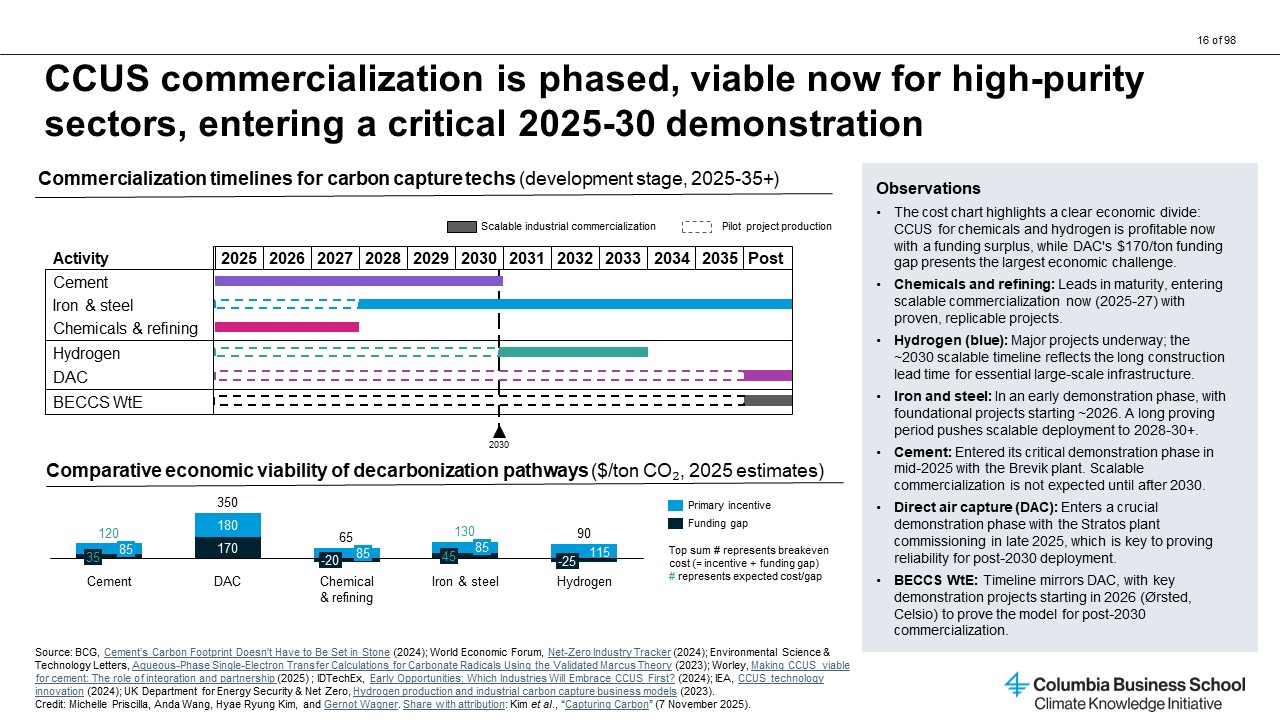
Carbon capture’s economic and strategic role is strongest for applications with high-purity waste streams like ethanol and ammonia production; those with process emissions shares greater than 90%, like cement and some iron production; plants with remaining asset lifespans greater than 15 years; and industries with costly low-carbon alternatives. Applying CCUS indiscriminately risks capital misallocation that could undermine more effective climate solutions.
The moral hazard here cannot be overstated. If the mere prospect of CCUS down the line appears to offer a license to maintain existing operations, industrial sectors may delay necessary transitions to alternative production methods. Thus, selective application is imperative to carbon capture’s case as a legitimate abatement solution.
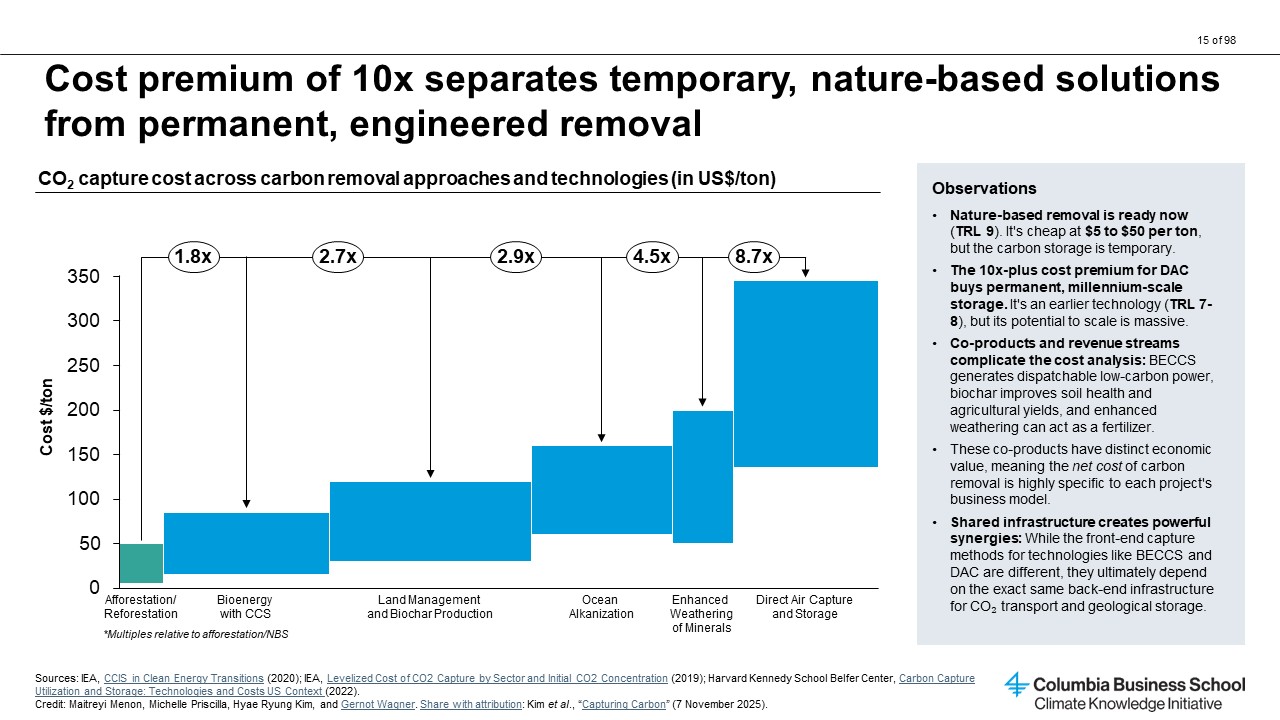
Direct air capture (DAC) current costs range from $135 to $350 per ton, with some projections claiming a reduction to under $100 by 2030. Even then, DAC would remain economically viable only for applications with extremely high carbon values or where alternatives don't exist.
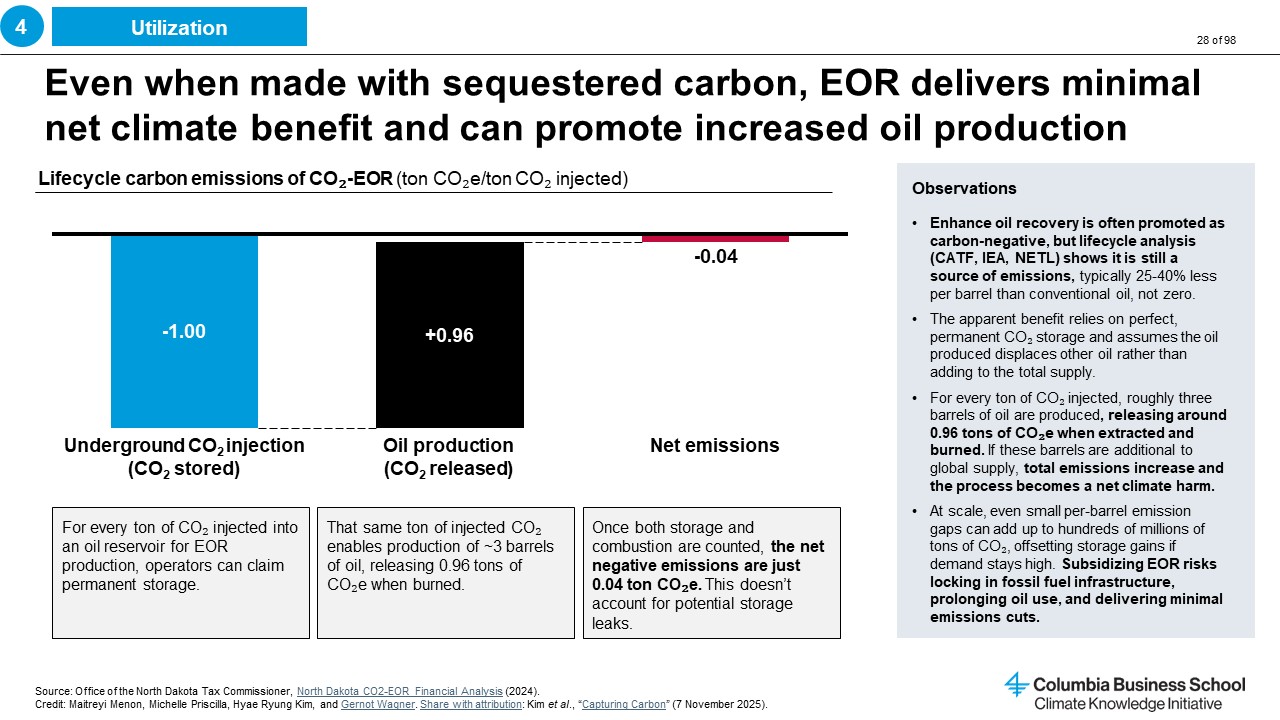
Nothing has damaged CCUS’s credibility more than its association with fossil fuel industry efforts to extend the operating life of oil and gas infrastructure. Major oil companies have positioned themselves as leaders in carbon capture research and deployment, creating skepticism about whether CCUS represents genuine climate action or strategic greenwashing.

Carbon Capture's ‘Yes, and’ Role in Climate Action
The global energy transition is experiencing unprecedented momentum. Solar and wind power have achieved grid parity in most markets, electric vehicle sales are accelerating exponentially, and renewable energy investment is outpacing fossil fuel investment by a factor of two to one. Yet, despite this remarkable progress, the world is unlikely to decarbonize fast enough to meet our climate commitments.