


The global energy transition is experiencing unprecedented momentum. Solar and wind power have achieved grid parity in most markets, electric vehicle sales are accelerating exponentially, and renewable energy investment is outpacing fossil fuel investment by a factor of two to one. Yet, despite this remarkable progress, the world is unlikely to decarbonize fast enough to meet our climate commitments.
The main reason lies not with the rapidly transforming electricity system but with stubborn industrial processes that have yet to significantly scale clean technologies. Conventional cement production releases carbon dioxide from burning fuel to heat kilns and from the chemical process that converts limestone into cement. Steel manufacturing, similarly, uses blast furnaces and releases carbon dioxide during the chemical reduction of iron ore. Long-haul shipping and aviation face energy density challenges that current battery technology cannot (yet) overcome. A rapidly decarbonizing electric grid can help, but it alone is not enough to address these emissions.
These hard-to-abate sectors represent roughly 30% of global emissions and a fundamental challenge to climate action. Various technological levers can address at least some of these emissions, but there will still be some where carbon capture is not just potentially useful but necessary. We estimate that range to be approximately 10 to 15% of global emissions. While it’s technically possible to electrify the chemical processes that produce cement or turn iron ore into iron, this is where carbon capture, utilization, and storage (CCUS) plays a potentially critical role — not as a lifeline for oil and gas, nor as a silver bullet or replacement for tackling supply chain emissions, but as one potential tool among many.
Here is also where the current discourse becomes problematic: CCUS has become entangled with efforts to extend the life of fossil fuel infrastructure, creating a credibility gap that undermines its legitimate climate applications. To understand why carbon capture matters, and where it doesn't, requires moving beyond both technological enthusiasm and ideological skepticism to examine the hard economics of industrial decarbonization.
Key Insight #1: Sector-specific economics determine CCUS viability
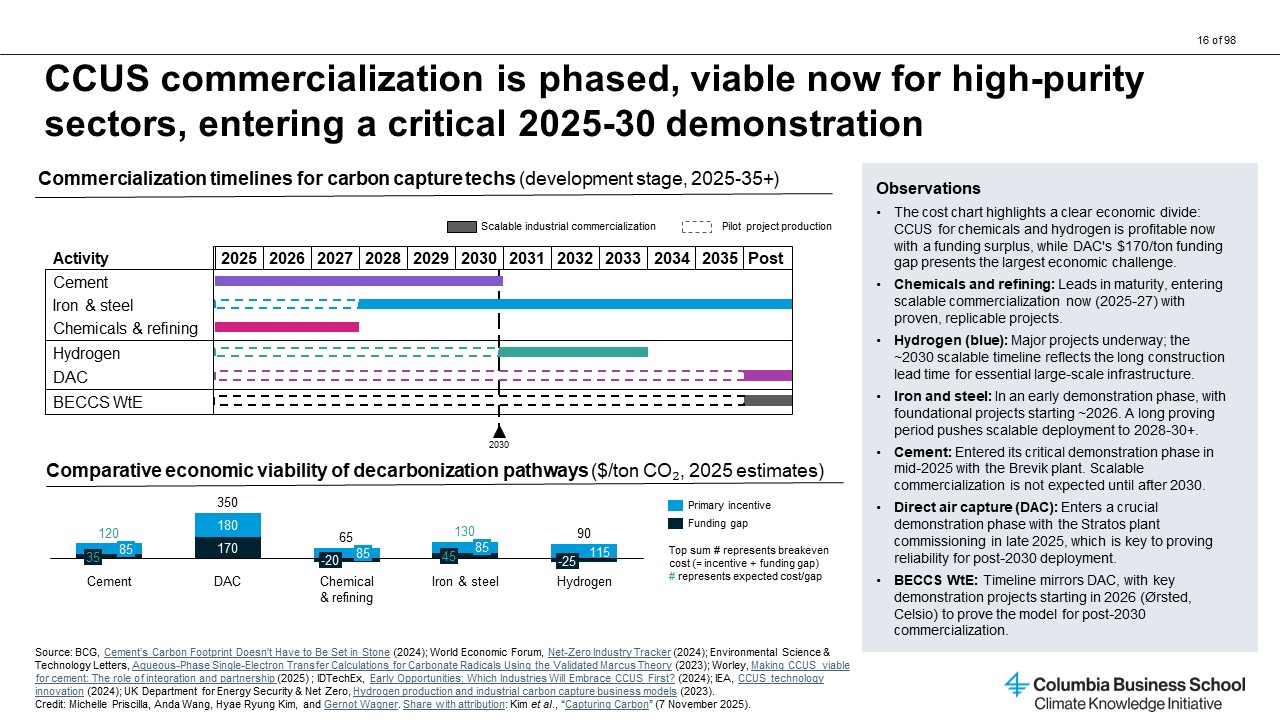
The fundamental question facing carbon capture deployment is not whether the technology works, but when it makes economic sense. Levelized costs vary dramatically across sectors, calling for strategic, targeted deployment where economics are most favorable, instead of blanket support for CCUS.
For instance, the economics of ammonia production are compelling: High-purity (95-99%) CO₂ streams enable capture costs of just $15 to $20 per ton, and the captured carbon can be utilized directly in the production process. This represents true commercial viability where CCUS improves rather than penalizes the economics of production.
.jpg)
Learn more about Columbia Business School’s Climate Knowledge Initiative: Carbon Capture
Contrast this with cement, where flue gas diluting requires energy-intensive separation, driving capture costs up to $60 to $134 per ton, with limited utilization opportunities. Even with generous policy support like the Inflation Reduction Act (IRA)'s $85 per ton of stored CO₂ 45Q tax credit (extended and expanded under the One Big Beautiful Bill Act, OBBBA), cement still falls about $22 per ton short of cost parity.
Relying on high-cost CCUS is "highly economically damaging" and projected to cost at least $30 trillion more than a pathway focused on renewables, energy efficiency, and electrification to reach net zero by 2050. Searching for lowest-cost mitigation opportunities favors immediate investment in proven and cost-efficient solutions over longer-term, costly CCUS infrastructure.
Key Insight #2: Scaling carbon transport and storage infrastructure is key to scaling deployment
Current global CCUS capacity stands at around 50 MtCO₂ per year, or just about 0.1% of global emissions. By IEA accounting, reaching net zero by 2050 would require a 20-fold increase by 2030 and 100-fold by 2050.
North America has the definitive head start in CCUS deployment, followed by Central and South America. Asia Pacific, meanwhile, is expected to grow the fastest by 2030, with Europe — driven by the EU’s emissions trading system — close behind.
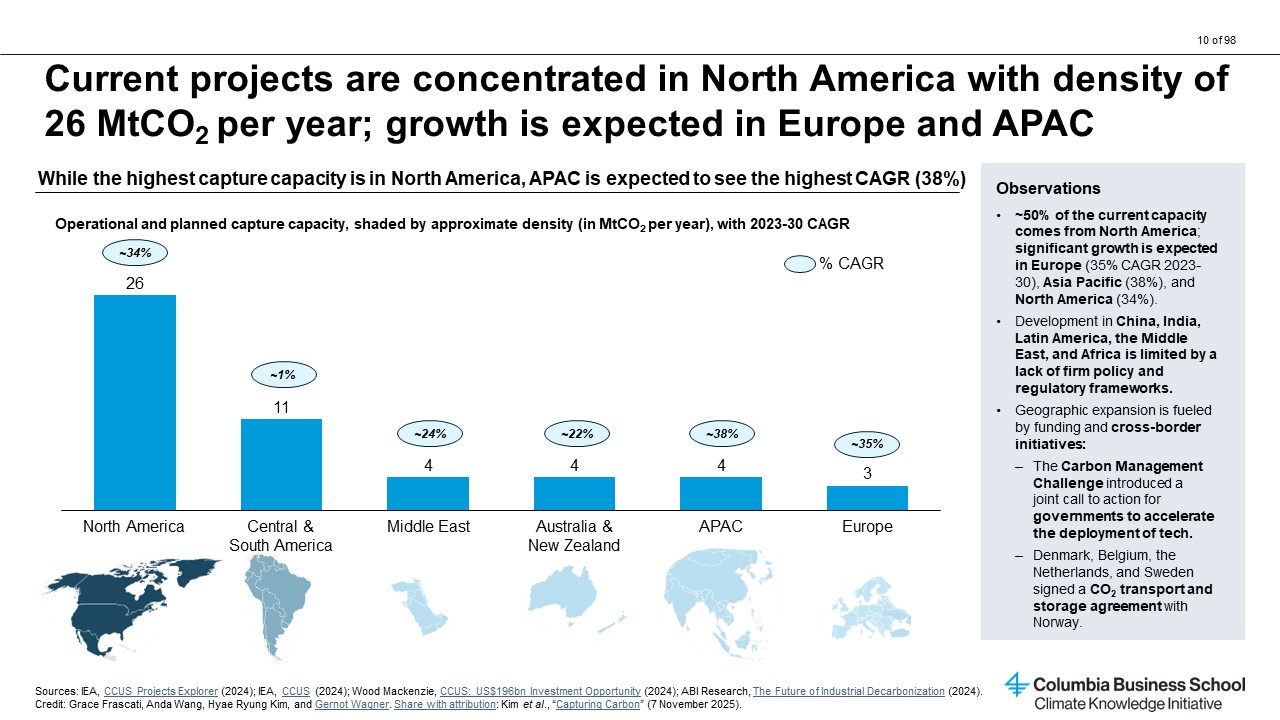
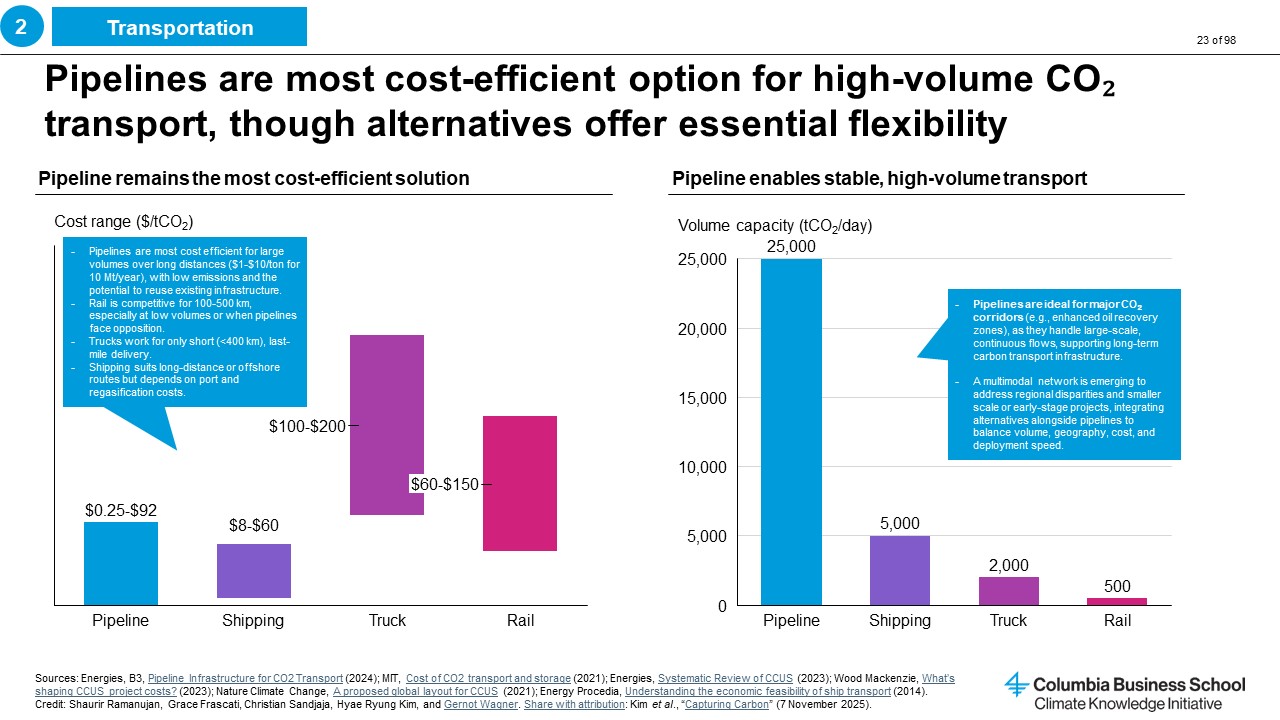
But the key bottleneck to widespread deployment, more so than capture technology itself (where chemical absorption and physical separation have reached commercial readiness), is carbon transport and storage infrastructure.
The good news: Strategic investment in shared CO₂ transport infrastructure and coordinated industrial clusters can drastically drop costs. Finland’s planned regional hubs, for instance, are projected to reduce total project costs by an average of 30%. And while small, project-specific pipelines can be cost-prohibitive, large shared CO₂ corridors moving more than ~12 Mt per year can achieve transport costs well below $10 per ton, thereby unlocking commercial viability.
Key Insight #3: CCUS should be reserved for high-purity waste streams and long-lived assets in hard-to-abate sectors with large process emissions to avoid a delayed low-carbon transition
Carbon capture’s economic and strategic role is strongest for applications with high-purity waste streams like ethanol and ammonia production; those with process emissions shares greater than 90%, like cement and some iron production; plants with remaining asset lifespans greater than 15 years; and industries with costly low-carbon alternatives. Applying CCUS indiscriminately risks capital misallocation that could undermine more effective climate solutions.
The moral hazard here cannot be overstated. If the mere prospect of CCUS down the line appears to offer a license to maintain existing operations, industrial sectors may delay necessary transitions to alternative production methods. Thus, selective application is imperative to carbon capture’s case as a legitimate abatement solution.
A key tradeoff is the timing of CCUS itself, with most applications achieving commercial scale on a five- to 10-year timeline. This temporal challenge emphasizes its role as a complement to, not a substitute for, immediate deployment of renewable energy and efficiency measures that can deliver emission reductions within this decade.
Key Insight #4: Direct air capture will be needed to remove legacy emissions but remains costly, energy-intensive, and reliant on sustained investment
Direct air capture (DAC) current costs range from $135 to $350 per ton, with some projections claiming a reduction to under $100 by 2030. Even then, DAC would remain economically viable only for applications with extremely high carbon values or where alternatives don't exist.
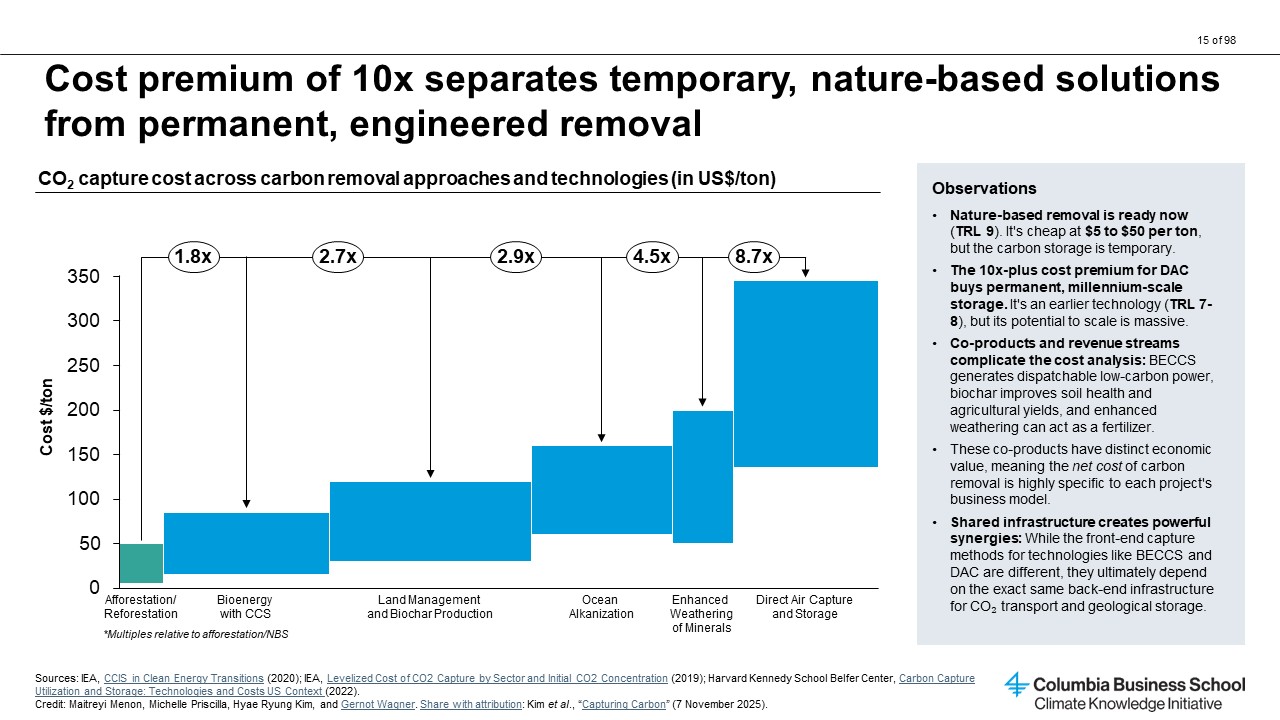
DAC faces the classic economic "valley of death," the gap between demonstration and commercial viability that requires sustained investment without clear economic returns. In other words, achieving cost competitiveness requires massive-scale deployment at costs that current economics cannot justify. Yet DAC serves a strategic purpose that point-source capture cannot: addressing legacy emissions and delivering net-negative emissions later this century. Atmospheric CO₂ concentrations accumulate emissions from decades past that only DAC, enhanced mineralization, and other ambient carbon removal technologies can remove. The strategy for DAC deployment should therefore focus on permanent storage for climate benefit rather than utilization for commercial applications, requiring different economic evaluation criteria than point-source capture.
DAC also highlights critical verification and permanence challenges that apply across all CCUS applications. Storage permanence requires geological monitoring for decades to centuries, and verification of capture rates remains technically complex and expensive. These factors add 5 to 20% to total system costs but are essential for climate credibility.
Additionally, the high energy requirements for DAC (1,500 to 2,000 kWh per ton CO₂) mean that deployment without dedicated renewable energy sources could potentially compromise net emissions reductions, a challenge that extends to energy-intensive point-source capture as well.
Key Insight #5: The oil industry’s use of CCUS and DAC to extend its “license to operate” undermines their credibility
Nothing has damaged CCUS’s credibility more than its association with fossil fuel industry efforts to extend the operating life of oil and gas infrastructure. Major oil companies have positioned themselves as leaders in carbon capture research and deployment, creating skepticism about whether CCUS represents genuine climate action or strategic greenwashing.
This skepticism reflects legitimate concerns about scope 1 versus scope 3 emissions. Scope 1 emissions occur directly from industrial operations like the CO₂ released from cement kilns or steel furnaces; scope 3 emissions happen downstream, when CO₂ is released by consumers burning gasoline or natural gas.
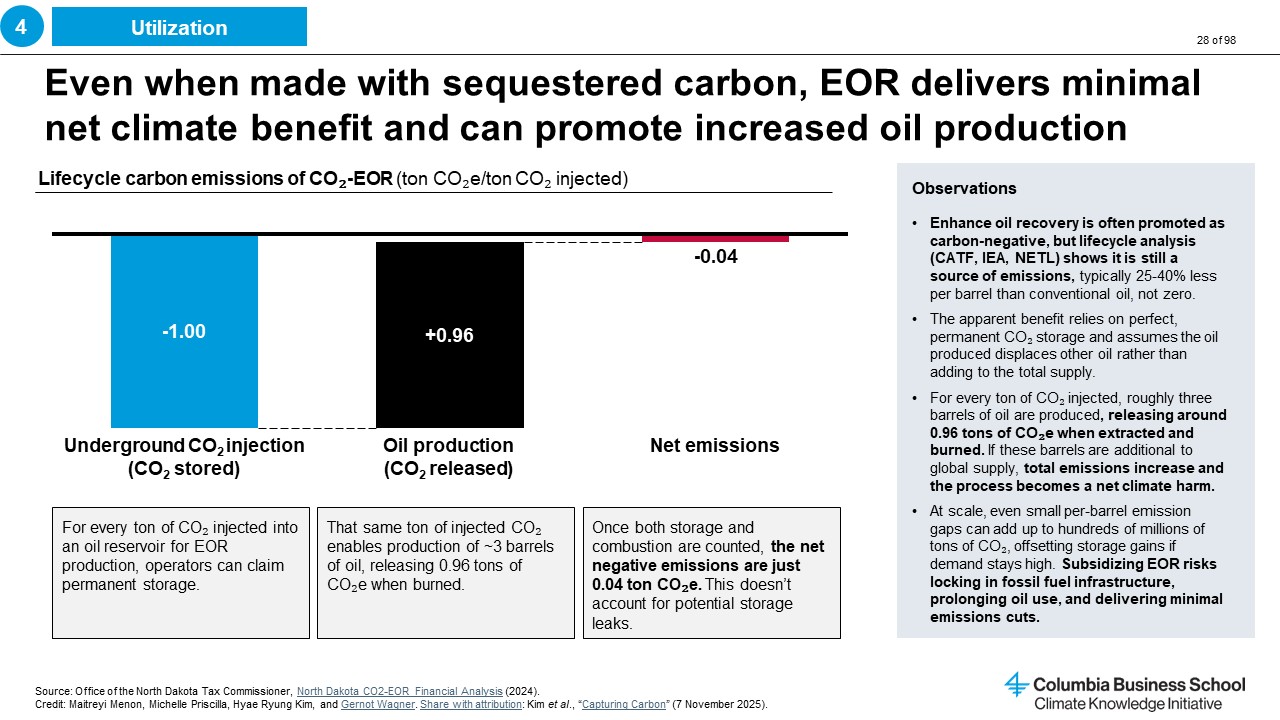
CCUS applied to oil and gas extraction (capturing CO₂ from refineries or natural gas processing) addresses scope 1 emissions from production but may indirectly increase scope 3 emissions by enabling increased supply to consumers. Enhanced oil recovery (EOR), which uses captured CO₂ to extract additional oil from depleted wells, is the worst offender, bringing more fossil fuels to market.
The question becomes whether CCUS deployment that enables continued fossil fuel production represents a net climate benefit or actually leads to worse carbon lock-in.
CCUS is a genuine decarbonization solution only when addressing emissions that cannot be eliminated through other pathways. Building new fossil fuel plants with carbon capture technology when clean and lower-cost energy alternatives are ready for deployment is a resource misallocation. Retrofitting young cement plants with CCUS represents legitimate climate action.
Key Insight #6: The CCUS policy landscape is shaped by political volatility, where incentives like 45Q persist but lack safeguards against fossil fuel dependence
The recent rescission of over $3.5 billion in U.S. Department of Energy funding for $7.56 billion in U.S. Department of Energy funding for 223 clean energy projects, announced October 2, 2025, underscores the political volatility facing carbon capture deployment. This move signals retreat from previous commitments and adds uncertainty to long-term infrastructure planning.
While Congress preserved the 45Q tax credit in July 2025, the EPA proposed gutting the Greenhouse Gas Reporting Program in September, dismantling the data infrastructure the IRS uses to verify storage claims. This bureaucratic maneuver threatens to render the tax credit unworkable without congressional action.
Nevertheless, carbon capture was a relative winner under the One Big Beautiful Bill Act (OBBBA) signed into law on July 4, 2025. While many clean energy tax credits were scaled back or eliminated, the 45Q carbon capture credit was largely preserved. In fact, OBBBA equalized the tax credit rates for sequestration and utilization, raising the EOR rate from $60 to $85 per ton to match permanent sequestration rates. This long-sought parity addressed industry concerns about differential treatment between utilization and storage applications, though it also means taxpayers now subsidize fossil fuel extraction at the same rate as permanent storage.
This matters because policy volatility undermines the long-term economics that CCUS deployment requires. Projects need 5 to 10 years to develop and operate for 20 to 30 years. When governments cancel billions in promised funding while simultaneously undermining tax credit verification, investors demand higher returns to compensate for political risk, raising effective costs by 2 to 3 percentage points even when subsidies remain on paper.
The political challenge reflects deeper tensions about CCUS's role in the energy transition. The U.S. Inflation Reduction Act's 45Q credits effectively created an $85 per ton carbon price for stored CO₂, making blue hydrogen and blue ammonia economically viable with net benefits of $25 to $45 per ton. But this benefit hinges on continued political backing for carbon management infrastructure.
Europe takes a different approach. The EU's Carbon Border Adjustment Mechanism (CBAM), which enters full force in January 2026, taxes importers for the carbon embedded in their products based on EU carbon prices. This incentivizes industrial decarbonization without favoring a specific technology. Companies will choose CCUS abatement when it makes economic sense and intrinsically lower-carbon alternatives when those are more cost-effective.
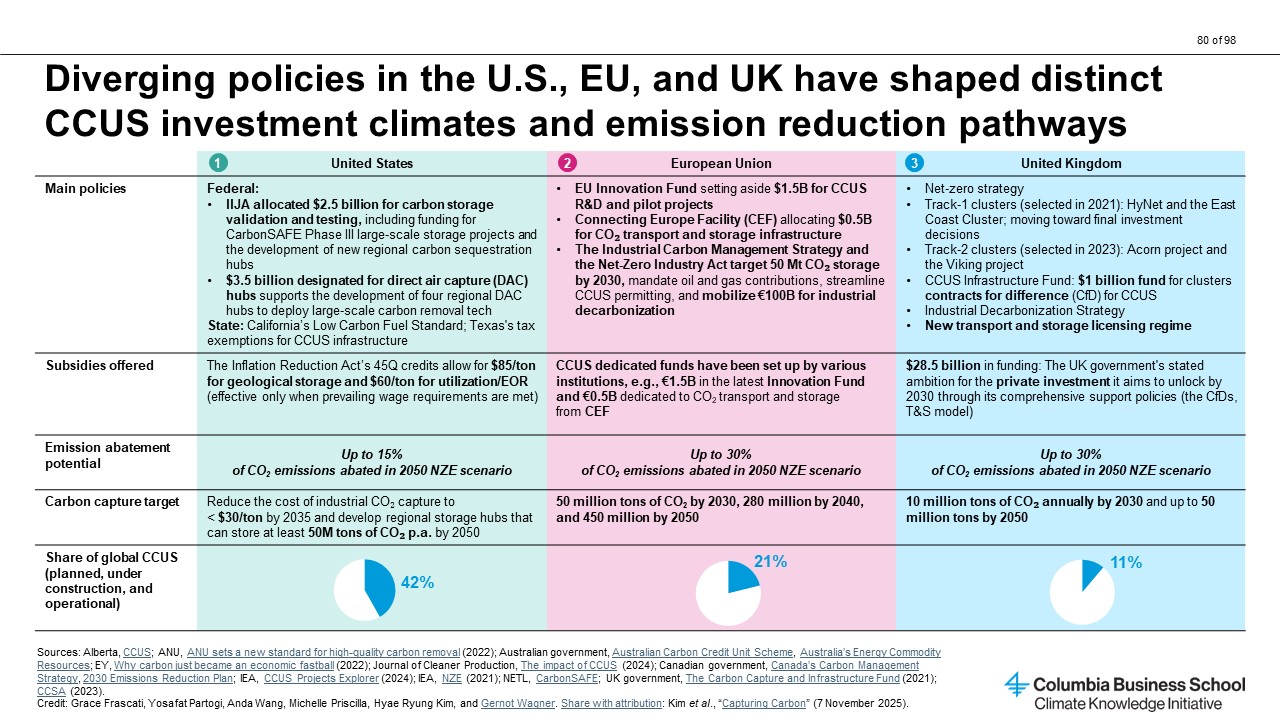
Nevertheless, a key omission in all current policies is a regulatory framework that distinguishes between legitimate climate applications and fossil fuel life extension, instead of treating all CCUS applications equally.
Effective policy would establish clear carbon pricing that rewards emission reductions regardless of technology, while restricting subsidies to applications addressing unavoidable industrial process emissions. Instead, current policy offers blanket support that subsidizes fossil fuel extraction at the same rate as industrial decarbonization, undermining both economic efficiency and climate credibility.
A strategic CCUS framework targets high-value sectors, leverages shared infrastructure, and relies on carbon pricing rather than blanket subsidies
To effectively deploy CCUS, we must abandon the notion that it's a universal climate solution and instead apply rigorous economic analysis to identify where it creates genuine value. This framework should prioritize three criteria: commercial viability without permanent subsidies, comparative advantage over alternatives, and strategic necessity for climate objectives.
First, focus deployment on sectors with greater than 90% process emissions, high-purity waste streams, and stranded assets with greater than 15-year remaining lifespans. Cement's calcination process, ammonia production's high-purity CO₂ streams, and ethanol fermentation's concentrated emissions all represent applications where CCUS economics can achieve positive returns. Steel production's mixed emissions profile requires case-by-case analysis comparing CCUS retrofits with hydrogen-based alternatives.
Second, infrastructure coordination is the most effective lever for improving CCUS economics. Developing shared CO₂ corridors with a minimum 5 million tons per year throughput can achieve transport costs under $10 per ton while enabling industrial clustering.
Third, carbon pricing frameworks provide more durable and efficient incentives than technology-specific subsidies, as they reward CCUS where it offers economic value while avoiding political volatility that undermines long-term infrastructure investment.
At $85 per ton, the value of the U.S. federal 45Q tax credit for carbon capture from industrial and power facilities, carbon capture can be cost-competitive with some industrial emissions reduction strategies, but in many cases, renewable energy deployment continues to offer a lower cost per ton of CO₂ abated.
Carbon capture is neither the climate panacea that industry advocates suggest nor the fossil fuel conspiracy that critics claim. It represents a necessary tool for addressing specific industrial emissions that cannot currently be eliminated through other pathways.
Economic discipline, rather than technological enthusiasm, will determine whether carbon capture becomes a transformative climate solution or an expensive distraction from more cost-effective alternatives. The stakes are too high for anything less than rigorous strategic thinking about where carbon capture fits in the broader decarbonization agenda.
We thank Grace Frascati, Petr Jenicek, Sean Lee, Yosafat Partogi, Michelle Priscilla, Shaurir Ramanujan, Christian Sandjaja, Anda Wang, and Xiaodan Zhu for research and analysis supporting this article.


