


Pathways for Nuclear Power Deployment
Nuclear energy use has decreased from its peak of 17% in the 1990s to 9% today, and deployment has largely moved from Europe and the United States to India and China. Yet, with accelerating power demand from (industrial) electrification and data centers, and record-high public support, this safe, clean, and dispatchable energy source is primed for a revival.
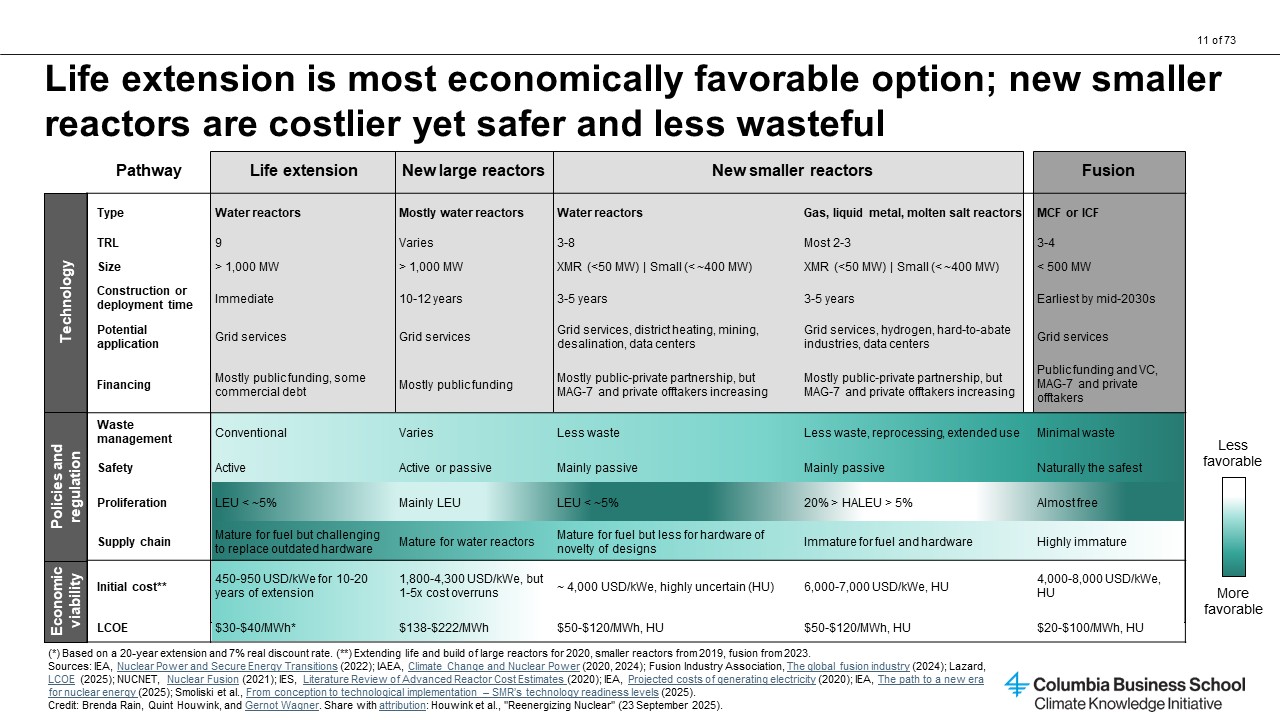
There are four pathways for the future of nuclear power:
- Extending the lifetime of existing nuclear plants, which has the lowest LCOE.
- Building new large reactors, which has low technology risk but high cost overruns and long time horizons.
- Developing small modular reactors (SMRs), which provide more flexibility, but are still emerging technologies.
- Developing fusion technology, which addresses many of nuclear’s challenges, but has yet to prove it can produce commercial power.
Download Reenergizing Nuclear below to explore the role of nuclear power in the future of energy.
Three Key Points
Large-scale nuclear plants are beset by a reputation risk separate from the accident-related anxieties spurred by Chernobyl and Fukushima. They are also hampered by their financial risks.
Many cite Plant Vogtle in Waynesboro, Georgia — the largest nuclear plant in the United States — as a prime case study. Vogtle’s first two units were constructed in the 1980s, and the initial capital investment estimate of $660 million mushroomed by more than a factor of 10 to $8.87 billion.
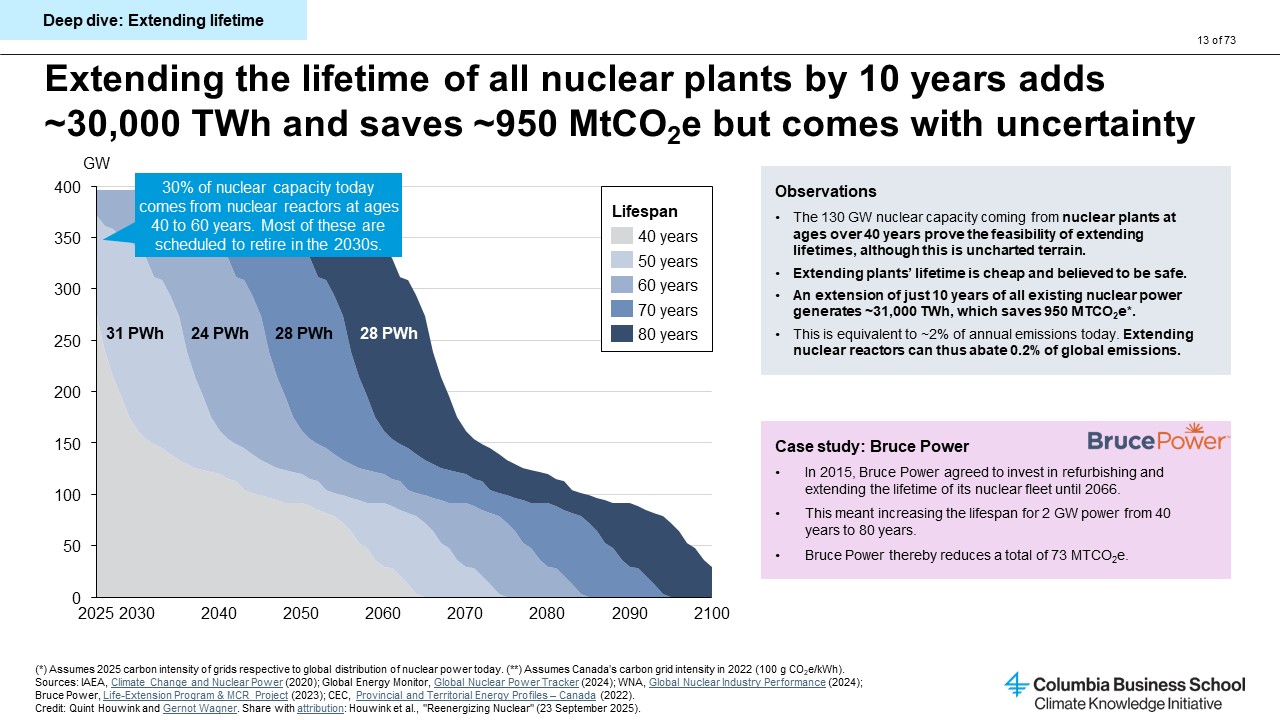
Extending the lifetimes of all existing nuclear plants by just 10 years would generate an estimated 31,000 additional TWh of energy, thereby saving about 950 metric tons of CO2 emissions — equivalent to 2% of today’s annual emissions.
This would require relatively cheap and safe refurbishments to standing power plants — at least, that’s the broadly shared belief, as this approach is still uncharted terrain.
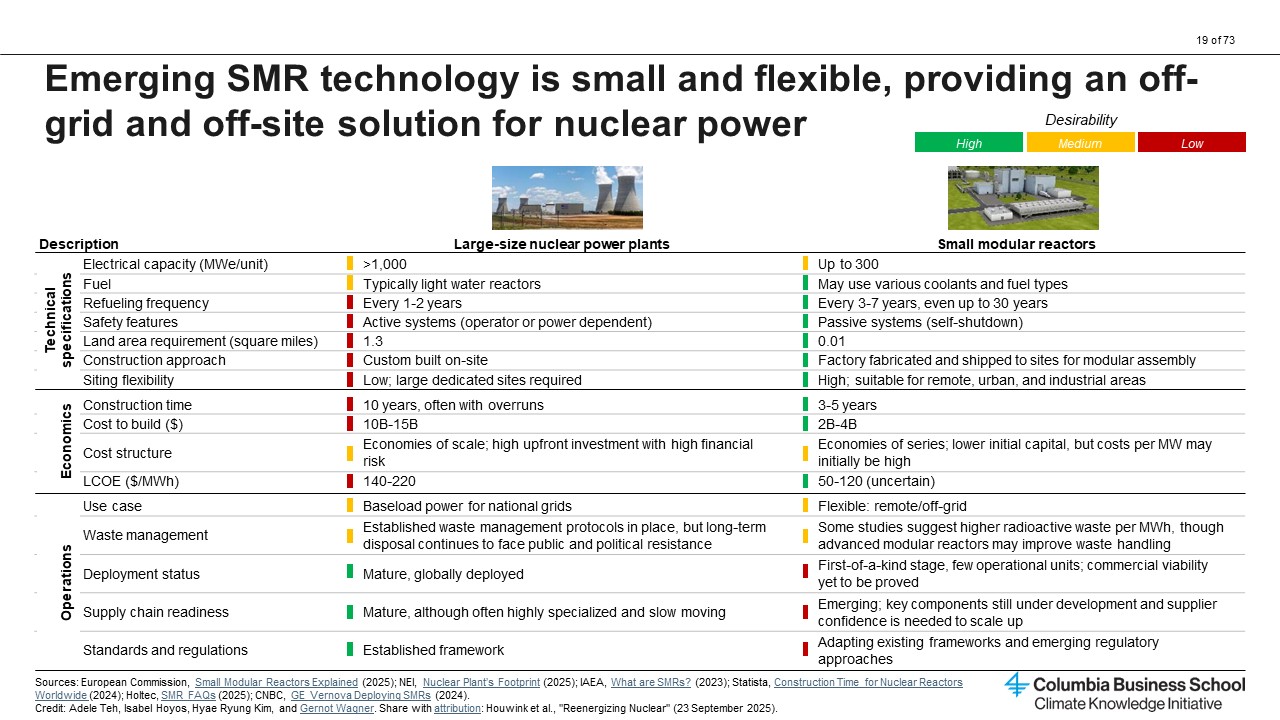
Emerging technologies like SMRs present a set of challenges that invert those posed by large nuclear reactors: While building a large nuclear plant is a known quantity and technologically safe, it’s a highly risky financial proposition because of unpredictability and cost overruns. In contrast, SMRs still pose plenty of tech risks, but their upfront financing costs are comparatively low — and therefore more attractive to VC investors and other private capital.
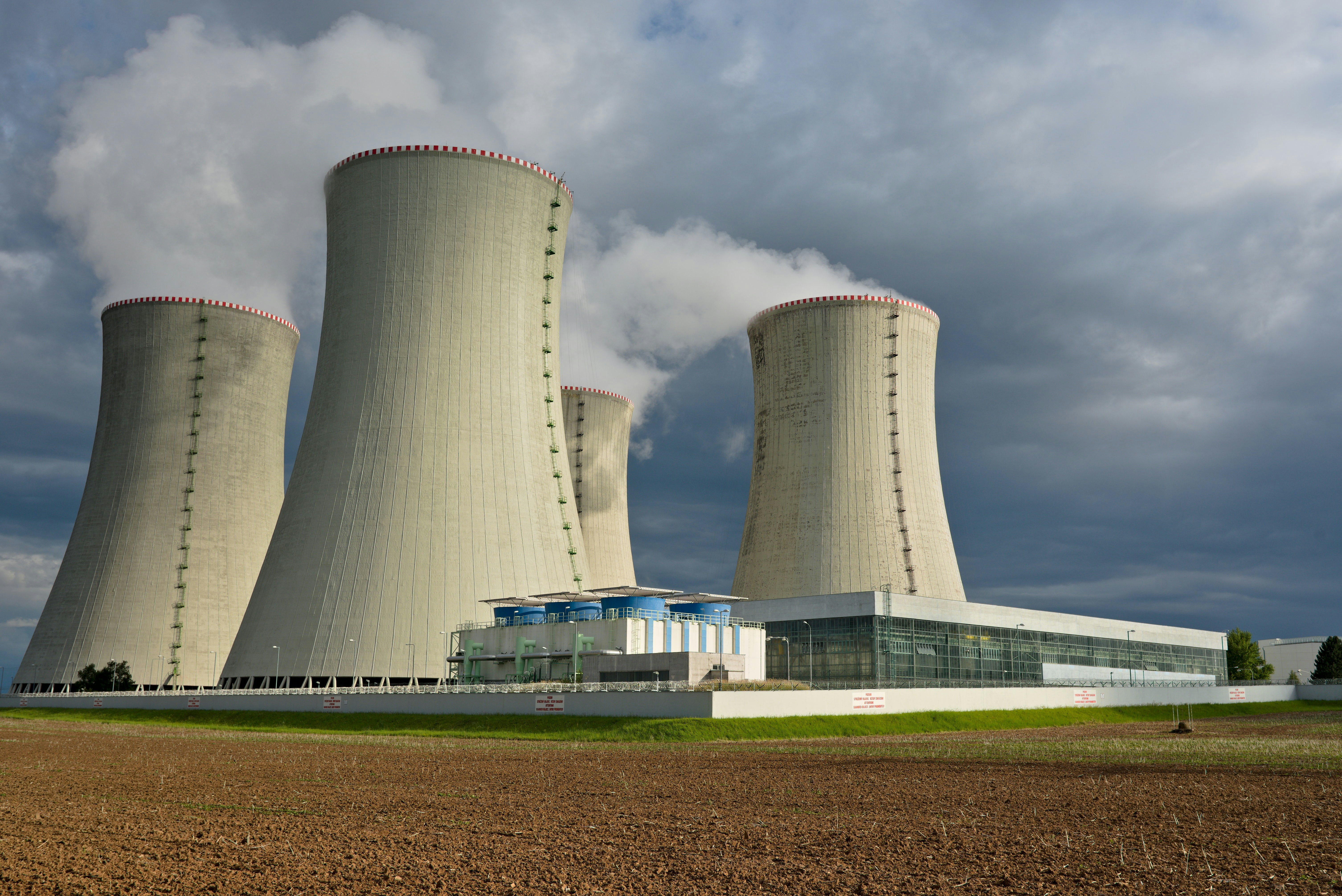

Sizewell C: Investing in a Regulated Nuclear Power Project
You are weighing an equity investment in Sizewell C: regulated, inflation-linked returns over 60 years, but only if it gets built. After Hinkley Point's overruns, does the Regulated Asset Base (RAB) framework, with government backing, transfer enough construction risk away from you to make this nuclear megaproject investable?

Marvel Fusion
How should Marvel Fusion navigate the technological challenges of commercializing laser-based fusion energy while managing investor expectations and competing against both established nuclear fission technologies and magnet-based fusion alternatives?
In March 2025, Marvel Fusion, a German startup founded in 2019, became the best-funded laser-based fusion company globally. It represents the new wave of private companies attempting to make fusion energy a reality, with an ambitious goal of translating breakthrough laser physics research into commercially viable power generation by 2035.

Reenergizing Nuclear Power: Key Insights from Industry Leaders
Nuclear power is safe, clean, and dispatchable. Yet, it's experiencing a paradox: while public support is at a record high, deployment remains stagnant. From extending the lives of existing large reactors to developing cutting-edge small modular reactors (SMRs) and fusion technology, different pathways promise to unlock nuclear's potential. What will it take to reenergize the industry, and which approach offers the best path forward?

Clean Core Thorium Energy and the Role of Nuclear Power in the Low-carbon Transition
Is nuclear power an attractive alternative for the production of cleaner, low-carbon energy?
In the landscape of low carbon sources of energy, nuclear power stands out as an option that has generated increasing attention and capital investment. Since 2001, nuclear energy production has been in decline, though Clean Core Thorium Energy, led by Mehul Shah, is one of the companies that is bringing nuclear back to the forefront.