
From technological disruption to climate challenges and geopolitical uncertainty, the pressures on the global finance industry—and its leaders—have rarely been greater.
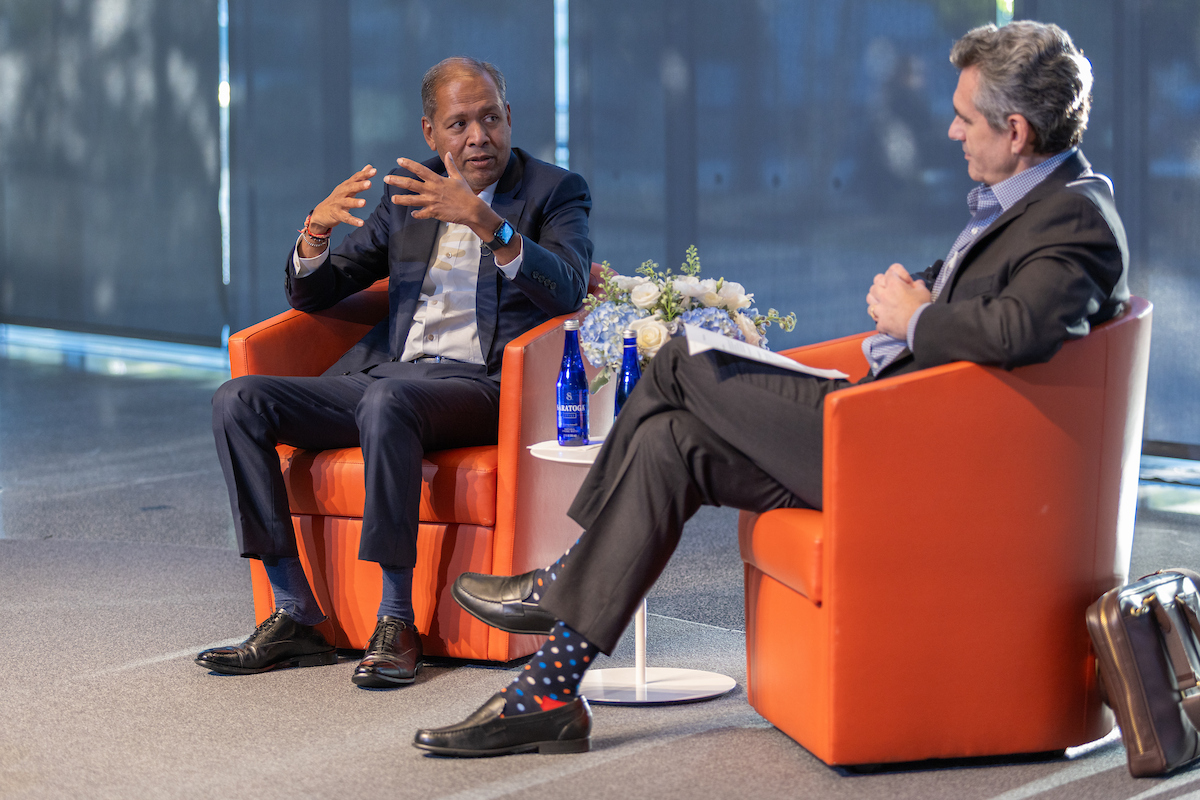
Few banking leaders are more aware of the challenge than Barclays CEO C.S. Venkatakrishnan, or Venkat, who visited Columbia Business School as part of the Silfen Distinguished Leadership Series.
Venkat’s own journey has been shaped by unexpected turns. Trained as an operations researcher at MIT, he began his career at JPMorgan, spending more than two decades in roles spanning asset management, investment banking, and risk. He joined Barclays in 2016, became Chief Risk Officer, and in 2021 was appointed Group Chief Executive.
In conversation with Professor Harry Mamaysky, Venkat reflected on what it takes to lead through uncertainty, sharing five lessons on leadership and drawing on his career to show how adaptability and judgment matter as much as technical skills.
1. Careers Are Built on Serendipity
Venkat was candid about how little of his career unfolded according to plan. After completing his PhD at MIT in operations research, he struggled to find an academic role and instead accepted a position at JPMorgan. He started as a programmer writing valuation models for derivatives, hardly the glamorous start to a Wall Street career. Over the next two decades, he rotated through asset management, fixed income, and eventually structured derivatives.
Most of these moves were unplanned. “Of all the job changes I made, I don’t think I asked for a single one. They all came to me,” he recalled.
Some opportunities, such as becoming Chief Investment Officer of Fixed Income during the global financial crisis, were a trial by fire. Others, like being asked to run the risk function, he initially resisted but later found transformative.
For Venkat, the key lesson is that adaptability matters more than careful planning. Careers will involve both good years and setbacks, supportive bosses and difficult ones. What sustains progress is resilience—the ability to keep learning, absorb disappointments, and step into roles that may not have been part of your original blueprint.
2. Risk-Based Thinking Builds Stronger Leader
While risk management has often been viewed as a non-traditional career track, Venkat argues it has become one of the most valuable training grounds for senior leaders. He acknowledged he did not want to move into risk when first asked, but the role reshaped his thinking. Today, he noted, several global bank CEOs share a risk background, and for good reason.
“Risk is not about cutting losses,” he said. “It is about the long-term profitability of the institution.”
This mindset forces leaders to look beyond quarterly earnings and weigh the consequences of today’s decisions years into the future. Venkat contrasted the banks that survived the financial crisis with those that failed, emphasizing that the difference often came down to leadership teams who truly understood the risks they were taking.
He also described how risk roles reveal the full picture of a bank: short-term profit drivers, long-term exposures, and the cultural behaviors that can make or break an institution. That perspective, he argued, equips leaders to guide organizations through cycles of growth, volatility, and disruption. For aspiring leaders, this means embracing risk is not just about protecting against losses—it is about developing the discipline to preserve resilience over the long term.
3. Lasting Leadership Depends on Integrity and Stewardship
When asked about the qualities that matter most for a CEO, Venkat pointed to adaptability and resilience, but placed integrity above all. He noted that values are not abstract; they are the foundation of trust, both inside an institution and with the public. That is because reputational damage can erode confidence more quickly than financial losses.
“You can’t be the CEO in the newspapers every week for the wrong reasons,” he said.
He likened the role of a banker to that of a doctor. Doctors must combine technical expertise with compassion, recognizing they are entrusted with patients’ lives. Similarly, financial leaders are entrusted with people’s money—a responsibility that touches livelihoods, families, and futures. This responsibility demands a long-term horizon. While many finance leaders focus on the next quarter or year, Venkat argues that true leaders must think three, five, or even more years ahead.
This sense of stewardship, he suggested, should shape how leaders approach decisions on strategy, people, and risk. Technical competence and strategic foresight are necessary, but they mean little without a moral compass and good character.
4. Leadership Is Strengthened Through Mentorship and Learning
For Venkat, leadership is not a solitary pursuit. Early in his career, he relied less on formal mentors and more on observing colleagues, copying good habits and avoiding bad ones.
“Mimicry is important,” he said, noting how early-career professionals often learn by watching how others manage time, communicate, or approach problems.
As his responsibilities grew, Venkat came to value direct mentorship and peer learning. He described how other CEOs, even competitors, can form a supportive network for sharing advice and perspective. Professors and leadership scholars have also shaped his thinking.
Leaders must keep seeking input and be open to evolving, Venkat noted. Building a network of mentors, peers, and advisors not only helps in making better decisions but also guards against the isolation that often comes with senior leadership.
5. Technology and Finance Must Evolve Together
Artificial intelligence is already transforming banking, and Barclays is investing heavily to keep pace, according to Venkat. He described how the bank has rolled out Microsoft Copilot across its global workforce, giving employees new tools to summarize documents, generate reports, and find patterns in data. Hackathons encourage teams to test how AI can streamline processes, while in trading, bots now execute most electronic requests.
Strong AI governance, particularly for customer-facing uses, is critical to protect both clients and institutions, however.
“If a bot quotes a slightly wrong price, the bank may lose a little money and that may be okay. But if you give a customer wrong advice, that’s less okay,” Venkat said.
Despite its promise, Venkat cautioned against viewing AI as a replacement for human judgment. Mobile banking and automation may make financial transactions seamless, but when clients face major life events , such as selling a business, planning for retirement, or navigating family transitions, they still turn to people they trust.
His reflections extended beyond technology to broader shifts in finance. On private credit, he warned retail investors to understand the risks of illiquidity and lack of long-term data. On climate, he described his change of heart: once skeptical, he now sees banks as essential to financing the transition to sustainable technologies.
“It’s as wrong to say, ‘I won’t do it because I don’t believe in it,’ as it is to say, ‘I must do this even if it’s uneconomical.’ The answer is somewhere in between.”
FAQs:
Q: What qualities does Venkat consider most important for future leaders?
A: Adaptability, resilience, integrity, and the ability to think long-term.
Q: How does Barclays use AI today?
A: From Microsoft Copilot for employees to trading bots and AI-powered customer service, Barclays is embedding AI across the firm while also prioritizing strong oversight.
Q: What role does finance play in addressing climate change?
A: Banks must help fund sustainable technologies, balancing commercial returns with societal responsibility.


